

Researchers have identified key properties of aqueous electrolytes that improve low-temperature battery performance, focusing on antifreezing and supercooling abilities to enhance ion transport and conductivity.
Energy storage via rechargeable battery technology powers our digital lifestyles and supports renewable energy integration into the power grid. However, battery function under cold conditions remains a challenge, motivating research on improving the low-temperature performance of batteries. Aqueous batteries (in a liquid solution) do better than non-aqueous batteries in terms of rate capability (a measure of energy discharged per unit of time) at low temperatures.
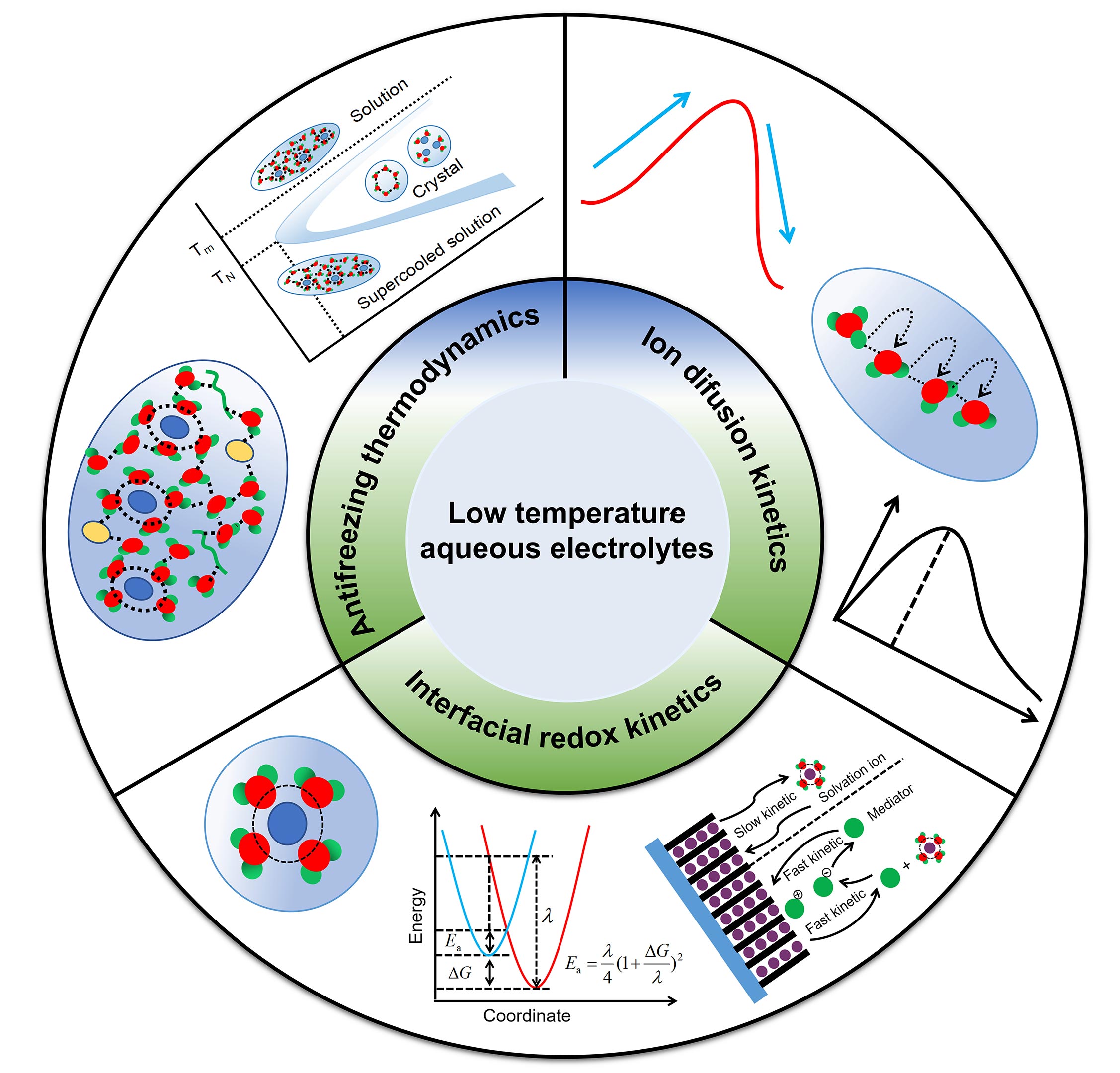
New research from engineers at the China University of Hong Kong, which was recently published in the journal Nano Research Energy, proposes optimal design elements of aqueous electrolytes for use in low-temperature aqueous batteries. The research reviews the physicochemical properties of aqueous electrolytes (that determine their performance in batteries) based on several metrics: phase diagrams, ion diffusion rates, and the kinetics of the redox reactions.
Main Challenges in Low-Temperature Aqueous Batteries
The main challenges for low-temperature aqueous batteries are that the electrolytes freeze, the ions diffuse slowly, and the redox kinetics (electron transfer processes) are consequently sluggish. These parameters are closely related to the physicochemical properties of the low-temperature aqueous electrolytes used in batteries.
In order to improve battery performance under cold conditions, therefore, requires an understanding of how the electrolytes respond to cold (–50 oC to –95 oC / –58 oF to –139 oF). Says study author and associate professor Yi-Chun Lu, “To obtain high-performance low-temperature aqueous batteries (LT-ABs), it is important to investigate the temperature-dependent physicochemical properties of aqueous electrolytes to guide the design of low-temperature aqueous electrolytes (LT-AEs).”
Evaluating Aqueous Electrolytes
The researchers compared various LT-AEs used in energy storage technologies, including aqueous Li+/Na+/K+/H+/Zn2+-batteries, supercapacitors, and flow batteries. The study collated information from many other reports regarding the performance of diverse LT-AEs, for example an antifreezing hydrogel electrolyte for an aqueous Zn/MnO2 battery; and an ethylene glycol (EG)-H2O based hybrid electrolyte for a Zn metal battery.
They systematically examined equilibrium and non-equilibrium phase diagrams for these reported LT-AEs in order to understand their antifreezing mechanisms. The phase diagrams showed how the electrolyte phase change across changing temperatures. The study also examined conductivity in LT-AEs with respect to temperature, electrolyte concentrations, and charge carriers.
Study author Lu predicted that “ideal antifreezing aqueous electrolytes should not only exhibit low freezing temperature Tm but also possess strong supercooling ability,” i.e. the liquid electrolyte medium remains liquid even below freezing temperature, thus enabling ion transport at ultra-low temperature.
Improving Charge Conductivity in LT-AEs
The study authors found that, indeed, the LT-AEs that enable batteries to operate at ultralow temperatures mostly demonstrate low freezing points and strong supercooling abilities. Further, Lu proposes that “the strong supercooling ability can be realized by improving the minimum crystallization time t and increasing the ratio value of glass transition temperature and freezing temperature (Tg/Tm) of electrolytes.”
The charge conductivity of the reported LT-AEs for use in batteries could be improved by lowering the amount of energy required for ion transfer to occur, adjusting the concentration of electrolytes, and choosing certain charge carriers that promote fast redox reaction rates. Says Lu “Lowering the diffusion activation energy, optimizing electrolyte concentration, choosing charge carriers with low hydrated radius, and designing concerted diffusion mechanism[s] would be effective strategies to improve the ionic conductivity of LT-AEs.”
In the future, the authors hope to further study the physicochemical properties of electrolytes that contribute to improved aqueous battery performance at low temperatures. “We would like to develop high-performance low-temperature aqueous batteries (LT-ABs) by designing aqueous electrolytes possessing low freezing temperature, strong supercooling ability, high ionic conductivity, and fast interfacial redox kinetic,” says Lu.
Reference: “Design strategies for low temperature aqueous electrolytes” by Liwei Jiang, Dejian Dong and Yi-Chun Lu, 17 April 2022, Nano Research Energy.
DOI: 10.26599/NRE.2022.9120003
Authors of the paper are Liwei Jiang, Dejian Dong, and Yi-Chun Lu.
This research was funded by the Research Grant Council of the Hong Kong Special Administrative Region, China.
Never miss a breakthrough: Join the SciTechDaily newsletter.
Follow us on Google and Google News.
1 Comment
How about using Phase change materials (PCMs) in Batteries