
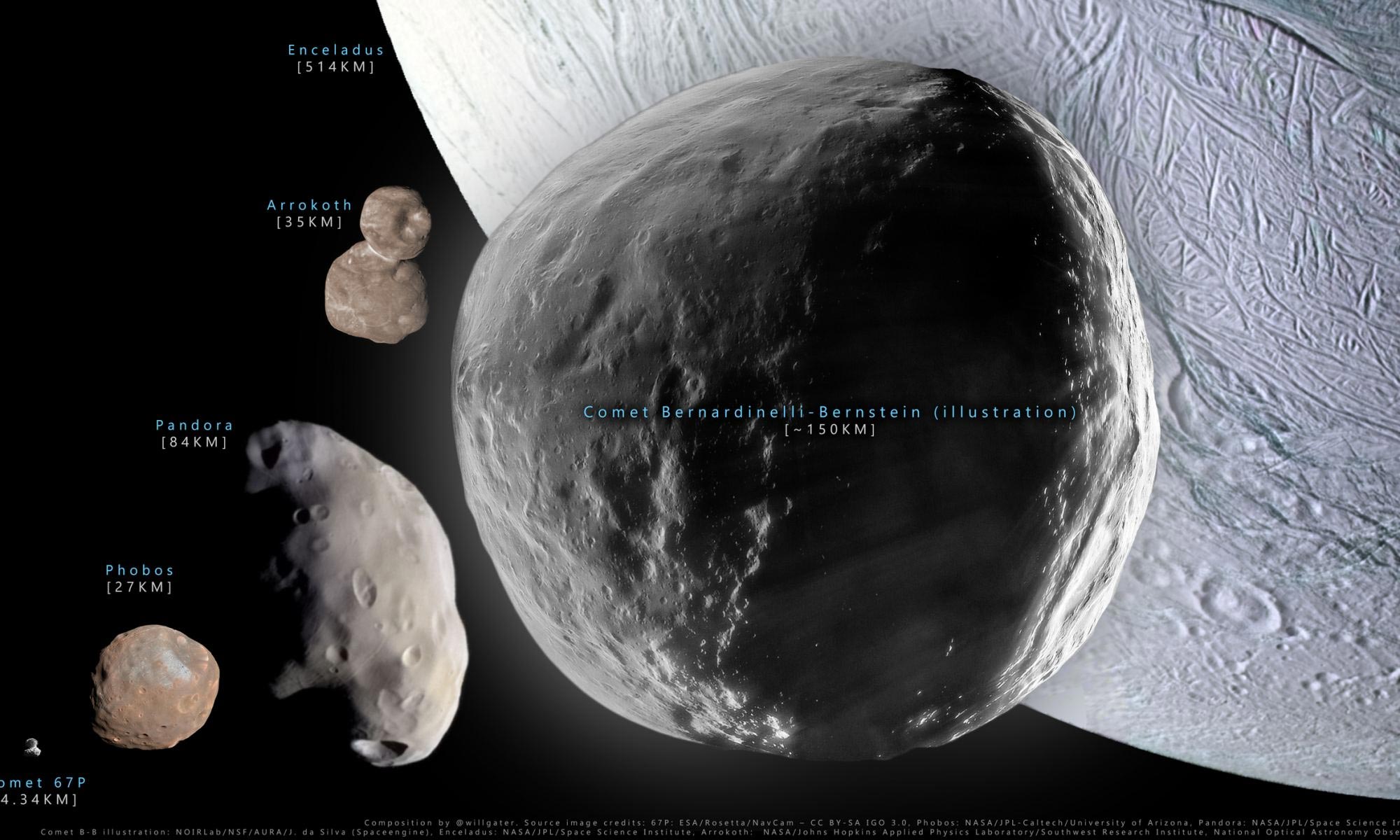
Comet Bernardinelli-Bernstein, the largest comet ever detected, is traveling inward from the distant Oort Cloud. It will reach its closest approach in 2031 near Saturn’s orbit but will likely remain invisible without large telescopes.
A mega-comet – potentially the largest ever discovered – is heading from the Oort Cloud towards our direction. Estimated to be 100–200 kilometers across, the unusual celestial wanderer will make its closest approach to the Sun in 2031. However, the closest it will come to Earth is to the orbit of Saturn.
Astronomers say Comet Bernardinelli-Bernstein (C/2014 UN271) could be the largest member of the Oort Cloud ever detected, and it is the first comet on an incoming path to be detected so far away.
The graphic above, by astronomer Will Gater compares the size of the comet to other Solar System objects.
The comet was discovered by Pedro Bernardinelli and Gary Bernstein, from the University of Pennsylvania earlier this year. They were scouring through data from the 570-megapixel Dark Energy Camera (DECam) on the Víctor M. Blanco 4-meter (13-foot) Telescope in Chile. They found data of this object that was originally collected from 2014–2018, which did not show a typical comet tail, and the object was therefore thought to be a dwarf planet.
From Dwarf Planet Candidate to True Comet
But within a day of the announcement of its discovery via the Minor Planet Center, astronomers using the Las Cumbres Observatory network took new images which revealed that it has grown a coma in the past 3 years, and that it was rapidly moving rapidly through the Oort Cloud. The object was then officially classified as a comet.
Bernardinelli and Bernstein (along with a crew of other astronomers) then began studying this comet in earnest, taking data from all sorts of previous and recent observational sources. They have now posted a paper on Arxiv, with the unusual title of “C/2014 UN271 (Bernardinelli-Bernstein): the nearly spherical cow of comets.”
They said studying the comet’s orbit using astrometry and “backwards integration” suggests this is a pristine new comet, and its previous closest approach to the Sun would have been about 3.5 million years ago, only reaching about 18 au (astronomical units = distance of Earth from the Sun) away.
They also said the coma appears to be displaying normal “simple” sublimation thermodynamics of most comets (hence the spherical cow title for the paper), but they can’t predict how much brighter or more active the comet might get as it gets closer to the Sun. However, a recent Astronomer’s Telegram said that the object had brightened with an “outburst” on September 14, from magnitude 20 to 18.9.
Chemical Clues from Sublimation
On Twitter, Bernardnelli said, “We were able to determine that this is probably consistent with CO2 or NH3 sublimation, but couldn’t do much more than that.”
And also a weak tail whose detection required not only stacking all of our 250×250 pixel scene-modeled (precise static source subtraction) images, but also binning the pixels themselves. This is my favorite figure of this paper!
(7/n) pic.twitter.com/c77wrM5rx4
— Dr. Pedro Bernardinelli (@phbernardinelli) September 22, 2021
The astronomers deduced that the current inward journey of the comet began at a distance of over 40,000 astronomical units (au) from the Sun — in other words, 40,000 times farther from the Sun than Earth is, or 6 trillion kilometers away (3.7 trillion miles or 0.6 light-years — 1/7 of the distance to the nearest star). For comparison, Pluto is 39 au from the Sun, on average.
Currently, the comet is about as far away as Uranus ( about 3 billion kilometers or 1.8 billion miles away) and has a magnitude of just under 20. Despite the comet’s size, even at its closest approach 10 years from now, it is currently predicted that it won’t be visible to the naked eye, and only the largest amateur telescopes will be able to see it.
Adapted from an article originally published on Universe Today.
Never miss a breakthrough: Join the SciTechDaily newsletter.
Follow us on Google and Google News.
1 Comment
This is based on the assumption it doesn’t break up on entry?