
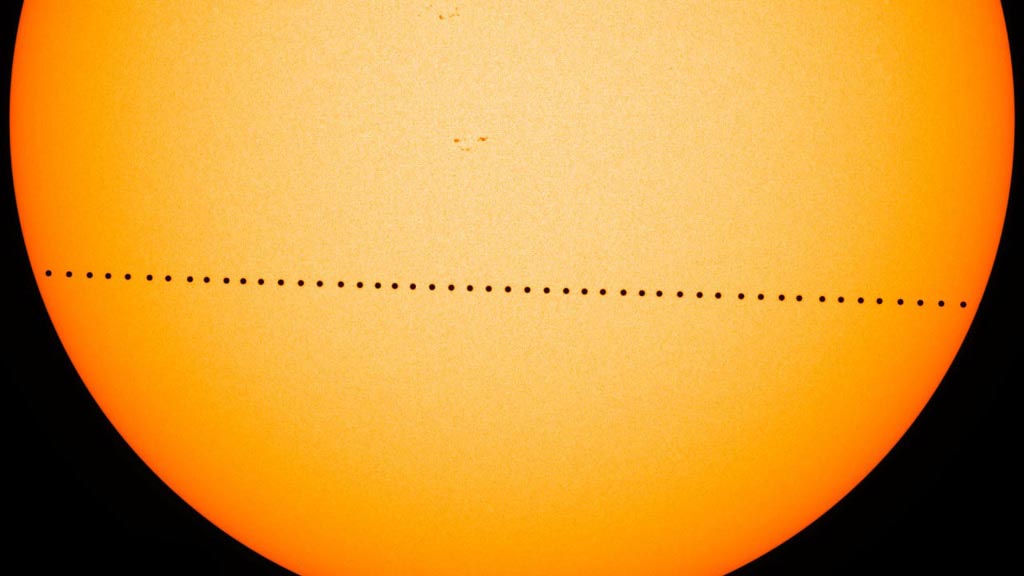
Today, November 11, 2019, we’re in for a rare treat, as the innermost planet, Mercury, passes directly in front of the Sun for a few hours. This event is called a transit, and for Mercury they happen only about 13 times in a century. (Transits of Venus are even more rare.)
Want to catch a glimpse of Mercury? Don’t look too close, but on November 11, our solar system’s smallest planet will appear as a small black dot gliding across the face of the Sun. During this rare astronomical event, called a transit, Mercury’s orbit passes directly between Earth and the Sun, similar to a solar eclipse. These events only occur about 13 times per century! In fact, the next transit won’t take place until 2032.
It’s never safe to look directly at the Sun, whether with the naked eye or with a telescope, but NASA will offer stunning, high-definition views of the Mercury transit in near real time, courtesy of the Solar Dynamics Observatory. Mercury will begin crossing onto the Sun at around 7:36 a.m. EST before exiting the solar disk at around 1:04 p.m. EST.
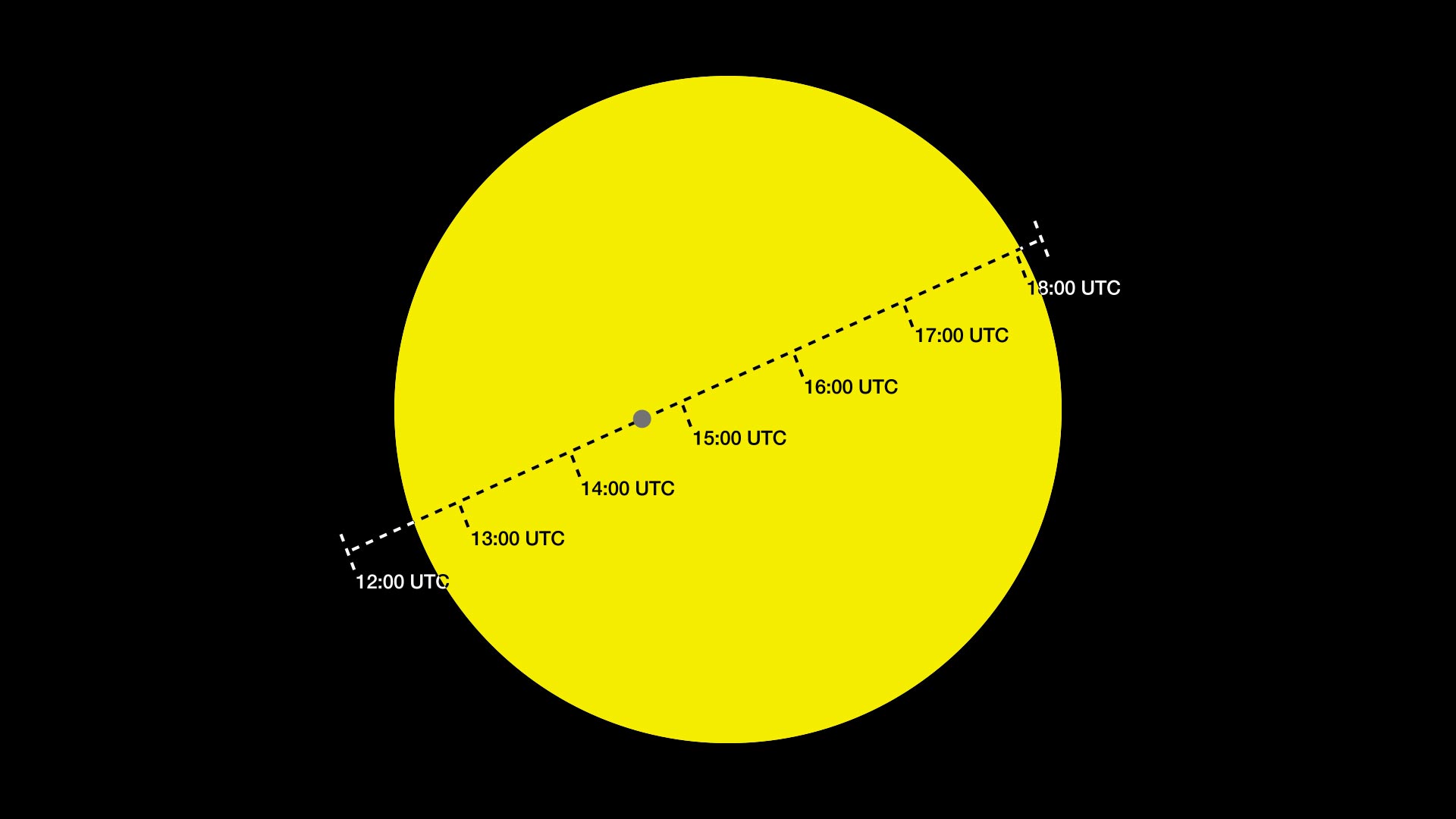
The event will last about five and a half hours, during which Mercury’s path will take it right across the middle of the Sun’s disk. For observers in the Eastern U.S., the transit begins after sunrise, meaning you’ll be able to view the entire thing. For the central and western U.S., the transit begins before sunrise, but there’s enough time left as the Sun climbs up the sky for you to catch a glimpse before Mercury makes its exit.

Now remember, you should never look directly at the Sun without proper protection, as it can permanently damage your eyes. If you have a pair of eclipse shades, those are okay for viewing the Sun, but Mercury is so small in comparison that it can be next to impossible to see a transit without magnification.
Your best bet is a telescope with a certified sun filter, but other options include solar projection boxes and sun funnels. Plus, NASA’s Solar Dynamics Observatory spacecraft will be sharing near-realtime images during the transit. Whatever method you choose, be safe when observing the Sun!
The next Mercury transit that will be visible in the U.S. isn’t until 2049! So if you’re in the States, you might want to make the effort to catch this special celestial event.
This interview with NASA Astrophysicist Dr. Padi Boyd provides great information on the transit of Mercury, viewing tips, and how NASA uses transits like this to detect planets around other stars:
During a transit, planets (either Mercury or Venus) appear as dark spots that seem to crawl across the surface of the Sun. Transits are much rarer than eclipses of the Moon. A Mercury transit occurs, on average, once every seven years. As for Venus, its next solar transit will not occur for another century, on December 11, 2117.
Not all transits are the same because the planets cross the Sun at different places, sometimes just grazing the Sun’s outer edges. The 2019 Mercury transit is an especially good one because it will have a degree of separation of just 0.02 degrees (76 arcseconds). This means Mercury’s center will pass very close to the Sun’s center, making it a real treat for observers. (Arcseconds, denoted with quotation marks, represent the degree of separation between the planet’s center and the Sun’s center. For reference, one degree is about the width of your little finger at arm’s length. There are 3,600 arcseconds in one degree.)
What will the transit of Mercury look like? This 4K UHD video shows the last Mercury Transit (which occurred in 2016) as captured by NASA’s Solar Dynamics Observatory:
The 2016 Mercury transit occurred on May 9th, between about 7:12 a.m. and 2:42 p.m. EDT. The images in this video are from NASA’s Solar Dynamics Observatory, or SDO.
Transits provide a great opportunity to study the way planets and stars move in space – information that has been used throughout the ages to better understand the solar system and which still helps scientists today calibrate their instruments.
Credit: NASA’s Goddard Space Flight Center
For more videos, charts, and information read The Transit of Mercury – Skywatching Tips and All the Details and Watch Mercury Glide Across the Sun in Rare Transit.
Never miss a breakthrough: Join the SciTechDaily newsletter.
Follow us on Google and Google News.