
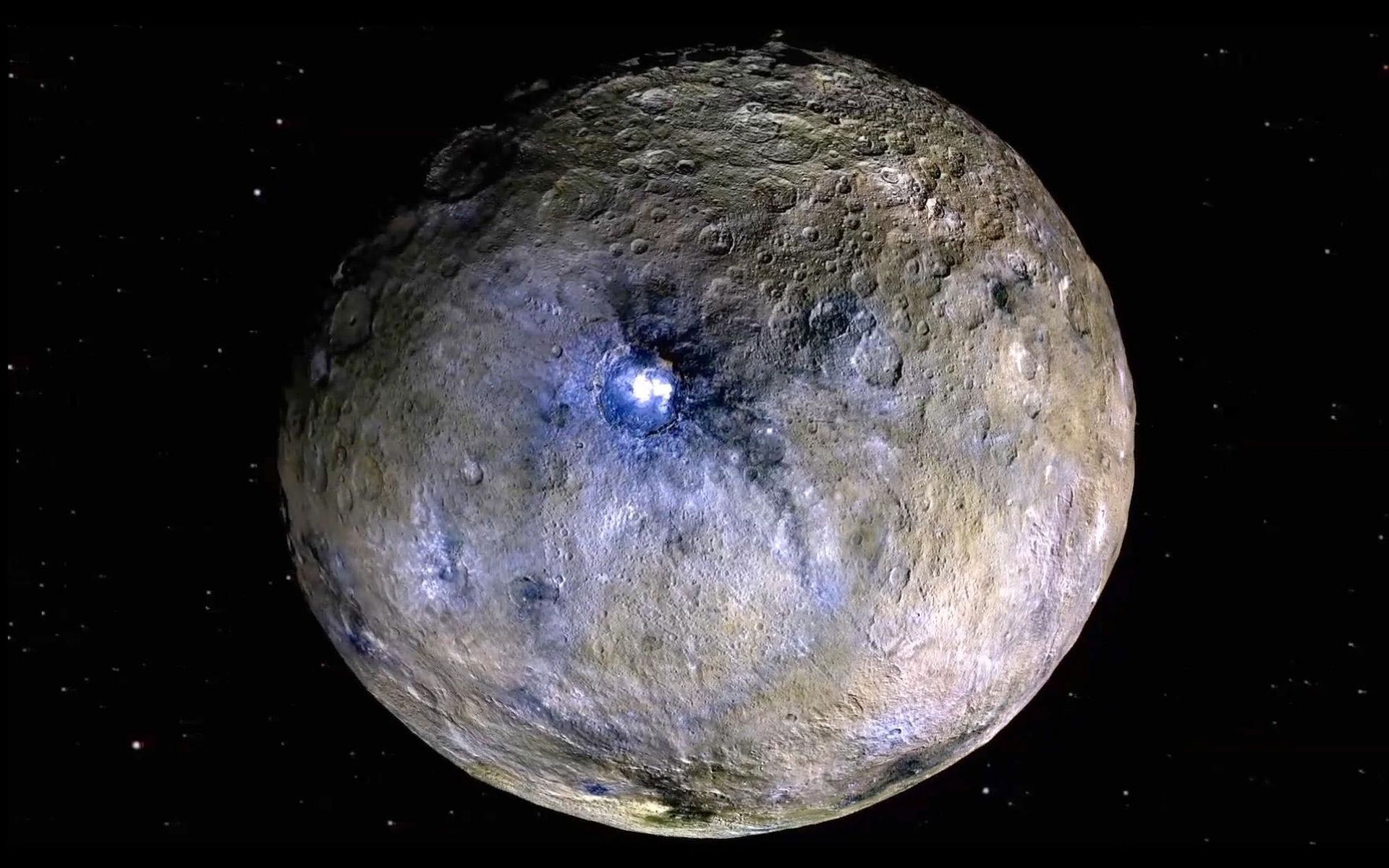
Researchers have explored mysterious flow features on airless celestial bodies like Vesta, Ceres, and Europa.
In their latest study, they demonstrate how meteoroid impacts can release liquid brines that etch gullies and deposit debris on these bodies, offering new insights into subsurface water and its behavior in space.
Exploring Mysterious Flow Features on Airless Celestial Bodies
A researcher from the Southwest Research Institute (SwRI) teamed up with NASA’s Jet Propulsion Laboratory (JPL) to investigate mysterious flow features on the surfaces of airless celestial bodies, including asteroids like Vesta and Ceres, recently explored by NASA’s Dawn mission, and Jupiter’s moon Europa, set to be studied in detail by the upcoming NASA Europa Clipper mission, which includes SwRI’s involvement.
In a new paper published in The Planetary Science Journal, lead author Dr. Michael J. Poston from SwRI and his team describe how post-impact conditions, such as those caused by meteoroid impacts, could generate liquid brines. These brines may briefly flow along the surface, carving curved gullies and leaving behind debris fans within newly formed craters.
Investigating Post-Impact Brine Behavior
“We wanted to investigate our previously proposed idea that ice underneath the surface of an airless world could be excavated and melted by an impact and then flow along the walls of the impact crater to form distinct surface features,” said project PI Dr. Jennifer Scully (JPL).
The team wanted to understand how long the liquid could potentially flow before refreezing, as most liquids lose stability in strong vacuum conditions.

Experimental Insights Into Ice Behavior in Space
The paper, “Experimental Examination of Brine and Water Lifetimes after Impact on Airless Worlds,” details the team’s findings after simulating the pressures that ice on Vesta, one of the largest asteroids in our solar system, experiences after a meteoroid impact and how long it takes the liquid released from the subsurface to refreeze.
The team modified a test chamber at the Jet Propulsion Laboratory to rapidly decrease pressure over a liquid sample to simulate the dramatic drop in pressure as the temporary atmosphere created after an impact on an airless body like Vesta dissipates. According to Poston, the pressure drop was so fast that test liquids immediately and dramatically expanded, ejecting material from the sample containers.
Implications for Water Presence on Celestial Bodies
“Through our simulated impacts, we found that the pure water froze too quickly in a vacuum to effect meaningful change, but salt and water mixtures, or brines, stayed liquid and flowing for a minimum of one hour,” said Poston. “This is sufficient for the brine to destabilize slopes on crater walls on rocky bodies, cause erosion and landslides, and potentially form other unique geological features found on icy moons.”
These findings could also help to explain the origins of certain observed features on distant bodies, such as the smooth plains of Europa and the distinct “spider” feature in its Manannán crater, or the various gullies and fan-shaped debris deposits on Mars. The study could also help build a stronger case for the existence of subsurface water in seemingly inhospitable locations in the solar system.
“If the findings are consistent across these dry and airless or thin-atmosphere bodies, it demonstrates that water existed on these worlds in the recent past, indicating water might still be expelled from impacts,” said Poston. “There may still be water out there to be found.”
Reference: “Experimental Examination of Brine and Water Lifetimes after Impact on Airless Worlds” by Michael J. Poston, Samantha R. Baker, Jennifer E. C. Scully, Elizabeth M. Carey, Lauren E. Mc Keown, Julie C. Castillo-Rogez and Carol A. Raymond, 21 October 2024, The Planetary Science Journal.
DOI: 10.3847/PSJ/ad696a
The study was funded through a grant from NASA’s Discovery Data Analysis Program as part of an ongoing project led by the Jet Propulsion Laboratory at the California Institute of Technology, Pasadena.
Never miss a breakthrough: Join the SciTechDaily newsletter.
Follow us on Google and Google News.