
Close Menu
    Facebook X (Twitter) Instagram
    SciTechDaily
    • Biology
    • Chemistry
    • Earth
    • Health
    • Physics
    • Science
    • Space
    • Technology
    Facebook X (Twitter) Pinterest YouTube RSS
    SciTechDaily
    Home»Space»Surprise: Saturn’s Icy Rings May Actually Be As Old As the Solar System Itself
    Space

    Surprise: Saturn’s Icy Rings May Actually Be As Old As the Solar System Itself

    By Southwest Research InstituteSeptember 18, 20192 Comments3 Mins Read
    Facebook Twitter Pinterest Telegram LinkedIn WhatsApp Email Reddit
    Share
    Facebook Twitter LinkedIn Pinterest Telegram Email Reddit
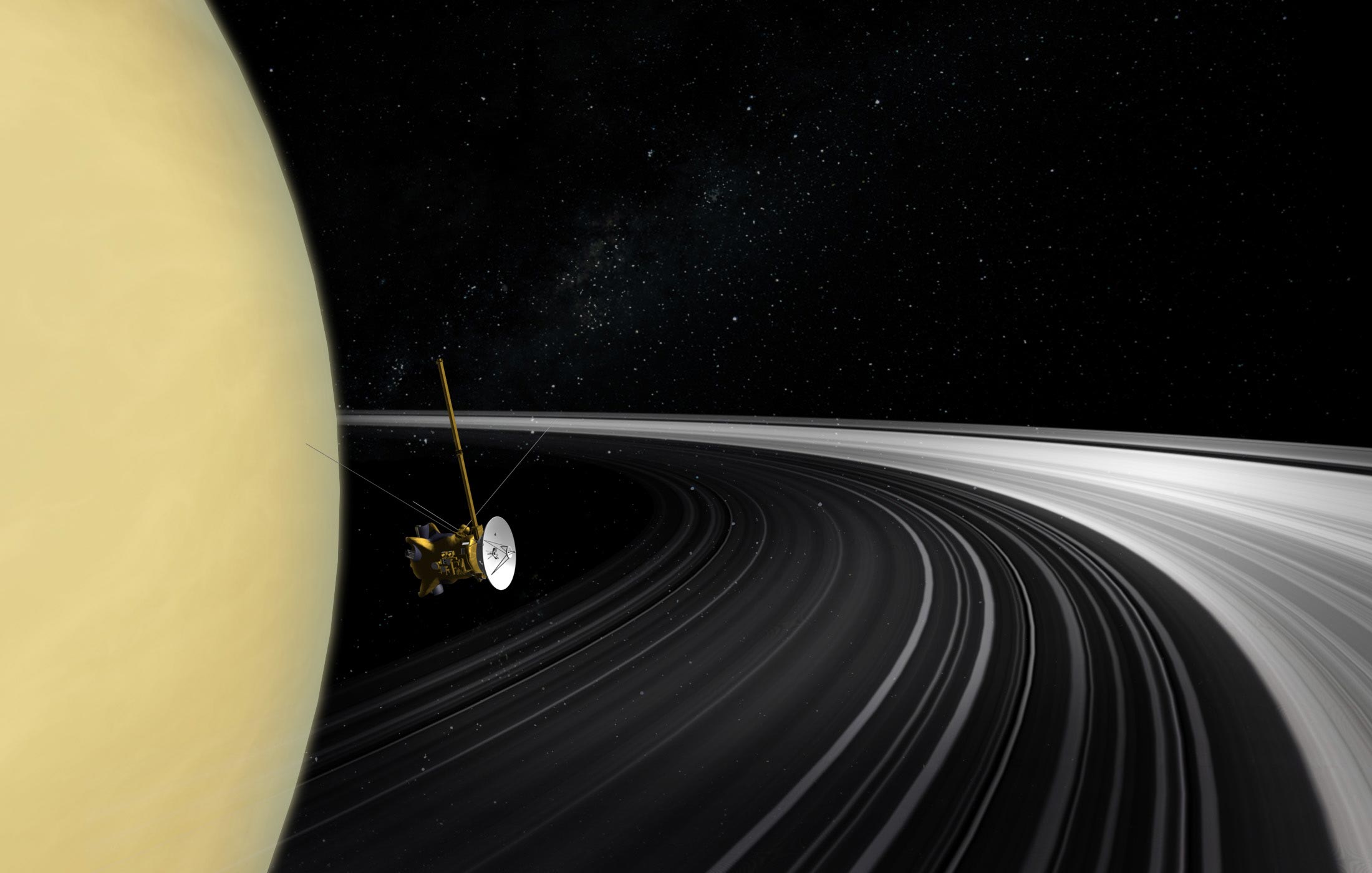
    Cassini Spacecraft Saturn Rings
    An artist’s impression of the Cassini spacecraft among Saturn’s rings. Credit: NASA

    Research of Cassini data suggests icy rings are as old as the solar system itself.

    No one knows for certain when Saturn’s iconic rings formed, but a new study co-authored by a Southwest Research Institute scientist suggests that they are much older than some scientists think.

    The study takes a closer look at 2017 Cassini spacecraft data that inspired several research papers suggesting that the rings were formed around the time dinosaurs roamed the Earth. Those studies, published in 2018 and 2019, challenged long-held models that put the formation of the rings several billion years earlier, around the time Saturn formed with the rest of the solar system.

    In a new twist, Southwest Research Institute scientist Luke Dones and three French researchers argue that the historic models probably had it right in the first place. The age debate centers around Cassini data from 2017, when the craft revealed a trove of data with dazzling images of Saturn’s rings, which are composed of clear, almost pure water ice.

    “After Cassini’s mission ended, there was a small flood of research that claimed the rings were much younger than we had considered them to be. A common argument was that the rings, if much older, would have become much more polluted as a result of meteoroids crashing into them,” Dones said.

    A series of studies suggested that the rings would have absorbed portions of dark, dusty material from the meteoroids and gradually become darker. Therefore, the rings would be too bright and clean to have existed in the solar system for billions of years.

    Dones and his collaborators, Aurélien Crida of the Université Côte d’Azur, Sébastien Charnoz of the Institut de Physique du Globe de Paris, and Hsiang-Wen Hsu of the University of Colorado, Boulder, pointed out Cassini measurements that show the rings are constantly losing matter to Saturn. The process, which is largely a mystery, could very well be “cleaning” the ice of the rings and making them brighter over time.

    Dones and his collaborators state that one of the clearest indications that the rings are old is that their mass is consistent with researchers’ current understanding of how primordial rings change. Rings spread with time, spawning satellites at their outer edge and losing mass to Saturn at their inner edge. More massive rings spread faster, so even a very massive primordial ring would be expected to now have the present mass of the rings. If the rings are young, then their current mass would have to be a coincidence.

    “It’s not impossible to determine the age of the rings, but to do so we’ll need a future mission to Saturn that spends a long, intense period studying the rings themselves as well as the relationship between them and the gas giant,” Dones said.

    Never miss a breakthrough: Join the SciTechDaily newsletter.
    Follow us on Google and Google News.

    Astrophysics Cassini-Huygens Mission Planets Saturn Southwest Research Institute
    Share. Facebook Twitter Pinterest LinkedIn Email Reddit

    Related Articles

    A Cosmic Accident Just Exposed the Hidden Chemistry of Giant Planets

    NASA’s Webb Just Revealed Something Astonishing in Saturn’s Atmosphere

    Two Scientists Have Figured Out What Caused Saturn’s Tilt

    Most Extensive System of Haze Layers in the Solar System Have Been Discovered on Saturn

    Saturn’s Great Atmospheric Mystery Explained by New Data From NASA’s Cassini

    Strange Erupting ‘Tiger Stripes’ on Saturn’s Icy Moon Enceladus Finally Explained

    New NASA Video Shows a 360-Degree View of Saturn’s Auroras

    Cassini Data Suggests Saturn’s Moons and Rings Are More Than 4 Billion Years Old

    Saturn’s Moon Phoebe Has Planet-Like Qualities

    2 Comments

    1. zeke on October 8, 2019 5:41 am

      Maybe but they are disappearing they may disappear in our life time.recently astronomers found 20 new moons orbiting saturn which puts saturn ahead of jupiter.

      Reply
    2. you suck on October 25, 2019 1:19 pm

      you suck

      Reply
    Leave A Reply Cancel Reply

    • Facebook
    • Twitter
    • Pinterest
    • YouTube

    Don't Miss a Discovery

    Subscribe for the Latest in Science & Tech!

    Trending News

    Largest-Ever Study Finds Medicinal Cannabis Ineffective for Anxiety, Depression, PTSD

    250-Million-Year-Old Egg Solves One of Evolution’s Biggest Mysteries

    Living With Roommates Might Be Changing Your Gut Microbiome Without You Knowing

    Century-Old Cleaning Chemical Linked to 500% Increased Risk of Parkinson’s Disease

    What if Your Memories Never Happened? Physicists Take a New Look at the Boltzmann Brain Paradox

    One of the Universe’s Largest Stars May Be Getting Ready To Explode

    Scientists Discover Enzyme That Could Supercharge Ozempic-Like Weight Loss Drugs

    Popular Sweetener Linked to DNA Damage – “It’s Something You Should Not Be Eating”

    Follow SciTechDaily
    • Facebook
    • Twitter
    • YouTube
    • Pinterest
    • Newsletter
    • RSS
    SciTech News
    • Biology News
    • Chemistry News
    • Earth News
    • Health News
    • Physics News
    • Science News
    • Space News
    • Technology News
    Recent Posts
    • Want Less Stress? Landmark Study Points to a Simple Habit
    • Scientists Reveal Eating Fruits and Vegetables May Increase Your Risk of Lung Cancer
    • AI Reveals Explosive Growth of Floating Algae Across the World’s Oceans
    • 5.5 Million Bees Discovered Living Beneath a New York Cemetery
    • Scientists Reverse Brain Aging With Simple Nasal Spray
    Copyright © 1998 - 2026 SciTechDaily. All Rights Reserved.
    • Science News
    • About
    • Contact
    • Editorial Board
    • Privacy Policy
    • Terms of Use

    Type above and press Enter to search. Press Esc to cancel.