
Mineralogy points to large, water-rich parent asteroid for carbonaceous chondrite meteorite.
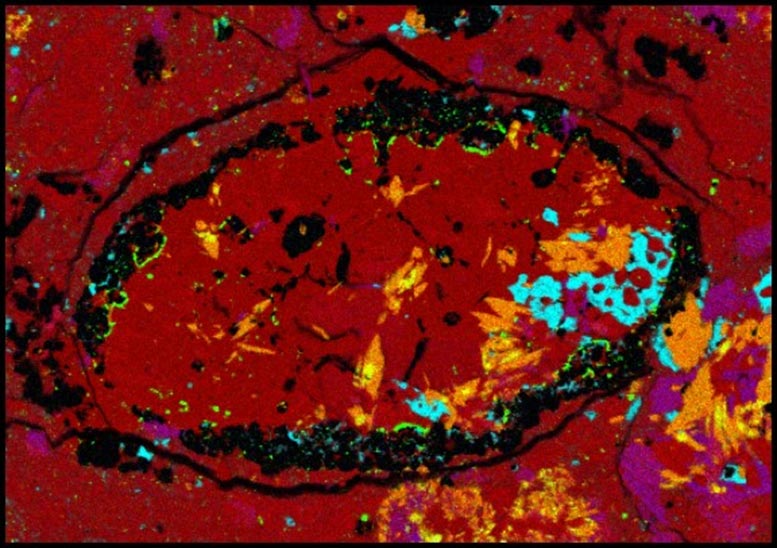
A Southwest Research Institute-led team of scientists has identified a potentially new meteorite parent asteroid by studying a small shard of a meteorite that arrived on Earth a dozen years ago. The composition of a piece of the meteorite Almahata Sitta (AhS) indicates that its parent body was an asteroid roughly the size of Ceres, the largest object in the main asteroid belt, and formed in the presence of water under intermediate temperatures and pressures.
“Carbonaceous chondrite (CC) meteorites record the geological activity during the earliest stages of the Solar System and provide insight into their parent bodies’ histories,” said SwRI Staff Scientist Dr. Vicky Hamilton, first author of a paper published in Nature Astronomy outlining this research. “Some of these meteorites are dominated by minerals providing evidence for exposure to water at low temperatures and pressures. The composition of other meteorites points to heating in the absence of water. Evidence for metamorphism in the presence of water at intermediate conditions has been virtually absent, until now.”
Asteroids — and the meteors and meteorites that sometimes come from them — are leftovers from the formation of our Solar System 4.6 billion years ago. Most reside in the main asteroid belt between the orbits of Mars and Jupiter, but collisions and other events have broken them up and ejected remnants into the inner Solar System. In 2008, a 9-ton, 13-foot diameter asteroid entered Earth’s atmosphere, exploding into some 600 meteorites over the Sudan. This marked the first time scientists predicted an asteroid impact prior to entry and allowed recovery of 23 pounds of samples.
“We were allocated a 50-milligram sample of AhS to study,” Hamilton said. “We mounted and polished the tiny shard and used an infrared microscope to examine its composition. Spectral analysis identified a range of hydrated minerals, in particular amphibole, which points to intermediate temperatures and pressures and a prolonged period of aqueous alteration on a parent asteroid at least 400, and up to 1,100, miles in diameter.”
Amphiboles are rare in CC meteorites, having only been identified previously as a trace component in the Allende meteorite. “AhS is a serendipitous source of information about early Solar System materials that are not represented by CC meteorites in our collections,” Hamilton said.
Orbital spectroscopy of asteroids Ryugu and Bennu visited by Japan’s Hayabusa2 and NASA’s OSIRIS-REx spacecraft this year is consistent with aqueously altered CC meteorites and suggests that both asteroids differ from most known meteorites in terms of their hydration state and evidence for large-scale, low-temperature hydrothermal processes. These missions have collected samples from the surfaces of the asteroids for return to Earth.
“If the compositions of the Hayabusa2 and OSIRIS-REx samples differ from what we have in our collections of meteorites, it could mean that their physical properties cause them to fail to survive the processes of ejection, transit, and entry through Earth’s atmosphere, at least in their original geologic context,” said Hamilton, who also serves on the OSIRIS-REx science team. “However, we think that there are more carbonaceous chondrite materials in the Solar System than are represented by our collections of meteorites.”
Reference: “Meteoritic evidence for a Ceres-sized water-rich carbonaceous chondrite parent asteroid” by V. E. Hamilton, C. A. Goodrich, A. H. Treiman, H. C. Connolly Jr, M. E. Zolensky and M. H. Shaddad, 21 December 2020, Nature Astronomy.
DOI: 10.1038/s41550-020-01274-z
Never miss a breakthrough: Join the SciTechDaily newsletter.
Follow us on Google and Google News.