
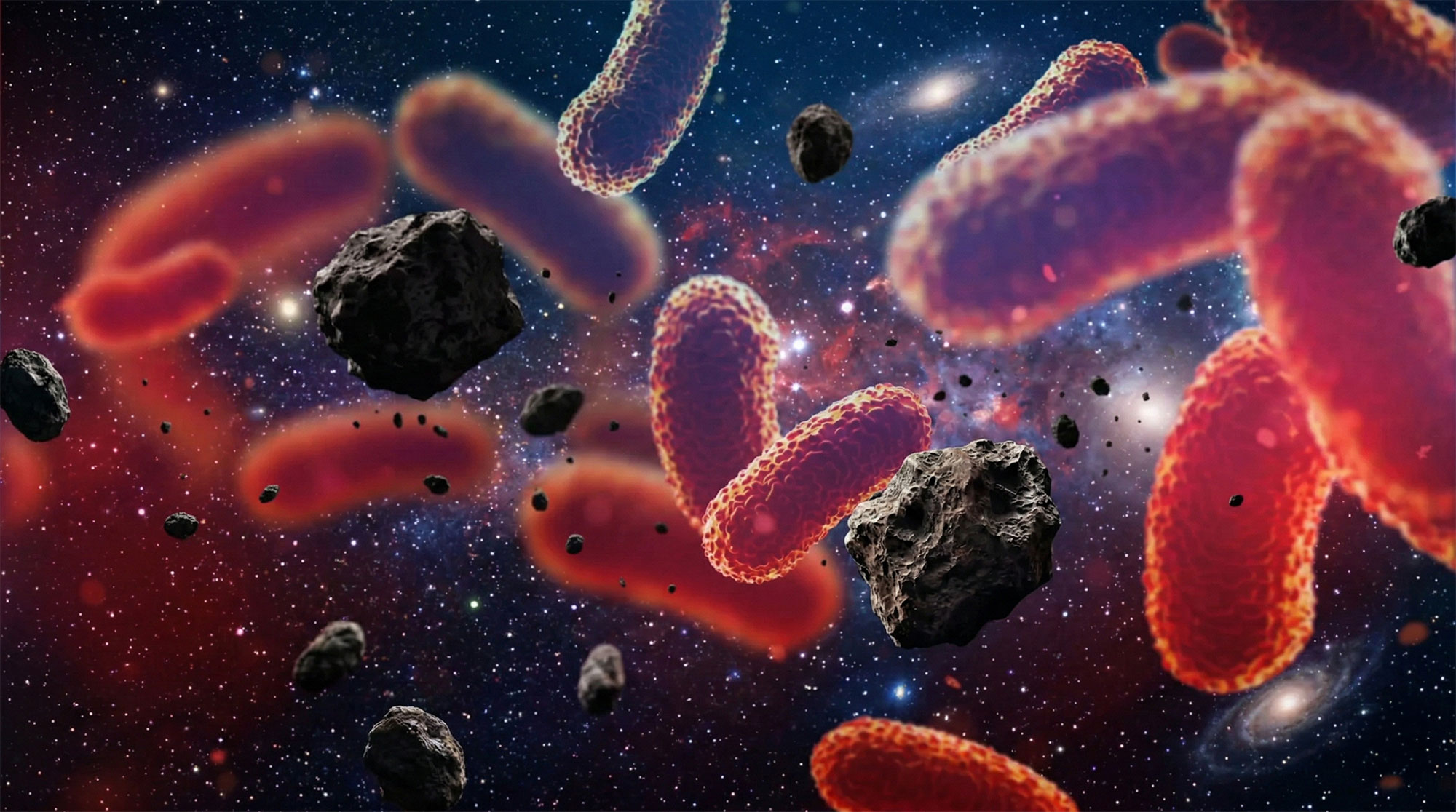
Space-based experiments show fungi can efficiently extract valuable metals from meteorites in microgravity, advancing prospects for asteroid biomining and sustainable resource use.
As humans look toward deep-space travel, there is one group of travelers that will inevitably come along: microbes.
They are impossible to separate from us, living on our skin, inside our bodies, and on everyday surfaces and food. Understanding how these microscopic organisms respond to space conditions is essential. Beyond simply tagging along, they could actively support efforts to explore and inhabit space.
Certain microorganisms, including bacteria and fungi, are capable of extracting important minerals from rocks. This ability could one day reduce the need to haul large quantities of raw materials from Earth, offering a more sustainable approach to supporting missions far from home.
ISS Biomining Experiment Targets Platinum Group Metals
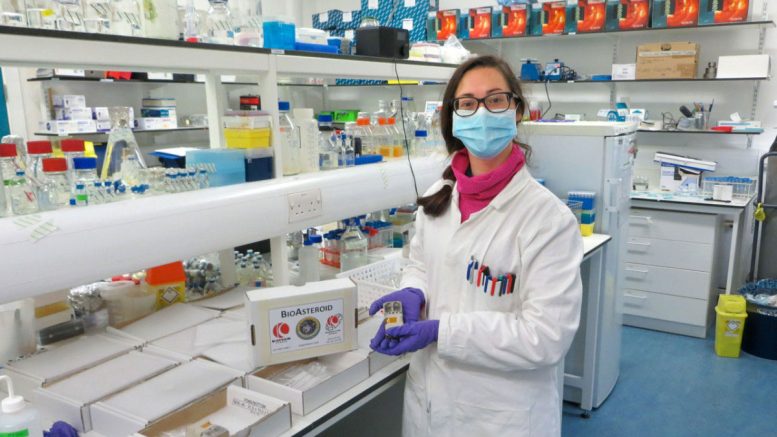
To investigate this potential, scientists from Cornell University and the University of Edinburgh teamed up to examine how microbes recover platinum group elements from meteorite material in microgravity. Their experiment took place aboard the International Space Station. The results indicated that fungi used for “biomining” were especially effective at extracting palladium, a valuable metal. When the fungus was removed, nonbiological leaching in microgravity became less effective.
The findings were published in npj Microgravity. Rosa Santomartino, assistant professor of biological and environmental engineering in the College of Agriculture and Life Sciences, served as lead author. Alessandro Stirpe, a research associate in microbiology, is a co-author.
The work was carried out as part of the BioAsteroid project, led by senior author Charles Cockell, professor of astrobiology at the University of Edinburgh, along with other colleagues from the university. The team tested the bacterium Sphingomonas desiccabilis and the fungus Penicillium simplicissimum to determine which elements could be extracted from L-chondrite asteroidal material. In addition to identifying recoverable elements, the researchers aimed to better understand how microbes interact with rock under microgravity conditions.
Microgravity, Metabolomics, and Microbial Mechanisms
“This is probably the first experiment of its kind on the International Space Station on meteorite,” Santomartino said. “We wanted to keep the approach tailored in a way, but also general to increase its impact. These are two completely different species, and they will extract different things. So we wanted to understand how and what, but keep the results relevant for a broader perspective, because not much is known about the mechanisms that influence microbial behavior in space.”
Microbes are attractive candidates for resource extraction because they produce carboxylic acids, carbon-based molecules that bind to minerals through complexation and help release them. However, many aspects of this process remain unclear, Santomartino explained. To explore it further, the team performed a metabolomic analysis. They collected part of the liquid culture from completed experiment samples and examined the biomolecules present, focusing on secondary metabolites.
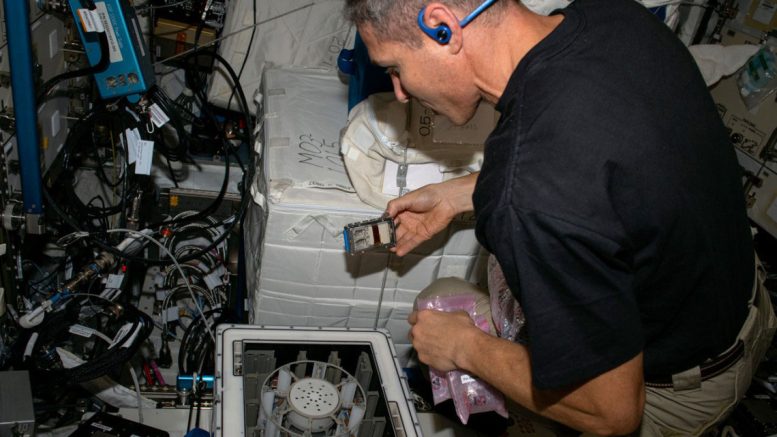
NASA astronaut Michael Scott Hopkins carried out the space-based portion of the experiment to evaluate microgravity effects. On Earth, the researchers ran parallel control experiments under normal gravity to compare results. Santomartino and Stirpe then processed a large dataset covering 44 elements, 18 of which were biologically extracted.
Fungal Palladium Extraction and Gravity Effects
“We split the analysis to the single element, and we started to ask, OK, does the extraction behave differently in space compared to Earth? Are these elements more extracted when we have a bacterium or a fungus, or when we have both of them? Is this just noise, or can we see something that maybe makes a bit of sense? We don’t see massive differences, but there are some very interesting ones,” Stirpe said.
The data showed noticeable shifts in microbial metabolism in orbit, especially in the fungus. In microgravity, it increased production of several molecules, including carboxylic acids, and boosted the release of palladium along with platinum and other elements.
For many elements, nonbiological leaching, in which a solution without microbes is used to pull out the elements, performed worse in microgravity than it did on Earth. By contrast, microbial extraction remained relatively steady under both gravity conditions.
Space Biomining Applications on Earth and Beyond
“In these cases, the microbe doesn’t improve the extraction itself, but it’s kind of keeping the extraction at a steady level, regardless of the gravity condition,” Santomartino said. “And this is not just true for the palladium, but for different types of metals, although not all of them. Indeed, another complex but very interesting result, I think, is the fact that the extraction rate changes a lot depending on the metal that you are considering, and also depending on the microbe and the gravity condition.”
Beyond supporting space missions, the findings may also benefit Earth-based industries. Potential applications include more efficient biomining in environments with limited resources, processing mine waste, and developing sustainable biotechnologies that support a circular economy. Still, Santomartino noted that researchers hoping for a simple explanation of how space affects microbes may be disappointed. The system involves too many interacting factors.
“Depending on the microbial species, depending on the space conditions, depending on the method that researchers are using, everything changes,” Santomartino said. “Bacteria and fungi are all so diverse, one to each other, and the space condition is so complex that, at present, you cannot give a single answer. So maybe we need to dig more. I don’t mean to be too poetic, but to me, this is a little bit the beauty of that. It’s very complex. And I like it.”
Reference: “Microbial biomining from asteroidal material onboard the international space station” by Rosa Santomartino, Giovanny Rodriguez Blanco, Alfred Gudgeon, Jason H. Hafner, Alessandro Stirpe, Martin Waterfall, Nicola Cayzer, Laetitia Pichevin, Gus Calder, Kyra R. Birkenfeld, Annemiek C. Waajen, Scott McLaughlin, Alessandro Mariani, Michele Balsamo, Gianluca Neri, Lorna J. Eades and Charles S. Cockell, 30 January 2026, npj Microgravity.
DOI: 10.1038/s41526-026-00567-3
The research was supported by the United Kingdom Science and Technology Facilities Council, the Leverhulme Trust, the University of Edinburgh School of Physics and Astronomy and Edinburgh-Rice Strategic Collaboration Awards.
Never miss a breakthrough: Join the SciTechDaily newsletter.
Follow us on Google and Google News.
3 Comments
thqnks for this
Everything is in space all the time always. I wish people would use the correct words. They mean studying bacteria in zero gravity or off-world. All bacteria are already in space and always have been.
Microbes is what I should have said instead of bacteria. I wish we could edit our comments.