
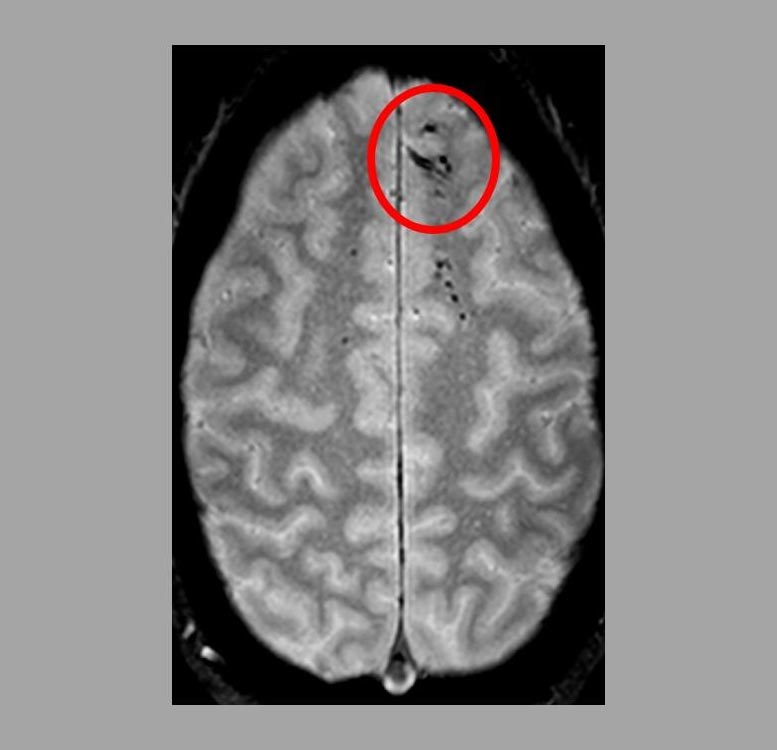
NIH study examines the effects of blood vessel damage following brain injury.
Using advanced imaging, researchers have uncovered new information regarding traumatic microbleeds, which appear as small, dark lesions on MRI scans after a head injury but are typically too small to be detected on CT scans. The findings published in Brain suggest that traumatic microbleeds are a form of injury to brain blood vessels and may predict worse outcomes. The study was conducted in part by scientists at the National Institute of Neurological Disorders and Stroke (NINDS), part of the National Institutes of Health.
“Traumatic microbleeds may represent injury to blood vessels that occur following even minor head injury,” said Lawrence Latour, Ph.D., NINDS researcher and senior author of the study. “While we know that damage to brain cells can be devastating, the exact impact of this vascular injury following head trauma is uncertain and requires further study.”
This study, which involved researchers from Cold Spring Harbor Laboratory in New York and the Uniformed Services University of the Health Sciences in Bethesda, Maryland, included 439 adults who experienced head injuries and were treated in the emergency department. The subjects underwent MRI scans within 48 hours of injury, and again during four subsequent visits. Participants also completed behavioral and outcome questionnaires.
The results showed that 31% of all study participants had evidence of microbleeds on their brain scans. More than half (58%) of participants with severe head injury showed microbleeds as did 27% of mild cases. The microbleeds appeared as either linear streaks or dotted, also referred to as punctate, lesions. The majority of patients who exhibited microbleeds had both types. The findings also revealed that the frontal lobes were the brain region most likely to show microbleeds.
The patients with microbleeds were more likely to have a greater level of disability compared to patients without microbleeds. Disability was determined by a commonly used outcome scale.
The family of a participant who died following the completion of the study donated the brain for further analysis. Dr. Latour’s team imaged the brain with a more powerful MRI scanner and conducted detailed histological analysis, allowing the pathology underlying the traumatic microbleeds to be better described. The results showed iron, indicating blood, in macrophages (the brain’s immune cells) tracking along the vessels seen on the initial MRI as well as in extended areas beyond that seen on MRI.
“Combining these technologies and methods allowed us to get a much more detailed look at microbleed structure and get a better sense of just how extensive they are,” said Allison Griffin, a graduate student and first author of the paper.
The authors note that microbleeds following brain injury may be a potential biomarker for identifying which patients may be candidates for treatments that target vascular injury.
Read New Brain Research May Change How Concussions and Other Traumatic Brain Injuries Are Treated for more on this research.
Reference: ” Traumatic microbleeds suggest vascular injury and predict disability in traumatic brain injury” by Allison D Griffin, L Christine Turtzo, Gunjan Y Parikh, Alexander Tolpygo, Zachary Lodato, Anita D Moses, Govind Nair, Daniel P Perl, Nancy A Edwards, Bernard J Dardzinski, Regina C Armstrong, Abhik Ray-Chaudhury, Partha P Mitra and Lawrence L Latour, 14 October 2019, Brain.
DOI: 10.1093/brain/awz290
More research is needed to determine the additional effects of microbleeds and ways to treat them. In addition, future studies will help clinicians decide which patients should undergo specific imaging following head injury. There is currently no evidence that MRI scans should replace CT scans for a suspected head injury.
This work was supported by the NIH Intramural Research Program.
The NINDS is the nation’s leading funder of research on the brain and nervous system. The mission of NINDS is to seek fundamental knowledge about the brain and nervous system and to use that knowledge to reduce the burden of neurological disease.
About the National Institutes of Health (NIH): NIH, the nation’s medical research agency, includes 27 Institutes and Centers and is a component of the U.S. Department of Health and Human Services. NIH is the primary federal agency conducting and supporting basic, clinical, and translational medical research, and is investigating the causes, treatments, and cures for both common and rare diseases.
Never miss a breakthrough: Join the SciTechDaily newsletter.
Follow us on Google and Google News.
3 Comments
Algorithms that track the things going on in the brain. Sounds like the resurch at Janelia research campus, howard Hughes Jr medical institute. Hhmi.org they are working on the viniger fly and they are working on the neurons of the mouse brain they have maped 1000 to date and 100000 to go, the most extensive to have ever been done. The mouse brain is the size of an almond.they are looking for more scientist to help map it.
This is important work for Humanity and my mom was in nurses training. This is real progress in learning about how the brain works more resurch is needed. Thanks everybody else involved. DSH
I had seen my mother’s scan of ischemic strokes, and now I am getting a real time experience in what seems to be my genetic heritage. It is important for patients to recognize the third cause of strokes, – which seems to be largely ignored by some neurologists. My experience so far with the Minneapolis VA indicates to me that although research on micro brain bleeds is in existence – my experience is that recognition at the VA is totally – inadequate – possibly due to CT may not show micro bleeds – and so I am totally disregarded in pointing out and suggesting this fact. DI am writing this after being totally shut down after my VA appointment ( TODAY IS Dec.13
2023. Now I have to educe THOSE WHO SHOULD BE TREATING ME……
Micro bleeds and Depolarization.