
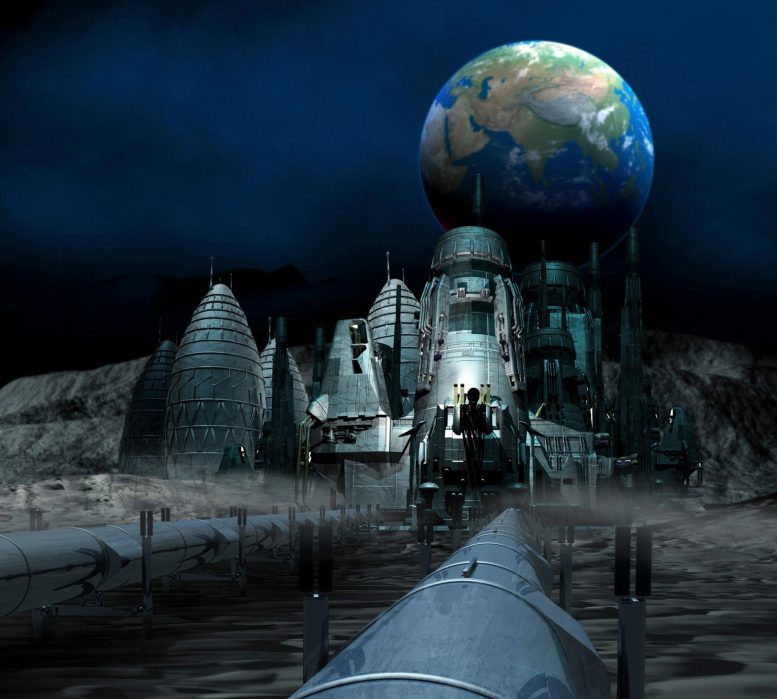
New research into metal-rich asteroids reveals information about the origins and compositions of these rare bodies that could one day be mined.
Metal-rich near-Earth asteroids, or NEAs, are rare, but their presence provides the intriguing possibility that iron, nickel, and cobalt could someday be mined for use on Earth or in Space.
New research, published in the Planetary Science Journal, investigated two metal-rich asteroids in our own cosmic backyard to learn more about their origins, compositions and relationships with meteorites found on Earth.
These metal-rich NEAs were thought to be created when the cores of developing planets were catastrophically destroyed early in the solar system’s history, but little more is known about them. A team of students co-led by University of Arizona planetary science associate professor Vishnu Reddy studied asteroids 1986 DA and 2016 ED85 and discovered that their spectral signatures are quite similar to asteroid 16 Psyche, the largest metal-rich body in the solar system. Psyche, located in the main asteroid belt between the orbits of Mars and Jupiter rather than near Earth, is the target of NASA’s Psyche mission.
‘Mini Psyches’ Discovered Near Earth
“Our analysis shows that both NEAs have surfaces with 85% metal such as iron and nickel and 15% silicate material, which is basically rock,” said lead author Juan Sanchez, who is based at the Planetary Science Institute. “These asteroids are similar to some stony-iron meteorites such as mesosiderites found on Earth.”
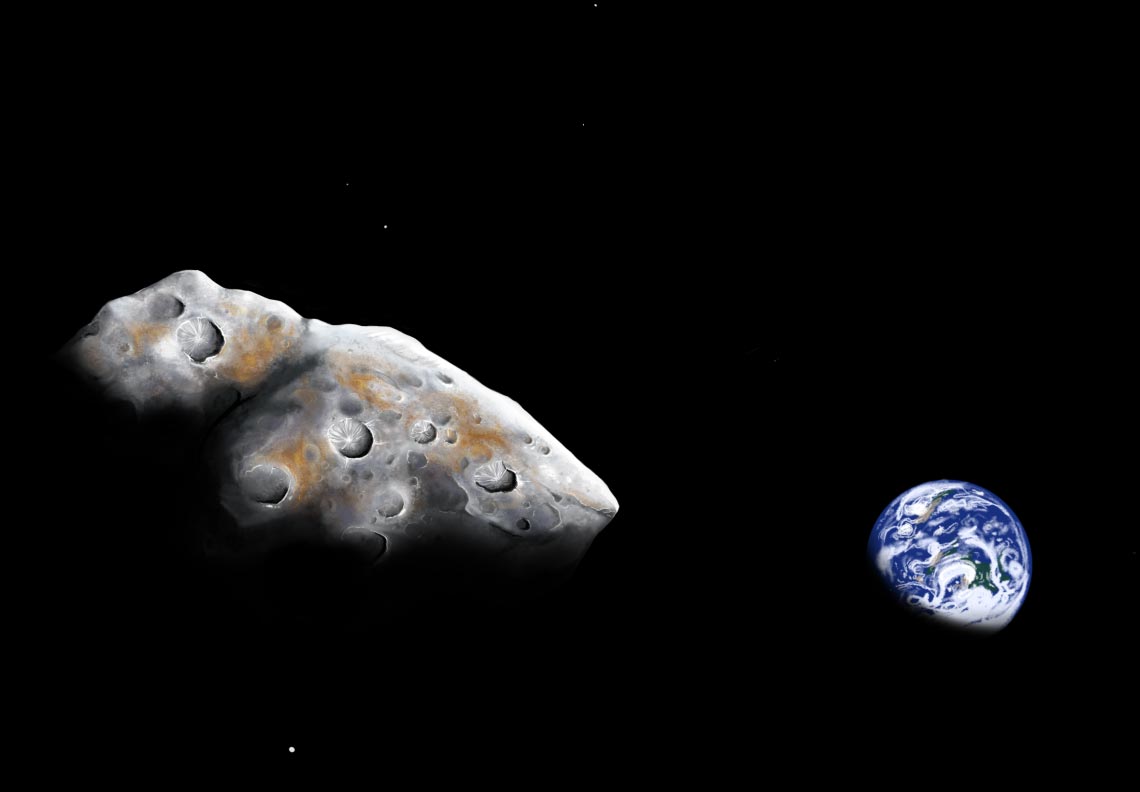
Astronomers have been speculating as to what the surface of Psyche is made of for decades. By studying metal-rich NEAs that come close to the Earth, they hope to identify specific meteorites that resemble Psyche’s surface.
“We started a compositional survey of the NEA population in 2005, when I was a graduate student, with the goal of identifying and characterizing rare NEAs such as these metal-rich asteroids,” said Reddy, principal investigator of the NASA grant that funded the work. “It is rewarding that we have discovered these ‘mini Psyches’ so close to the Earth.”
“For perspective, a 50-meter (164-foot) metallic object similar to the two asteroids we studied created the Meteor Crater in Arizona,” said Adam Battle, who is a co-author of the paper along with fellow Lunar and Planetary Laboratory graduate students Benjamin Sharkey and Theodore Kareta, and David Cantillo, an undergraduate student in the Department of Geosciences.
The paper also explored the mining potential of 1986 DA and found that the amount of iron, nickel and cobalt that could be present on the asteroid would exceed the global reserves of these metals.
Tracing Their Ancestry in the Asteroid Belt
Additionally, when an asteroid is catastrophically destroyed, it produces what is called an asteroid family – a bunch of small asteroids that share similar compositions and orbital paths.
The team used the compositions and orbits of asteroids 1986 DA and 2016 ED85 to identify four possible asteroid families in the outer region of the main asteroid belt, which is home to the largest reservoir of small bodies in the inner part of the solar system. This also happens to be the region where most of the largest known metallic asteroids including 16 Psyche reside.
“We believe that these two ‘mini Psyches’ are probably fragments from a large metallic asteroid in the main belt, but not 16 Psyche itself,” Cantillo said. “It’s possible that some of the iron and stony-iron meteorites found on Earth could have also come from that region in the solar system too.”
Reference: “Physical Characterization of Metal-rich Near-Earth Asteroids 6178 (1986 DA) and 2016 ED85” by Juan A. Sanchez, Vishnu Reddy, William F. Bottke, Adam Battle, Benjamin Sharkey, Theodore Kareta, Neil Pearson and David C. Cantillo, 1 October 2021, Planetary Science Journal.
DOI: 10.3847/PSJ/ac235f
The paper’s findings are based on observations from the NASA Infrared Telescope Facility on the island of Hawaii. The work was funded by the NASA Near-Earth Object Observations Program, which also funds the NASA Infrared Telescope Facility.
Never miss a breakthrough: Join the SciTechDaily newsletter.
Follow us on Google and Google News.