
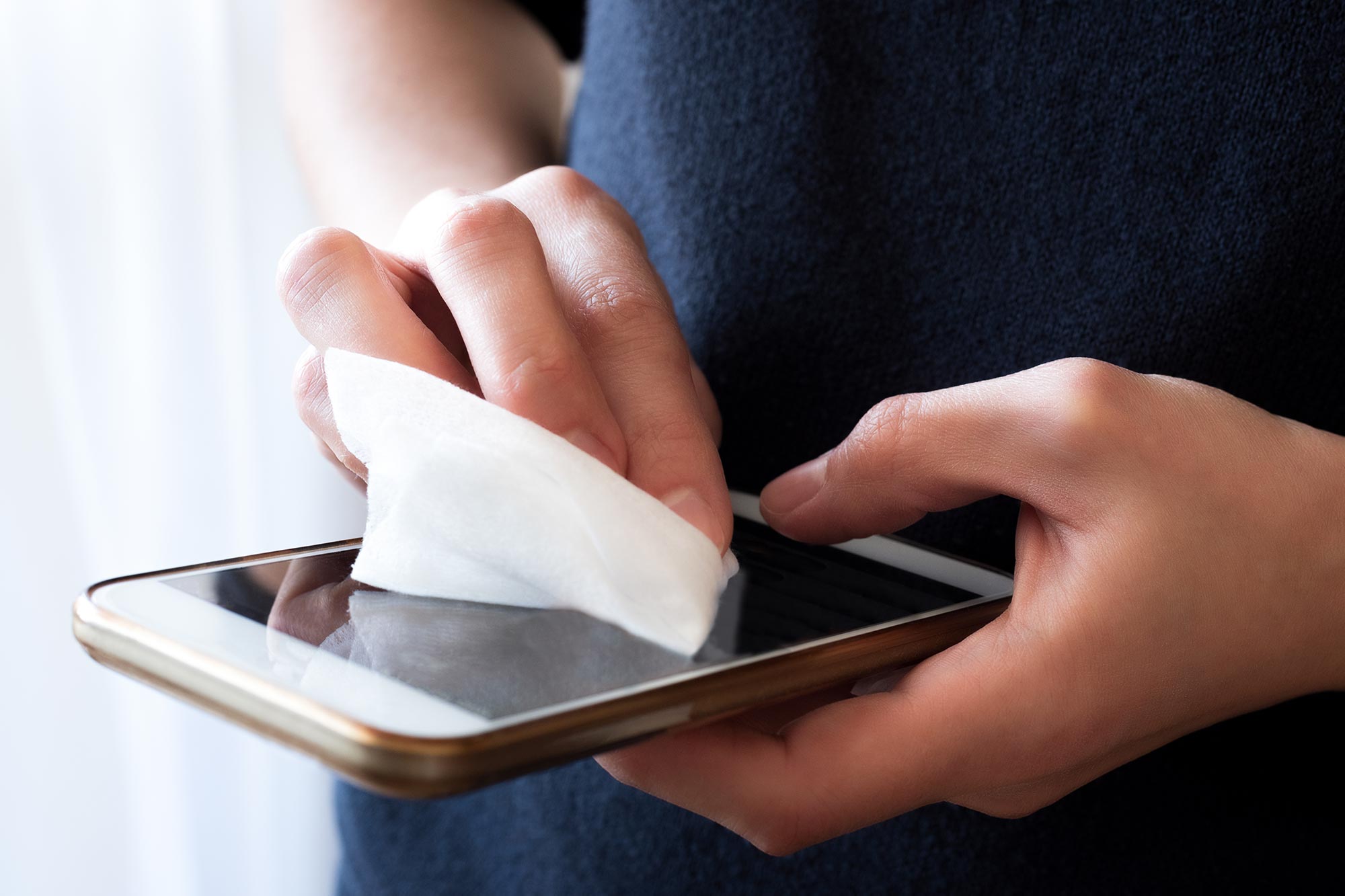
Materials scientist explores why some household cleaners could harm the protective coating on a smartphone screen.
To help curb the spread of the COVID-19 virus, public health experts have emphasized the importance of frequent hand washing, and the need for cleaning and disinfecting frequently touched surfaces. But what about our smartphones and other personal electronic devices that we touch throughout the day?
Many smartphone manufacturers advise against using cleaning products or disinfectants to clean touchscreens, although some have updated their advice. Robert Macfarlane, the Paul M. Cook Assistant Professor in Materials Science and Engineering at MIT, is developing new techniques to manufacture materials via self-assembly that could eventually be used to create protective coatings, adhesives, sensors, and other types of devices. He spoke with MIT News about why certain cleaning products could interfere with how a smartphone screen operates, how to disinfect your phone screen, and the feasibility of designing touchscreens with antimicrobial properties.

Q: Many people are interested in disinfecting their smartphones and other personal electronic devices to help stem the spread of COVID-19. Experts recommend using soap and water or disinfecting wipes to clean surfaces, but could these sorts of cleaning products harm the phone’s display?
A: Every time we touch our phones, or any surface, a certain amount of the material on our hands is transferred to the surface that is touched. Additionally, a certain amount of the material on the surface we touch sticks to our hands. This is why we should be washing our hands constantly to prevent spread of COVID-19. The amount that is transferred varies depending on what the actual composition of the surface is, and we can modify or minimize the amount of residue left behind on a surface by coating it with a material that does not have a strong chemical attraction to the materials on our fingers. The residue left behind by our fingers consists of a large number of substances, including water or various salts, but a majority of it consists of oils. Placing an “oleophobic” coating on a surface — a material that does not have a strong affinity for binding to oily substances — minimizes the amount of oils that are left behind.
Oleophobic coatings are commonly made of fluorinated polymers or fluorocarbons, which are classes of molecules that do not really have strong binding affinity for either water-soluble or oil-soluble materials. While using rubbing alcohol or an alcohol-based wipe is unlikely to remove this coating entirely, prolonged exposure to alcohols in high concentration could potentially disrupt this coating by either removing small patches of the fluorocarbons or altering the coating’s distribution so that it is not entirely uniform across a surface. Without a uniform coating to prevent material adhesion, residue is much more likely to stick. This will affect the device’s optical properties; for example it could create smudges that make it difficult to see through the coating. It could also affect the mechanical properties, so your finger might not glide across the surface as easily.
Touch screens themselves have, as one of their basic components, sensors based on electrical currents. The sensors are designed so that when you touch the screen with your fingers, you complete an electrical circuit right at the point of contact. The phone can therefore register where you are touching the screen and use that as part of its interface. Keeping the materials that constitute the screen and its coating intact are necessary for optimal function. It is best to follow manufacturer specifications and not use full-strength rubbing alcohol or bleach to clean your phone’s screen.
Q: How would you recommend cleaning your phone without harming the device?
A: There are a number of guides online that provide recommendations on how to best disinfect a touchscreen device using gentler methods than straight rubbing alcohol or bleach. Most involve diluting rubbing alcohol with water, a substance that the engineers who designed the touchscreens probably figured the phone would be more likely to come in contact with (both via human contact in fingerprints and via accidental exposure) and thus have optimized the device to be stable under those conditions. At appropriate dilution, the alcohol can still have some of its disinfecting properties.
Q: Could phone coatings and displays be engineered so they are able to more easily withstand cleaning? Do you think it would be possible to develop an antimicrobial coating that helps prevent germs or pathogens from adhering to the surface of a touchscreen?
A: That is certainly a possibility and likely an active area of research. The challenge in all of this is that the materials and structures that make up these devices have to serve a large number of functions — they have to be transparent so you can see the screen, they have to be electrically resistant when not touched and conductive when touched, they have be mechanically strong so that they don’t break, they have to be easily cleanable via simple wiping, and they have to be able to resist smudging in the first place.
There are already a large number of material characteristics that go into these devices, and each added property requires reformulation of the materials, not to mention a redesign of the processing and fabrication conditions. With each reformulation, there is a chance that the material components added to impart a new property may negatively impact some of the other material properties that are crucial for device function. As more components are added to a material’s required specifications, the development of the right structure becomes exponentially more difficult. While these types of coatings are certainly something both the consumer and companies are interested in having, continuing to improve the performance of these materials across so many different design criteria is a challenging task.
The oleophobic coatings that we already use are not entirely impossible to clean, and they probably already prevent microbial adhesion at least to a limited degree. However, they don’t completely eliminate the possibility of contamination, which is something we are now thinking about a lot more given the current pandemic.
Never miss a breakthrough: Join the SciTechDaily newsletter.
Follow us on Google and Google News.