
MIT physicists are studying phase transition to gain a better understanding of superconductivity of electrons in metals. By examining how a gas turns into a superfluid, a state where particles flow without any friction, they hope to gain a better understanding of the equation of state for incredibly dense neutron stars.
Every time you boil water in a kettle, you witness a phenomenon known as a phase transition — water transforms from a liquid to a gas, as you can see from the bubbling water and hissing steam. MIT physicists have now observed a much more elusive phase transition: that from a gas into a superfluid, a state where particles flow without any friction.
The MIT work, published last week in the online edition of Science, also sheds light on the superconductivity of electrons in metals, including high-temperature superconductors that have the potential to revolutionize energy efficiency.
The researchers, led by MIT assistant professor of physics Martin Zwierlein, carried out their experiment with an isotope of lithium that has an odd number of electrons, protons and neutrons. Such particles are called fermions. In order to become superfluid and flow without friction, fermions need to team up in pairs. This is what happens in superconductors, where electrons form so-called Cooper pairs, which can flow without any resistance.
Analogous to the transition from water to steam, the transition from the superfluid (pairs) to the normal gas (single unpaired atoms) should be accompanied by a dramatic change in the gas’s pressure, density and energy. To directly observe such a transition in a gas, the MIT team had to first trap the lithium gas in an atom trap (in which atoms are held in place by electromagnetic fields) and cool it to ultralow temperatures — less than a hundred billionths of a degree above absolute zero.
At this point, a superfluid comprising atom pairs was expected to form in the center of the atom trap, surrounded by a normal region of unpaired atoms. A light was then used to cast this atom cloud’s shadow on a camera.
Using the shadow images, Zwierlein and MIT graduate students Mark Ku, Ariel Sommer, and Lawrence Cheuk set out to precisely measure the relationship between the pressure, density and temperature of the gas. The relation between these three variables is known as an “equation of state” for the system. (For example, for the steam in the kettle, it is known that as the temperature increases, the pressure will also increase.) An equation of state completely determines the thermodynamic properties of a system, including its phase transitions.
A new ‘thermometer’
An obstacle in previous experiments on the thermodynamics of ultracold gases was the absence of a reliable thermometer that can measure the temperature of a puff of gas more than 10 million times colder than interstellar space. The researchers solved this problem by carefully characterizing the properties of their atom trap.
“Like geometers who measure the height lines of a landscape, we determined the exact shape of our trap,” explains graduate student Mark Ku. “These height lines then served as our thermometer.”
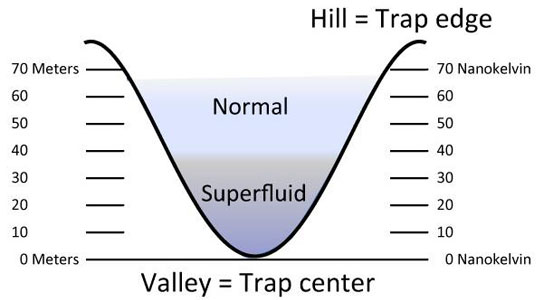
Think of the trap as a valley filled with fog: In the upper regions, one would encounter less dense regions of fog, while down in the valley the fog gets denser. By measuring three quantities — the gas density at a given height line, its change from one line to the next and the total amount of gas encountered on the way down to that height — the researchers could determine the equation of state of their gas of fermions.
The atoms in these gases interact very strongly, not unlike the electrons in high-temperature superconductors. The exact mechanism for superconductivity is not yet understood, and so far, physicists have not been able to predict materials that would become superconducting at room temperature. The MIT team has now measured the critical temperature for superfluidity in their atomic Fermi gas and shown that scaled to the density of electrons in a metal, superfluidity would occur far above room temperature.
The new work represents an “outstanding achievement,” says Wilhelm Zwerger, a professor of physics at Germany’s Technical University of Munich who was not involved in the research. According to Zwerger, determining the phase transition for superfluids not only sheds light on Fermi gases and high-temperature superconductors, but could also help scientists better understand the equation of state for incredibly dense neutron stars, which are heavier than the sun but have a diameter of only about 12 kilometers.
Never miss a breakthrough: Join the SciTechDaily newsletter.
Follow us on Google and Google News.
1 Comment
B Memo 2603_091728,100332_Source 1. Reinterpretation []
Source 1.
https://scitechdaily.com/mit-physicists-study-superfluid-to-better-understand-neutron-stars/
1.
_MIT physicists study superfluidity to better understand neutron stars
_Ann Trafton, Massachusetts Institute of Technology, January 21, 2012
—【Science news from 14 years ago? It doesn’t feel like science news from that distant time at all. Wow. My thoughts lingered on this source, and I explored the superconducting superfluid of a neutron star. 2603100330.32】
_MIT physicists have studied the process by which a cloud of ultracold lithium atoms transitions from a normal gas to a superfluid, a state in which particles flow without friction.
MIT physicists are studying phase transitions to better understand the superconductivity of electrons in metals.
By investigating how gases transform into superfluids, where particles flow frictionlessly, they hope to better understand the equations of state of extremely dense neutron stars.
1-1.
Every time we boil water in a kettle, we witness a phenomenon called phase transition. The water’s transition from liquid to gas is evidenced by the bubbling water and the rising steam.
But MIT physicists have observed a much more elusive phase transition: from gas to superfluid. Superfluidity is a state in which particles flow frictionlessly.
2.
This MIT study, published online last week in Science, broadens our understanding of superconductivity in electrons in metals, including high-temperature superconductors, and has the potential to revolutionize energy efficiency.
A research team led by MIT Assistant Professor of Physics Martin Zwierlein conducted an experiment using lithium isotopes with odd numbers of electrons, protons, and neutrons.
These particles are called fermions. For superfluid particles to flow frictionlessly, fermions must pair up. In superconductors, electrons form so-called Cooper pairs, allowing for resistance-free flow.
—a1. [The resistance-free flow can be seen in sample3.pms. This pattern is a linear function line representing a composite number formed by the product of prime numbers greater than 5 and those primes. This was discovered long ago and a method for finding superprimes was anticipated, but it remained a challenge. The probability of any odd number, pms.prime, becoming a superprime is 50%, or 50%.
—Separating this 50% from pms proved difficult. It seems like a simple win/loss situation, but… haha. 1739.
—Of course, it’ll be detailed in exquisite multi-conditioning. Hehe. 091741.
】
2-1.
_Similar to water turning into steam, the transition from a superfluid (paired atoms) to a normal gas (single, unpaired atoms) must be accompanied by dramatic changes in the gas’s pressure, density, and energy. To directly observe this transition in a gas, the MIT research team first had to confine lithium gas in an atomic trap (a device where atoms are held in place by an electromagnetic field) and cool it to an extremely low temperature, less than a trillionth of a degree below absolute zero.
—At this point, a superfluid composed of paired atoms would form at the center of the atom trap, surrounded by a normal region of unpaired atoms. They then used light to project the shadow of this atomic cloud onto a camera.
Zwierlein and MIT graduate students Mark Koo, Ariel Sommer, and Lawrence Chuk used shadow images to precisely measure the relationship between the pressure, density, and temperature of a gas.
The relationship between these three variables is known as the system’s “equation of state.” (For example, in the case of steam in a kettle, we know that as the temperature increases, the pressure also increases.) The equation of state perfectly determines the thermodynamic properties of the system, including phase transitions.
2-2. A New ‘Thermometer’
Previous experiments on the thermodynamics of ultra-cold gases were hampered by the lack of a reliable thermometer capable of measuring the temperature of a gas mass tens of millions of times colder than interstellar space. The researchers solved this problem by precisely analyzing the characteristics of the atom trap device.
“Like a geometer measuring the height lines of a landscape, we determined the precise shape of the trap,” explains graduate student Mark Koo. “These height lines served as our thermometer.”
Think of the trap as a valley filled with fog. The fog is less dense in the upper regions, and thickens as you descend into the valley. By measuring three quantities: the gas density at a given height, the change in density with height, and the total amount of gas encountered during the descent to that height, the researchers were able to determine the equation of state for the fermion gas.
_The atoms in this gas interact very strongly, much like the electrons in a high-temperature superconductor. The exact mechanism of superconductivity is not yet fully understood, and physicists have not yet predicted a material that exhibits superconductivity at room temperature.
2-3.
_The MIT research team recently measured the critical temperature at which superfluidity occurs in an atomic Fermi gas and demonstrated that increasing the electron density in this gas to that of a metal can lead to superfluidity at temperatures much higher than room temperature.
ㅡc1.【If the electron density of the gas is increased to that of a metal, and the qqcell.tsp density is increased to that of msbase.grid…
ㅡWill a room-temperature superconductor or *.superfluid phase appear?
Colorful matter from the dark matter msoss series appears in the universe? Uh-huh. 2603100248.
—This explains why neutron stars and quark stars are formed, and the density of qqcell.parpi.colorful.matter provides the answer. Uh-huh. 2603100252.
—Here, superfluid (vixxa.neutron_stars.qqshell.superfluid) is a fluid state with zero viscosity. It’s more closely related to the quantum mechanical aggregation phenomenon Bose-Einstein condensate than to electron density. It appears to be a different concept from superconductors, where electron interactions are important, or electron crystals within certain solid materials. Hmm. 03100314.
—Of course, qqshell is a phenomenon caused by the interference of singularities in the path of dark energy eqpms.nqvixer, but it’s likely a different concept from electron density or Bose-Einstein condensate. The reason is that since it’s a condensation with external energy input, the fundamental approach itself may be different from the internal fiction (imaginary_i.vixer.blackhole,wormhole, complex number)-based approach. Hmm. 100322.
—Suddenly, looking at Source 1, it’s a paper from 14 years ago, so it doesn’t seem like outdated science news. Hehe. 0325.
】
_Professor Wilhelm Zwerger of the Department of Physics at the Technical University of Munich in Germany, who was not involved in this research, praised the study as an “excellent achievement.”
_According to Professor Zwerger, elucidating the phase transition phenomenon of superfluids will not only broaden our understanding of Fermi gases and high-temperature superconductors, but may also help us better understand the equations of state of ultra-dense neutron stars, which are more massive than the Sun but only about 12 km in diameter.