
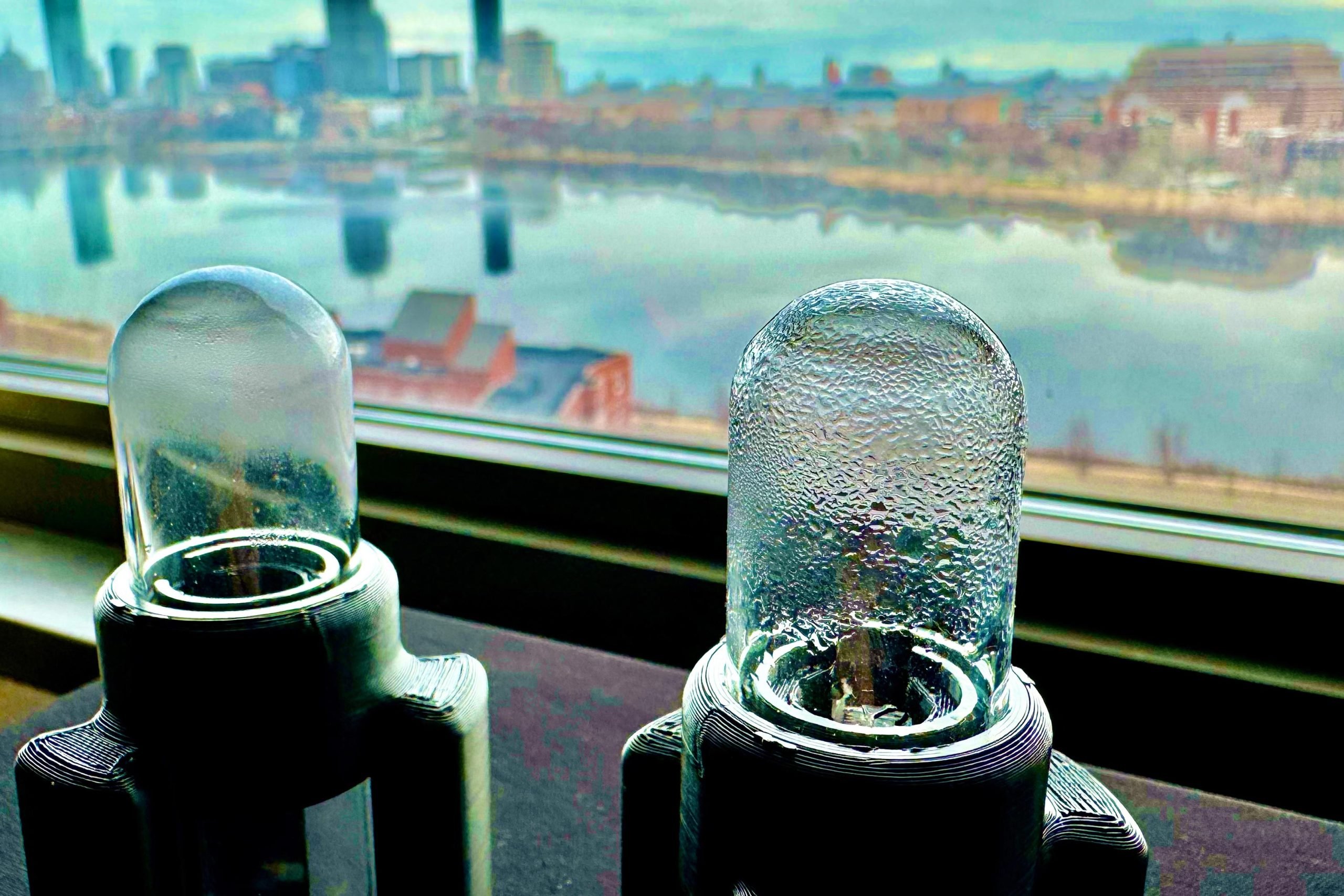
MIT engineers have developed an ultrasonic device that rapidly releases water from sorbent materials used in atmospheric harvesting.
By shaking water molecules free instead of heating them, the system boosts efficiency dramatically. Powered by a small solar cell, it could run multiple cycles per day. The advance could make off-grid, air-powered drinking water systems far more practical.
Tapping the Air for Water Harvesting
Feeling thirsty? It may be possible to draw drinking water straight from the air. Even very dry places still hold small traces of humidity that the right materials can capture and release as clean, drinkable water. In the last few years, researchers have created many sponge-like materials capable of this “atmospheric water harvesting.”
However, getting the collected water back out of these materials typically involves heat — and patience. Most systems depend on sunlight to warm the material until the trapped moisture evaporates and condenses into liquid form, a process that can stretch on for hours or even days.
MIT engineers now report a way to speed up this recovery step. Instead of relying on sunlight to coax water out, the team uses ultrasonic vibrations that physically shake the moisture free.
Ultrasound: A Faster Path to Water Recovery
The researchers designed an ultrasonic device that produces high-frequency vibrations. When a water-absorbing material, called a “sorbent,” is placed on top, the device emits ultrasound waves tuned to loosen water molecules from the sorbent. According to the team’s tests, the device extracts moisture in just a few minutes rather than the tens of minutes or hours needed for heat-based approaches.
Because it does not use heat, the device needs an external source of power. The team suggests that a small solar cell could run the system and also act as a sensor that signals when the sorbent has reached full capacity. The setup could even be programmed to activate automatically whenever enough water is ready to be collected. With such automation, a system could
Powering and Automating Ultrasonic Water Systems
“People have been looking for ways to harvest water from the atmosphere, which could be a big source of water particularly for desert regions and places where there is not even saltwater to desalinate,” says Svetlana Boriskina, principal research scientist in MIT’s Department of Mechanical Engineering. “Now we have a way to recover water quickly and efficiently.”
Boriskina and her colleagues describe their device in a study published today (November 18) in Nature Communications. The paper’s first author is Ikra Iftekhar Shuvo, an MIT graduate student in media arts and sciences, alongside Carlos Díaz-Marín, Marvin Christen, Michael Lherbette, and Christopher Liem.
MIT Team Behind the Breakthrough
Boriskina’s group at MIT focuses on materials that interact with their surroundings in innovative ways. The team recently explored atmospheric water harvesting (AWH) and how materials can be engineered to pull moisture from the air. If reliable, such systems could significantly help communities that have limited access to drinking water — and lack even saltwater options for desalination.
Like many researchers, Boriskina’s group initially assumed that an AWH system deployed outdoors would collect moisture at night and then rely on sunlight during the day to naturally evaporate the trapped water and allow it to condense for collection.
“Any material that’s very good at capturing water doesn’t want to part with that water,” Boriskina explains. “So you need to put a lot of energy and precious hours into pulling water out of the material.”
The Stubborn Challenge of Extracting Moisture
She realized there could be a faster way to recover water after Ikra Shuvo joined her group. Shuvo had been working with ultrasound for wearable medical device applications. When he and Boriskina considered ideas for new projects, they realized that ultrasound could be a way to speed up the recovery step in atmospheric water harvesting.
“It clicked: We have this big problem we’re trying to solve, and now Ikra seemed to have a tool that can be used to solve this problem,” Boriskina recalls.
How Ultrasonic Waves Shake Free Water
Ultrasound, or ultrasonic waves, are acoustic pressure waves that travel at frequencies of over 20 kilohertz (20,000 cycles per second). Such high-frequency waves are not visible or audible to humans. And, as the team found, ultrasound vibrates at just the right frequency to shake water out of a material.
“With ultrasound, we can precisely break the weak bonds between water molecules and the sites where they’re sitting,” Shuvo says. “It’s like the water is dancing with the waves, and this targeted disturbance creates momentum that releases the water molecules, and we can see them shake out in droplets.”
Shuvo and Boriskina designed a new ultrasonic actuator to recover water from an atmospheric water harvesting material. The heart of the device is a flat ceramic ring that vibrates when voltage is applied. This ring is surrounded by an outer ring that is studded with tiny nozzles. Water droplets that shake out of a material can drop through the nozzle and into collection vessels attached above and below the vibrating ring.
Designing a High-Frequency Water-Release Device
They tested the device on a previously designed atmospheric water harvesting material. Using quarter-sized samples of the material, the team first placed each sample in a humidity chamber, set to various humidity levels. Over time, the samples absorbed moisture and became saturated. The researchers then placed each sample on the ultrasonic actuator and powered it on to vibrate at ultrasonic frequencies. In all cases, the device was able to shake out enough water to dry out each sample in just a few minutes.
Testing the Actuator in Realistic Conditions
The researchers calculate that, compared to using solar heat, the ultrasonic design is 45 times more efficient at extracting water from the same material.
“The beauty of this device is that it’s completely complementary and can be an add-on to almost any sorbent material,” says Boriskina, who envisions a practical, household system might consist of a fast-absorbing material and an ultrasonic actuator, each about the size of a window. Once the material is saturated, the actuator would briefly turn on, powered by a solar cell, to shake out the water. The material would then be ready to harvest more water, in multiple cycles throughout a single day.
Toward Practical, High-Cycle Daily Water Production
“It’s all about how much water you can extract per day,” she says. “With ultrasound, we can recover water quickly, and cycle again and again. That can add up to a lot per day.”
Reference: “High-efficiency atmospheric water harvesting enabled by ultrasonic extraction” by Ikra Iftekhar Shuvo, Carlos D. Díaz-Marín, Marvin Christen, Michael Lherbette, Christopher Liem and Svetlana V. Boriskina, 18 November 2025, Nature Communications.
DOI: 10.1038/s41467-025-65586-2
This work was supported, in part, by the MIT Abdul Latif Jameel Water and Food Systems Lab and the MIT-Israel Zuckerman STEM Fund.
Never miss a breakthrough: Join the SciTechDaily newsletter.
Follow us on Google and Google News.
4 Comments
thanks
thanks for this
They’ve left out the matter of dried air falling under damper air and dessicating pedestrians, birds, cyclists, soil, etc. Really hope they at least nod to doing this at altitude and day rather than out-deserting the commons.
Perfect for off-grid living.