

Enormous potential range of applications.
MIT engineers and colleagues report important new advances on a tunable metasurface, or flat optical device patterned with nanoscale structures, that they compare to a Swiss army knife while its passive predecessor can be thought of as just one tool, like a flat-bladed screwdriver. Key to the work is a transparent material discovered by the team that quickly and reversibly changes its atomic structure in response to heat.
“The applications opened up by the ability to quickly reconfigure metasurfaces are enormous,” says Yifei Zhang, first author of a paper reporting the latest advances in a recent issue of Nature Nanotechnology. Zhang is a graduate student in the Department of Materials Science and Engineering (DMSE). “We are excited because the current work overcomes several obstacles to implement these metasurfaces into real-world applications.”
Says Associate Professor Arka Majumdar of the University of Washington, Seattle, of those applications: “I envision [that] this technology could revolutionize optical neural networks, depth sensing, and Lidar technology for autonomous cars.” Majumdar was not involved in the research.
Electrical Switch
In the Nature Nanotechnology paper, the MIT researchers describe using electrical currents to reversibly change the material structure—and therefore optical properties—of the new metasurface. In the past, they used bulky lasers or a furnace to supply the necessary heat. “This is important because we can now integrate the entire active optical device, along with the electrical switch, on a silicon chip to form a miniaturized optics platform,” says Juejun Hu, leader of the work and an Associate Professor of Materials Science and Engineering in DMSE.
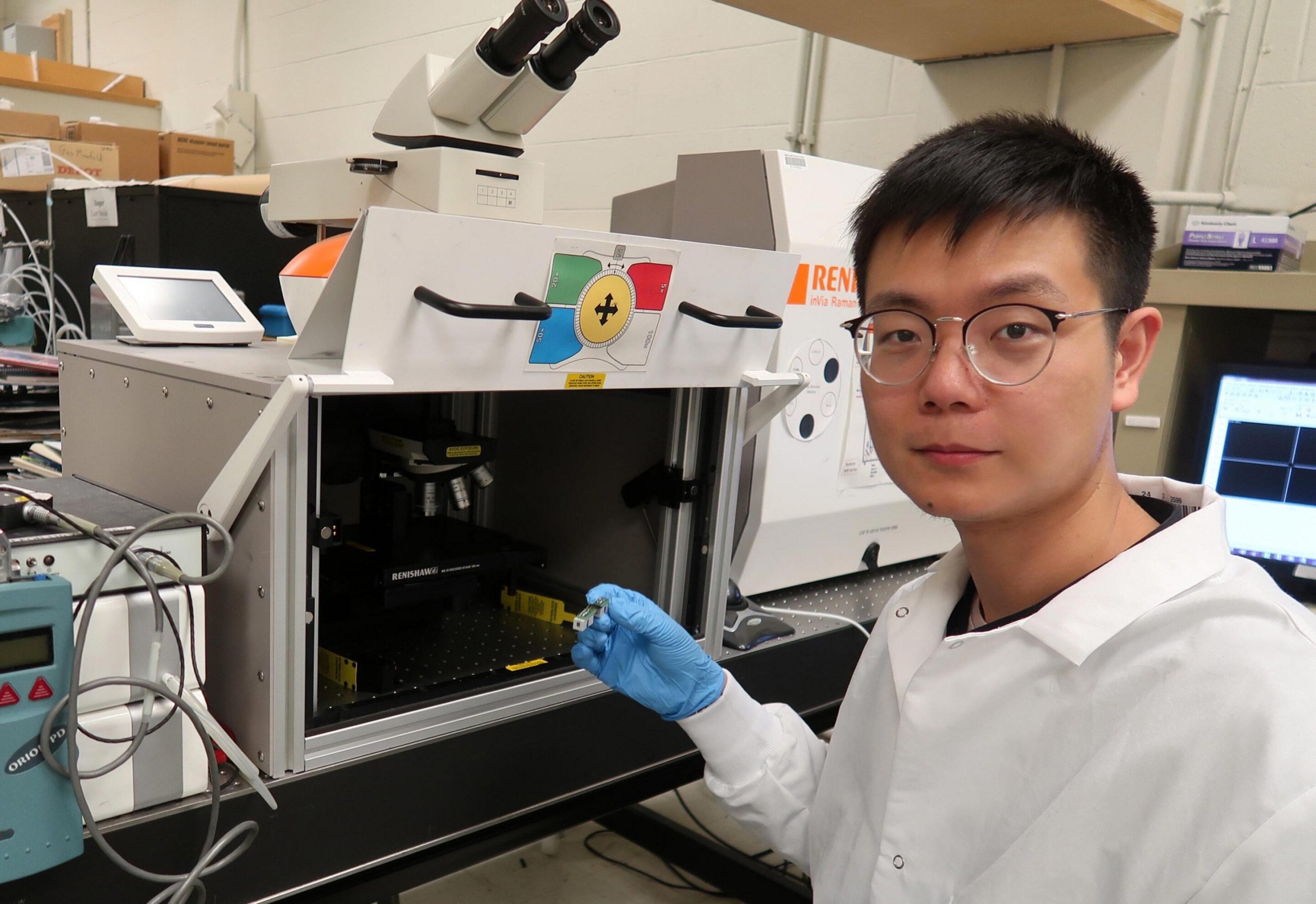
The team also reports demonstrating “a series of tunable optical functions using the platform,” Hu says. These include a beam steering device where “by switching the material to different [internal] structures, we can send light in one direction versus another, back and forth.” Beam steering is key to self-driving cars, although Hu emphasizes that the device he and colleagues demonstrated is still fairly rudimentary. “It’s more a proof of principle.”
In addition to Zhang and Hu, authors of the new paper are Junhao Liang, Bilal Azhar, Mikhail Y. Shalaginov, Skylar Deckoff-Jones, Carlos Rios, and Tian Gu, all of MIT DMSE; Clayton Fowler, Sensong An, and Hualiang Zhang of the University of Massachusetts, Lowell; Jeffrey B. Chou, Christopher M. Roberts, and Vladimir Liberman of MIT Lincoln Laboratory; Myungkoo Kang and Kathleen A. Richardson of the University of Central Florida, and Clara Rivero-Baleine of Lockheed Martin Corporation. Hu and Gu are also affiliated with MIT’s Materials Research Laboratory.
A New Material
Phase-change materials (PCMs) change their structure in response to heat. They are used commercially in rewritable CDs and DVDs. Explains Hu, “a laser beam changes the structure of the material locally, from amorphous to crystalline, and that change can be used to encode ones and zeros—digital information.”
However, conventional PCMs have limitations when it comes to optical applications. For one, they are opaque. They won’t let light pass through. “That motivated us to look into a new phase-change material for optical devices that is transparent,” Hu says. Earlier this year his team reported that adding another element, selenium, to a conventional PCM did the trick.
The new material, composed of germanium, selenium, antimony, and tellurium (GSST), is key to the new metasurface. The metasurface, in turn, is not just a thin film of GSST, it’s a film of GSST only about half a millimeter square patterned with some 100,000 nanoscale structures. And these, in turn, “allow you to control the propagation of light. So you can transform a collection of these nanostructures into, for example, a lens,” Hu says.
Harish Bhaskaran is a Professor at the University of Oxford who was not involved in the research. He commented on the work as a whole and on the advances reported in the new paper:
“This is a very important area of work as such tunable metasurfaces, i.e., surfaces that can modulate the reflection of light even though they are nominally ‘flat’ or very thin, are extremely interesting. They can dramatically reduce the bulk of lenses, which of course are used in everything that manipulates light. [MIT’s] use of phase change materials that are low loss (i.e., they absorb very little light) provides a real pathway towards making this a reality. The authors are also among the first to show the dynamic tuning using heaters which are controlled electrically.” (In the same issue of Nature Nanotechnology a team from Stanford also reports controlling metasurfaces with electrical heating using a different approach.)
According to a News & Views article in the same issue of Nature Nanotechnology about the MIT and Stanford advances, “these works make a breakthrough in the tunable PCM-based metasurfaces.” However, the News & Views authors emphasize that both approaches have drawbacks.
The Hu team is addressing some of those drawbacks. For example, the heater used in their miniaturized optics platform is currently made of metal. But “metals are problematic for optics, because they absorb light,” Hu says. “We are working on a new heater made of silicon that is transparent.”
Hu describes the work overall as especially exciting because it began with the discovery of a new material that the team then engineered for a new application. “This cuts across from materials innovation to device integration, which I think is pretty unique.”
Reference: “Electrically reconfigurable non-volatile metasurface using low-loss optical phase-change material” by Yifei Zhang, Clayton Fowler, Junhao Liang, Bilal Azhar, Mikhail Y. Shalaginov, Skylar Deckoff-Jones, Sensong An, Jeffrey B. Chou, Christopher M. Roberts, Vladimir Liberman, Myungkoo Kang, Carlos Ríos, Kathleen A. Richardson, Clara Rivero-Baleine, Tian Gu, Hualiang Zhang and Juejun Hu, 19 April 2021, Nature Nanotechnology.
DOI: 10.1038/s41565-021-00881-9
The work was supported by the US Defense Advanced Research Projects Agency and the US Air Force. The researchers also acknowledge the use of facilities provided by the MIT Materials Research Laboratory, the MIT Microsystems Technology Laboratories, and the Harvard University Center for Nanoscale Systems.
Never miss a breakthrough: Join the SciTechDaily newsletter.
Follow us on Google and Google News.