
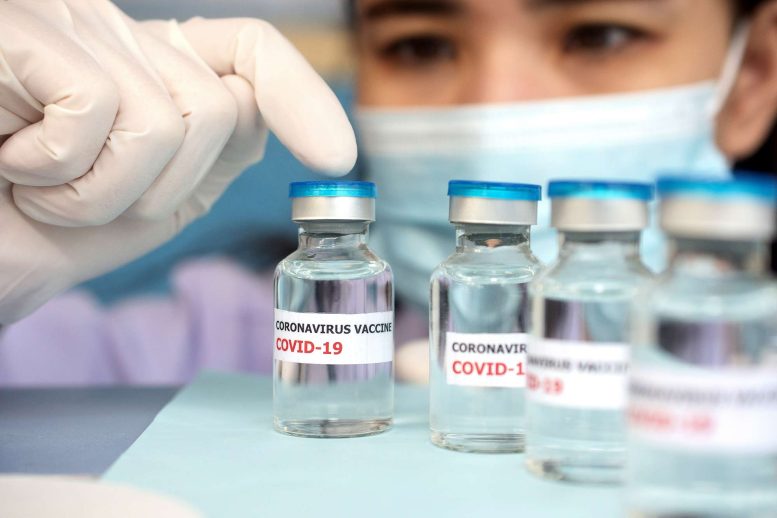
A study on Chile’s COVID-19 vaccination program revealed that using a different type of booster (heterologous) than the original two-dose schedule enhances vaccine effectiveness.
A new study on Chile’s national COVID-19 vaccination program, being presented at this year’s European Congress of Clinical Microbiology & Infectious Diseases (ECCMID 2022, Lisbon, April 23-26), and published in the journal The Lancet Global Health on April 23, 2022, shows that giving a different type of vaccine (heterologous) for the third or ‘booster’ dose than was received for the first two doses, leads to better vaccine performance than using the same (homologous) inactivated SARS-CoV-2 vaccine for all three doses.
Dr. Rafael Araos of the Institute of Science and Innovation in Medicine, Clinica Alemana, Universidad del Desarrollo, Dr. Alejandro Jara and Dr. Eduardo A Undurraga of Pontificia Universidad Católica de Chile, and colleagues from the Chilean Ministry of Health contributed to the study.
The study assessed the effectiveness of CoronaVac (Sinovac Biotech), AZD1222 (Oxford-AstraZeneca), or BNT162b2 (Pfizer-BioNTech) vaccine boosters in individuals who had completed a primary two-dose immunization schedule with CoronaVac, an inactivated SARS-CoV-2 vaccine which accounts for about half the COVID-19 vaccine doses delivered globally, compared with no vaccination. The study looked at Chile’s national immunization program, where the two-dose Coronavac schedule was by far the most widely used.
Individuals administered vaccines from February 2, 2021, to the prespecified trial end date of November 10, 2021, were evaluated; the team excluded individuals with a probable or confirmed SARS-CoV-2 infection (RT-PCR or antigen test) on or before February 2, 2021, and individuals who had received at least one dose of any COVID-19 vaccine before February 2, 2021. They estimated the vaccine effectiveness of booster doses against laboratory-confirmed symptomatic COVID-19 (symptomatic COVID-19) cases and COVID-19 outcomes (hospitalization, admission to the intensive care unit [ICU], and death).
A total of 11,174,257 individuals were eligible for this study, among whom 4,127,546 completed a primary immunization schedule (two doses) with CoronaVac and received a booster dose during the study period. 1 921 340 (46·5%) participants received a heterologous AZD1222 booster, 2 019 260 (48·9%) received a heterologous BNT162b2 booster, and 186 946 (4·5%) received a homologous booster with CoronaVac.
The authors calculated adjusted vaccine effectiveness (using statistical modeling) in preventing symptomatic COVID-19 of 79% for a two-dose schedule plus CoronaVac booster, 97% for a BNT162b2 booster, and 93% for an AZD1222 booster. The adjusted vaccine effectiveness against COVID-19-related hospitalization, ICU admission, and death was 86%, 92%, and 87% for a CoronaVac booster, 96%, 96%, and 97% for a Pfizer-BioNTech booster, and 98%, 99% and 98% for an Astra Zeneca booster.
The Importance of Boosters in Light of Waning Immunity
The authors explain that booster programs were initiated in various countries due to emerging evidence of waning immunity from two dose schedules. Boosters are also important because evidence suggests that inactivated vaccines like Coronavac offer lower protection than the new mRNA technology vaccines from Pfizer -BioNTech and Moderna. Delta was the predominant circulating variant in Chile during the study period.
They conclude: “Our results suggest that a third dose of Coronavac or using a different booster vaccine such as Pfizer-BioNTech or Astra Zeneca vaccines in those that had previously had two doses of Coronavac provides a high level of protection against COVID-19, including severe disease and death…However, receiving a different vaccine for the booster dose results in higher vaccine effectiveness than a third dose of Coronavac for all outcomes, providing additional support for a mix-and-match approach.”
The authors further explain that this is one of the first studies to examine the effectiveness of booster shots for inactivated SARS-CoV-2 vaccines. A recent study in Brazil1 showed that homologous and heterologous booster vaccines (BNT162b2 and AZD1222) following a CoronoVac primary vaccination schedule were safe and immunogenic. Similarly, a phase 1-2 study in the USA2 with mRNA-1273, Ad26.COV2.S, and BNT162b2 boosters found that heterologous boosters were on average more immunogenic than homologous boosters.
The UK’s Cov-Boost3 study (a phase 2 trial) showed that various vaccines are safe and immunogenic when given as boosters following a primary two-dose schedule of AZD1222 and BNT162b2, with the highest antibody levels achieved by mRNA boosters.
And prior studies4 have examined the immunogenicity of a heterologous two-dose regimen of ChAdOx1 followed by an mRNA vaccine, and found mix-and-match strategies were more immunogenic and offered more protection against COVID-19 than two-dose homologous strategies for that vaccine combination.
In Chile, the government has now advised that heterologous boosters should be used as the first option; however, people can and have received a homologous booster as an alternative.
References:
“Effectiveness of homologous and heterologous booster doses for an inactivated SARS-CoV-2 vaccine: a large-scale prospective cohort study” by Alejandro Jara, PhD; Eduardo A Undurraga, PhD; José R Zubizarreta, PhD; Cecilia González, MD; Alejandra Pizarro, MD; Johanna Acevedo, MS; Katherinne Leo, BSE; Fabio Paredes, MSc; Tomás Bralic, MS; Verónica Vergara, MS; Marcelo Mosso, BSE; Francisco Leon, MBA; Ignacio Parot, MA; Paulina Leighton, BSE; Pamela Suárez, BSE; Juan Carlos Rios, PhD; Heriberto García-Escorza, MS and Rafael Araos, MD, 23 April 2022, The Lancet Global Health.
DOI: 10.1016/S2214-109X(22)00112-7
“Heterologous versus homologous COVID-19 booster vaccination in previous recipients of two doses of CoronaVac COVID-19 vaccine in Brazil (RHH-001): a phase 4, non-inferiority, single blind, randomised study” by Sue Ann Costa Clemens, PhD; Lily Weckx, PhD; Ralf Clemens, PhD; Ana Verena Almeida Mendes, PhD; Alessandra Ramos Souza, PhD; Mariana B V Silveira, MD; Suzete Nascimento Farias da Guarda, PhD; Maristela Miyamoto de Nobrega, PhD; Maria Isabel de Moraes Pinto, PhD; Isabela G S Gonzalez, MD; Natalia Salvador, Nurse D; Marilia Miranda Franco, MD; Renata Navis de Avila Mendonça, MD; Isabelle Silva Queiroz Oliveira, MD; Bruno Solano de Freitas Souza, PhD; Mayara Fraga, Pharm D; Parvinder Aley, PhD; Sagida Bibi, PhD; Liberty Cantrell, MSc; Wanwisa Dejnirattisai, PhD; Xinxue Liu, PhD; Juthathip Mongkolsapaya, DPhil; Piyada Supasa, PhD; Gavin R Screaton, DPhil; Teresa Lambe, PhD and Merryn Voysey, DPhil, 21 January 2022, The Lancet.
DOI: 10.1016/S0140-6736(22)00094-0
“Homologous and Heterologous Covid-19 Booster Vaccinations” by Robert L. Atmar, M.D., Kirsten E. Lyke, M.D., Meagan E. Deming, M.D., Ph.D., Lisa A. Jackson, M.D., M.P.H., Angela R. Branche, M.D., Hana M. El Sahly, M.D., Christina A. Rostad, M.D., Judith M. Martin, M.D., Christine Johnston, M.D., M.P.H., Richard E. Rupp, M.D., Mark J. Mulligan, M.D., Rebecca C. Brady, M.D., Robert W. Frenck, Jr., M.D., Martín Bäcker, M.D., Angelica C. Kottkamp, M.D., Tara M. Babu, M.D., M.S.C.I., Kumaravel Rajakumar, M.D., Srilatha Edupuganti, M.D., M.P.H., David Dobrzynski, M.D., Rhea N. Coler, Ph.D., Christine M. Posavad, Ph.D., Janet I. Archer, M.Sc., Sonja Crandon, B.S.N., Seema U. Nayak, M.D., Daniel Szydlo, M.S., Jillian A. Zemanek, M.P.H., Clara P. Dominguez Islas, Ph.D, Elizabeth R. Brown, Sc.D., Mehul S. Suthar, Ph.D., M. Juliana McElrath, M.D., Ph.D., Adrian B. McDermott, Ph.D., Sarah E. O’Connell, M.S., David C. Montefiori, Ph.D., Amanda Eaton, M.B.A., Kathleen M. Neuzil, M.D., David S. Stephens, M.D., Paul C. Roberts, Ph.D. and John H. Beigel, M.D. for the DMID 21-0012 Study Group, 17 March 2022, The New England Journal of Medicine.
DOI: 10.1056/NEJMoa2116414
“Safety and immunogenicity of seven COVID-19 vaccines as a third dose (booster) following two doses of ChAdOx1 nCov-19 or BNT162b2 in the UK (COV-BOOST): a blinded, multicentre, randomised, controlled, phase 2 trial” by Alasdair P S Munro, MRCPCH; Leila Janani, PhD; Victoria Cornelius, PhD; Parvinder K Aley, PhD; Gavin Babbage, MPhil; Prof David Baxter, PhD; Marcin Bula, FRCP; Katrina Cathie, MD; Prof Krishna Chatterjee, FRCP; Kate Dodd, MSc; Yvanne Enever, BSc[Hons]; Karishma Gokani, MBBS; Anna L Goodman, DPhil; Christopher A Green, DPhil; Linda Harndahl, PhD; John Haughney, FRCGP; Alexander Hicks, PhD; Agatha A van der Klaauw, PhD; Jonathan Kwok, MB BChir; Prof Teresa Lambe, PhD; Prof Vincenzo Libri, MD; Prof Martin J Llewelyn, PhD; Alastair C McGregor, FRCPath; Angela M Minassian, DPhil; Patrick Moore, MRCGP; Mehmood Mughal, MBBS; Yama F Mujadidi, MSc; Jennifer Murira, BM; Orod Osanlou, FRCP; Rostam Osanlou, MBChB; Daniel R Owens, MRCPCH; Mihaela Pacurar, MBBS; Adrian Palfreeman, FRCP; Daniel Pan, MRCP; Tommy Rampling, DPhil; Karen Regan, BSc; Stephen Saich, BA; Jo Salkeld, BMBS; Prof Dinesh Saralaya, MD; Sunil Sharma, FRCPath; Ray Sheridan, MRCP; Ann Sturdy, MBBS; Prof Emma C Thomson, PhD; Shirley Todd, MSc; Prof Chris Twelves, MD; Prof Robert C Read, PhD; Sue Charlton, PhD; Bassam Hallis, PhD; Prof Mary Ramsay, FFPH; Prof Nick Andrews, PhD; Prof Jonathan S Nguyen-Van-Tam, DM; Prof Matthew D Snape, MD; Xinxue Liu, PhD and Prof Saul N Faust, PhD on behalf of theCOV-BOOST study group, 2 December 2021, The Lancet.
DOI: 10.1016/S0140-6736(21)02717-3
“Effectiveness of heterologous ChAdOx1 nCoV-19 and mRNA prime-boost vaccination against symptomatic Covid-19 infection in Sweden: A nationwide cohort study” by Peter Nordström, Marcel Ballin and Anna Nordström, 18 October 2021, The Lancet Regional Health – Europe.
DOI: 10.1016/j.lanepe.2021.100249
Never miss a breakthrough: Join the SciTechDaily newsletter.
Follow us on Google and Google News.