
Close Menu
    Facebook X (Twitter) Instagram
    SciTechDaily
    • Biology
    • Chemistry
    • Earth
    • Health
    • Physics
    • Science
    • Space
    • Technology
    Facebook X (Twitter) Pinterest YouTube RSS
    SciTechDaily
    Home»Space»Hubble Space Telescope Spies a Tenuous Diffuse Galaxy
    Space

    Hubble Space Telescope Spies a Tenuous Diffuse Galaxy

    By ESA/HubbleApril 24, 2022No Comments2 Mins Read
    Facebook Twitter Pinterest Telegram LinkedIn WhatsApp Email Reddit
    Share
    Facebook Twitter LinkedIn Pinterest Telegram Email Reddit
    GAMA 526784
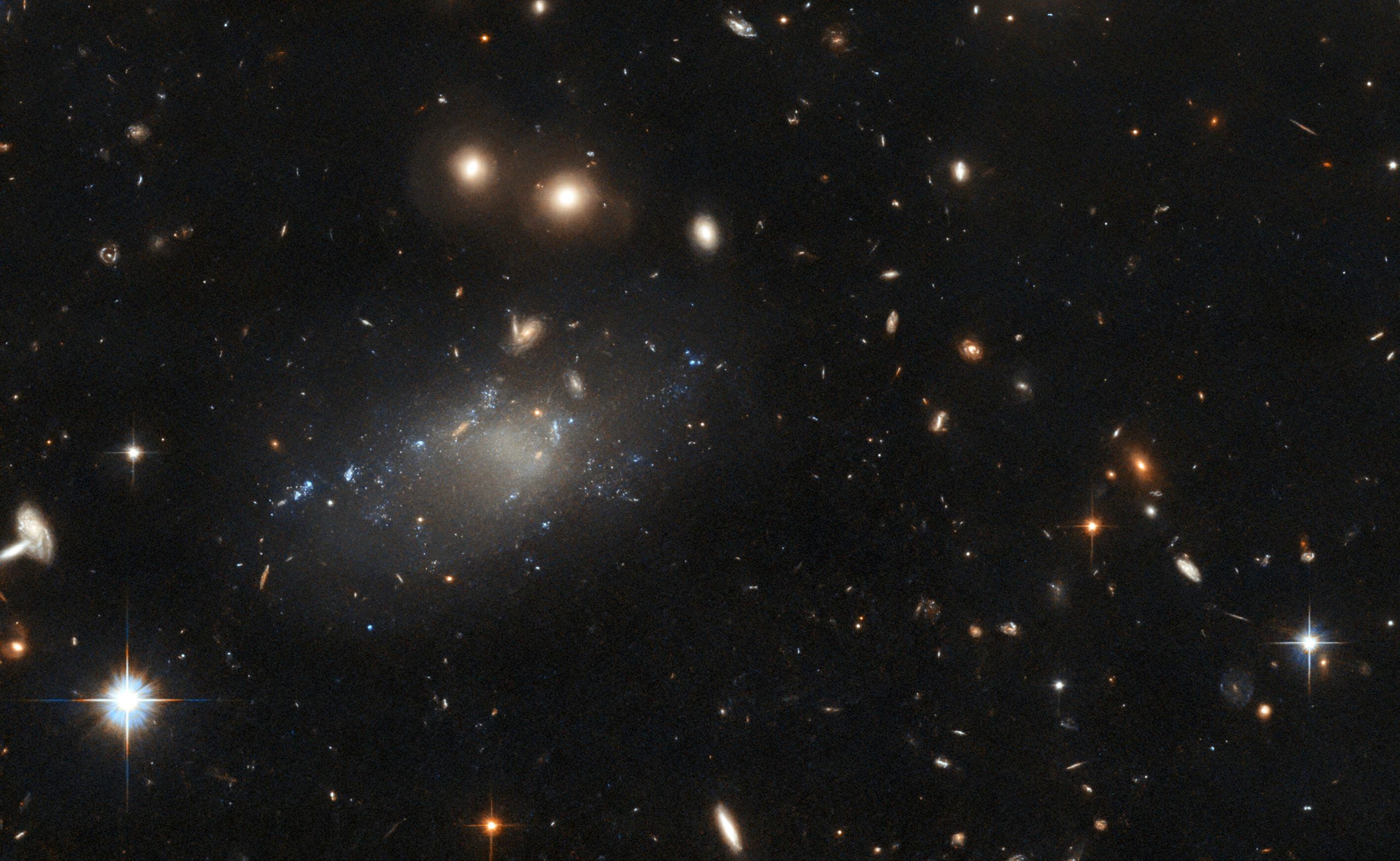
    Hubble Space Telescope captured GAMA 526784, an ultra-diffuse galaxy that appears as a tenuous patch of light in this image. This wispy object resides in the constellation Hydra, roughly four billion light-years from Earth. Ultra-diffuse galaxies such as GAMA 526784 have a number of peculiarities. Credit: ESA/Hubble & NASA, R. van der Burg, Acknowledgment: L. Shatz

    In this image from the NASA/ESA Hubble Space Telescope, the ultra-diffuse galaxy GAMA 526784 appears as a hazy patch of light. This wispy object is located in the constellation Hydra, approximately four billion light-years away from Earth.

    Ultra-diffuse galaxies such as GAMA 526784 have a number of peculiarities. For example, their dark matter abundance can be either extremely low or extremely high — ultra-diffuse galaxies have been observed with an almost complete lack of dark matter, whereas others are comprised of almost nothing but dark matter. Another peculiarity of this class of galaxies is their unusual abundance of bright globular clusters, something not observed in other types of galaxies.

    Hubble captured GAMA 526784 with the Advanced Camera for Surveys (ACS), which was installed in 2002 by astronauts during Hubble Servicing Mission 3B. Since then, the instrument has played a pivotal role in some of Hubble’s most impressive scientific results, including capturing the Hubble Ultra Deep Field. The ACS has also photographed Pluto in advance of the New Horizon mission, observed gargantuan gravitational lenses, and found fully formed galaxies in the early Universe.

    This image comes from a set of Hubble observations designed to shed light on the properties of ultra-diffuse galaxies. Hubble’s keen vision allowed astronomers to study GAMA 526784 in high resolution at ultraviolet wavelengths, helping to gauge the sizes and ages of the compact star-forming regions studding the galaxy.

    Never miss a breakthrough: Join the SciTechDaily newsletter.
    Follow us on Google and Google News.

    Astronomy European Space Agency Hubble Space Telescope NASA
    Share. Facebook Twitter Pinterest LinkedIn Email Reddit

    Related Articles

    Hubble’s Newest Discovery Isn’t a Star, It’s a Window Into the Dark Universe

    This Nearby Galaxy Shows How Frozen Clouds Ignite Into Stars

    This Chaotic Spiral Galaxy Is Still Recovering From a Cosmic Collision

    This Strange Spiral Galaxy Is Hiding a Massive Black Hole

    Hubble Zooms In on a Galaxy That Maps the Universe’s Expansion

    Hubble Captures a Dazzling Spiral Galaxy Alive With Birth and Destruction

    Hubble Spots a Glowing “Ring of Fire” in a Distant Spiral Galaxy

    Dust, Light & Ancient Collisions: The Sombrero Galaxy Like You’ve Never Seen It

    Star Formation in Motion: Hubble Reveals Spiraling Stars and Sculpted Nebulae

    Leave A Reply Cancel Reply

    • Facebook
    • Twitter
    • Pinterest
    • YouTube

    Don't Miss a Discovery

    Subscribe for the Latest in Science & Tech!

    Trending News

    Breakthrough Parkinson’s Drug Targets Disease at Its Genetic Roots

    Just 4 Weeks of Simple Diet Changes Reversed Signs of Aging in Older Adults

    Scientists May Have Finally Solved Why Humans Are Right-Handed

    NASA’s Hubble Accidentally Witnesses a Comet Shattering in Space

    Researchers Discover the Body’s Hidden “Off Switch” for Inflammation

    Scientists Discover Metformin Doesn’t Work the Way We Thought

    Tea or Coffee? Your Daily Choice Could Affect Osteoporosis Risk

    Vitamin C May Fight Cancer in a Surprising Way

    Follow SciTechDaily
    • Facebook
    • Twitter
    • YouTube
    • Pinterest
    • Newsletter
    • RSS
    SciTech News
    • Biology News
    • Chemistry News
    • Earth News
    • Health News
    • Physics News
    • Science News
    • Space News
    • Technology News
    Recent Posts
    • New Research Uncovers Lithium’s Surprising Effect on Alzheimer’s
    • New Anti-Clotting Medication Prevents Strokes Without the Usual Bleeding Risk
    • Simple Fiber Supplement Cuts Knee Arthritis Pain in Just 6 Weeks, Study Finds
    • Scientists Discover the Secret Bacteria Behind Artisan Cheeses – and They May Be Good for Your Health
    • Banned Antibiotic Discovered in Fish Raises Food Safety Concerns
    Copyright © 1998 - 2026 SciTechDaily. All Rights Reserved.
    • Science News
    • About
    • Contact
    • Editorial Board
    • Privacy Policy
    • Terms of Use

    Type above and press Enter to search. Press Esc to cancel.