
Close Menu
    Facebook X (Twitter) Instagram
    SciTechDaily
    • Biology
    • Chemistry
    • Earth
    • Health
    • Physics
    • Science
    • Space
    • Technology
    Facebook X (Twitter) Pinterest YouTube RSS
    SciTechDaily
    Home»Science»Modern Human Ancestry Cast in Doubt After Fossil Skull Discovery
    Science

    Modern Human Ancestry Cast in Doubt After Fossil Skull Discovery

    By Griffith UniversityApril 4, 2020No Comments3 Mins Read
    Facebook Twitter Pinterest Telegram LinkedIn WhatsApp Email Reddit
    Share
    Facebook Twitter LinkedIn Pinterest Telegram Email Reddit
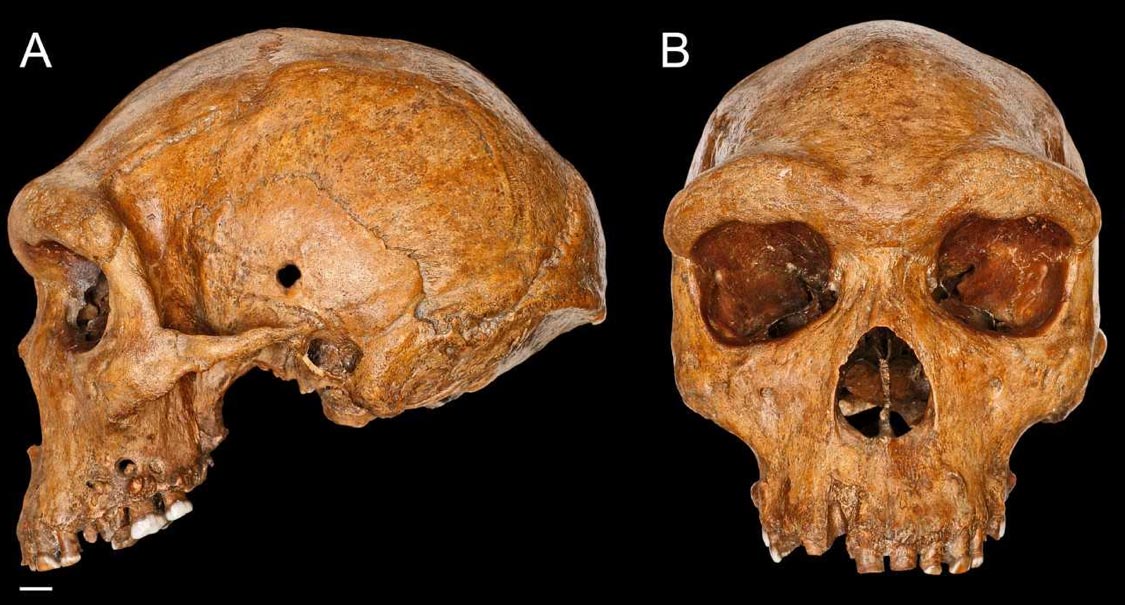
    Broken Hill Skull
    The Broken Hill (Kabwe 1) skull is one of the best-preserved fossils of Homo heidelbergensis. Credit: Natural History Museum London.

    Griffith University scientists have led an international team to date the skull of an early human found in Africa, potentially upending human evolution knowledge with their discovery.

    The Broken Hill (Kabwe 1) skull is one of the best-preserved fossils of the early human species Homo heidelbergensis and was estimated to be about 500,000 years old.

    Professor Rainer Grün from the Environmental Futures Research Institute led the team which analyzed the skull and other fossil human remains found in the vicinity including a tibia and femur midshaft fragment. The material is curated at the Natural History Museum in London, where collaborators Professor Chris Stringer and Senior Curator Michael Rumsey work.

    Discovered in 1921 by miners in Zambia, the Broken Hill remains have been difficult to date due to their haphazard recovery and the site being completely destroyed by quarrying.

    Using radiometric dating methods, Professor Grün’s analyses now puts the skull at a relatively young date, estimating it is between 274,000 and 324,000 years old.
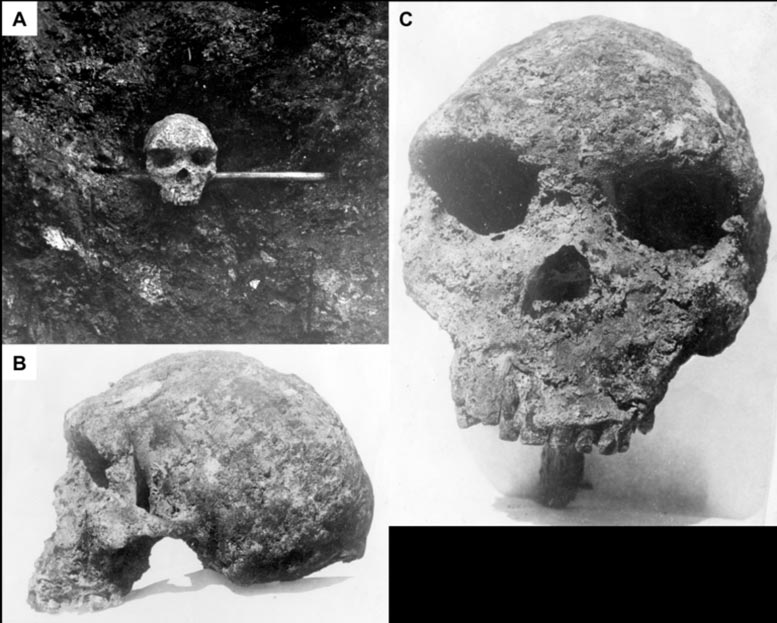
    Skull Shortly After Discovery.
    Photos of the skull shortly after its discovery.
    a, The cranium at the location in which it was found34. © Illustrated London News Ltd/Mary Evans. b, c, Frontal view (b) and lateral view (c) before the matrix was removed. Credit: Natural History Museum

    Publishing their findings and methodology in Nature, Professor Grün said “the new best age estimate of the fossil impacts our understanding of the tempo and mode of modern human origins.”

    “The Broken Hill human fossils are now within the time range of the early Middle Stone Age, challenging assumptions that only Homo sapiens made these stone tools in Africa.”

    The research also suggests that human evolution in Africa around 300,000 years ago was a much more complex process, with the co-existence of different human lineages.

    Professor Stringer said: “Previously, the Broken Hill skull was viewed as part of a gradual and widespread evolutionary sequence in Africa from archaic humans to modern humans. But now it looks like the primitive species Homo naledi survived in southern Africa, H. heidelbergensis was in Central Africa, and early forms of our species existed in regions like Morocco and Ethiopia.”

    Professor Grün said his team’s research adds to new and emerging studies which question the mode of modern human evolution in Africa and whether Homo heidelbergensis is a direct ancestor of our species.

    Reference: “Dating the skull from Broken Hill, Zambia, and its position in human evolution” by Rainer Grün, Alistair Pike, Frank McDermott, Stephen Eggins, Graham Mortimer, Maxime Aubert, Lesley Kinsley, Renaud Joannes-Boyau, Michael Rumsey, Christiane Denys, James Brink, Tara Clark and Chris Stringer, 1 April 2020, Nature.
    DOI: 10.1038/s41586-020-2165-4

    Never miss a breakthrough: Join the SciTechDaily newsletter.
    Follow us on Google and Google News.

    Archaeology Evolution Fossils Griffith University Popular Skull
    Share. Facebook Twitter Pinterest LinkedIn Email Reddit

    Related Articles

    Fossil Hotspot Bias: Are We Missing the Full Story of Human Evolution?

    The Real-Life “Hobbits” of Flores: Smallest Arm Bone in Human History Sheds Light on Mysterious Hominin Species

    Redefining Human Origins: New Study Reveals Persian Plateau as Key to Human Migration Puzzle

    Accurate Hominin Data: Getting the Fossil Record Right on Human Evolution

    Human Ancestor Fossils in the “Cradle of Humankind” May Be More Than a Million Years Older Than Thought

    Incredible Dinosaur Treasure Trove in Italy Rewrites History, Geography, and Evolution

    Incredible 635 Million-Year-Old Fungi-Like Microfossil That Bailed Our Planet Out of an Ice Age

    Fossil Discovered in the 1960s Finally Reveals Its Secrets: New Plant Species That Lived About 365 Million Years Ago

    Million-Year-Old Ash in South African Cave Yields Evidence of Cooking

    Leave A Reply Cancel Reply

    • Facebook
    • Twitter
    • Pinterest
    • YouTube

    Don't Miss a Discovery

    Subscribe for the Latest in Science & Tech!

    Trending News

    Mezcal “Worm” in a Bottle Mystery: DNA Testing Reveals a Surprise

    New Research Reveals That Your Morning Coffee Activates an Ancient Longevity Switch

    This Is What Makes You Irresistible to Mosquitoes

    Shockingly Powerful Giant Octopuses Ruled the Seas 100 Million Years Ago

    Scientists Stunned by New Organic Molecules Found on Mars

    Rewriting Dinosaur Evolution: Scientists Unearth Remarkable 150-Million-Year-Old Stegosaur Skull

    Omega-3 Supplements Linked to Cognitive Decline in Surprising New Study

    First-of-Its-Kind Discovery: Homer’s Iliad Found Embedded in a 1,600-Year-Old Egyptian Mummy

    Follow SciTechDaily
    • Facebook
    • Twitter
    • YouTube
    • Pinterest
    • Newsletter
    • RSS
    SciTech News
    • Biology News
    • Chemistry News
    • Earth News
    • Health News
    • Physics News
    • Science News
    • Space News
    • Technology News
    Recent Posts
    • Male Birth Control Breakthrough: Scientists Find Way To Turn Sperm Production Off and Back On
    • A Common Vitamin Could Hold the Key to Treating Fatty Liver Disease
    • New Research Shows Vitamin B12 May Hold the Key to Healthy Aging
    • Scientists Map Thousands of Brain Connections With RNA Barcodes
    • This Gene Tweak Turns Strawberries Into Healthier, Tastier Superfruit
    Copyright © 1998 - 2026 SciTechDaily. All Rights Reserved.
    • Science News
    • About
    • Contact
    • Editorial Board
    • Privacy Policy
    • Terms of Use

    Type above and press Enter to search. Press Esc to cancel.