
Close Menu
    Facebook X (Twitter) Instagram
    SciTechDaily
    • Biology
    • Chemistry
    • Earth
    • Health
    • Physics
    • Science
    • Space
    • Technology
    Facebook X (Twitter) Pinterest YouTube RSS
    SciTechDaily
    Home»Science»Modern Human-Like Brains Evolved Long After Earliest Humans First Dispersed From Africa
    Science

    Modern Human-Like Brains Evolved Long After Earliest Humans First Dispersed From Africa

    By American Association for the Advancement of ScienceApril 27, 2021No Comments3 Mins Read
    Facebook Twitter Pinterest Telegram LinkedIn WhatsApp Email Reddit
    Share
    Facebook Twitter LinkedIn Pinterest Telegram Email Reddit
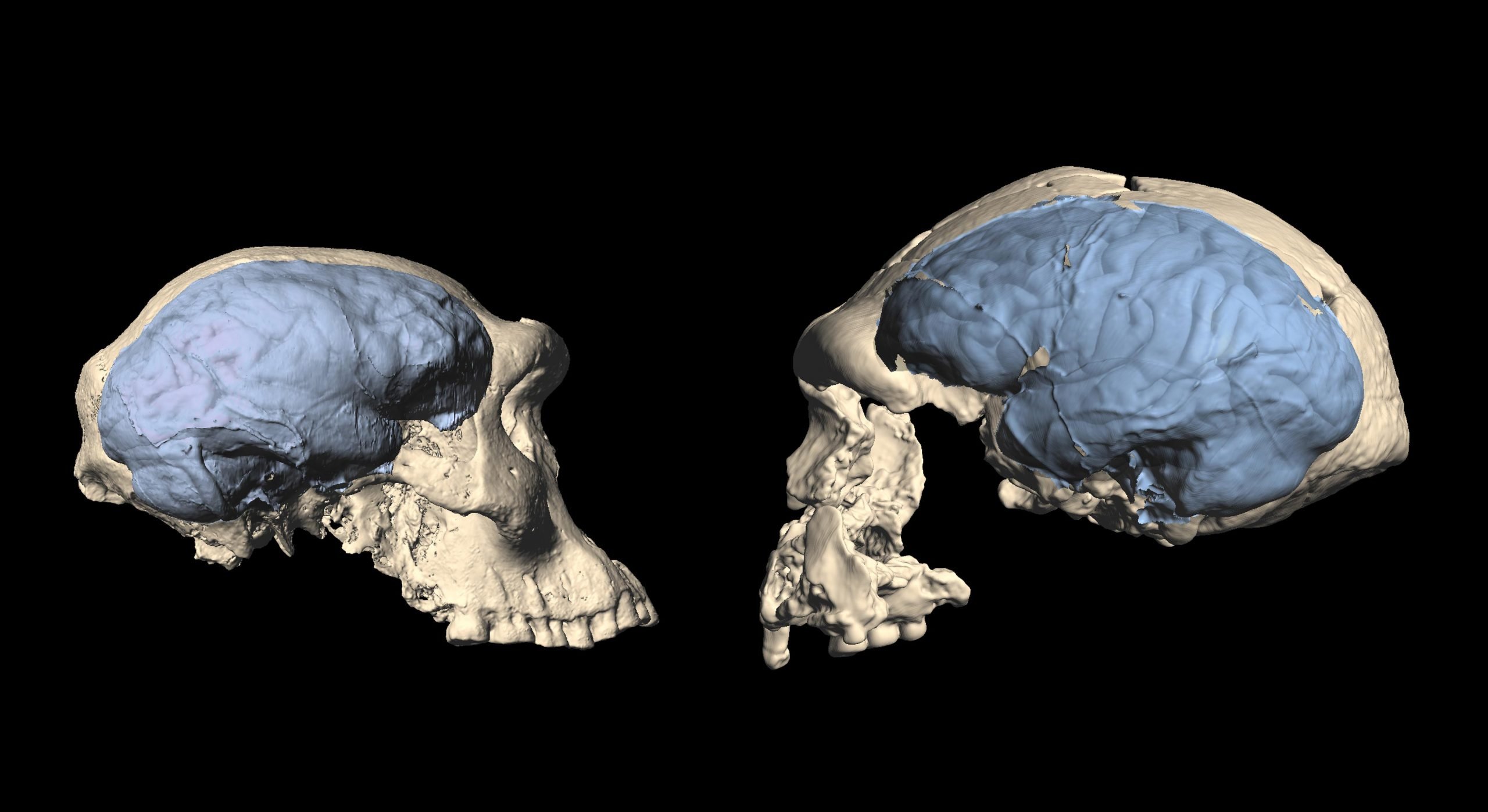
    Comparison of Early Homo Skulls
    Skulls of early Homo from Georgia with an ape-like brain (left) and from Indonesia with a human-like brain (right). Credit: M. Ponce de León and Ch. Zollikofer, UZH

    Fossil evidence shows early Homo had primitive, ape-like brains even after leaving Africa, suggesting advanced brain features evolved later than previously assumed.

    Modern human-like brains evolved comparatively late in the genus Homo and long after the earliest humans first dispersed from Africa, according to a new study.

    By analyzing the impressions left behind by the ancient brains that once sat inside now fossilized skulls, the authors discovered that the brains of the earliest Homo retained a primitive, great ape-like organization of the frontal lobe. The findings challenge the long-standing assumption that human-like brain organization is a hallmark of early Homo and suggest that the evolutionary history of the human brain is more complex than previously thought.

    Our modern brains are larger and structurally different than those of our closest living relatives, the great apes, particularly in frontal lobe areas involved with complex cognitive tasks like toolmaking and language. However, when these key differences arose during human evolution remains poorly understood.
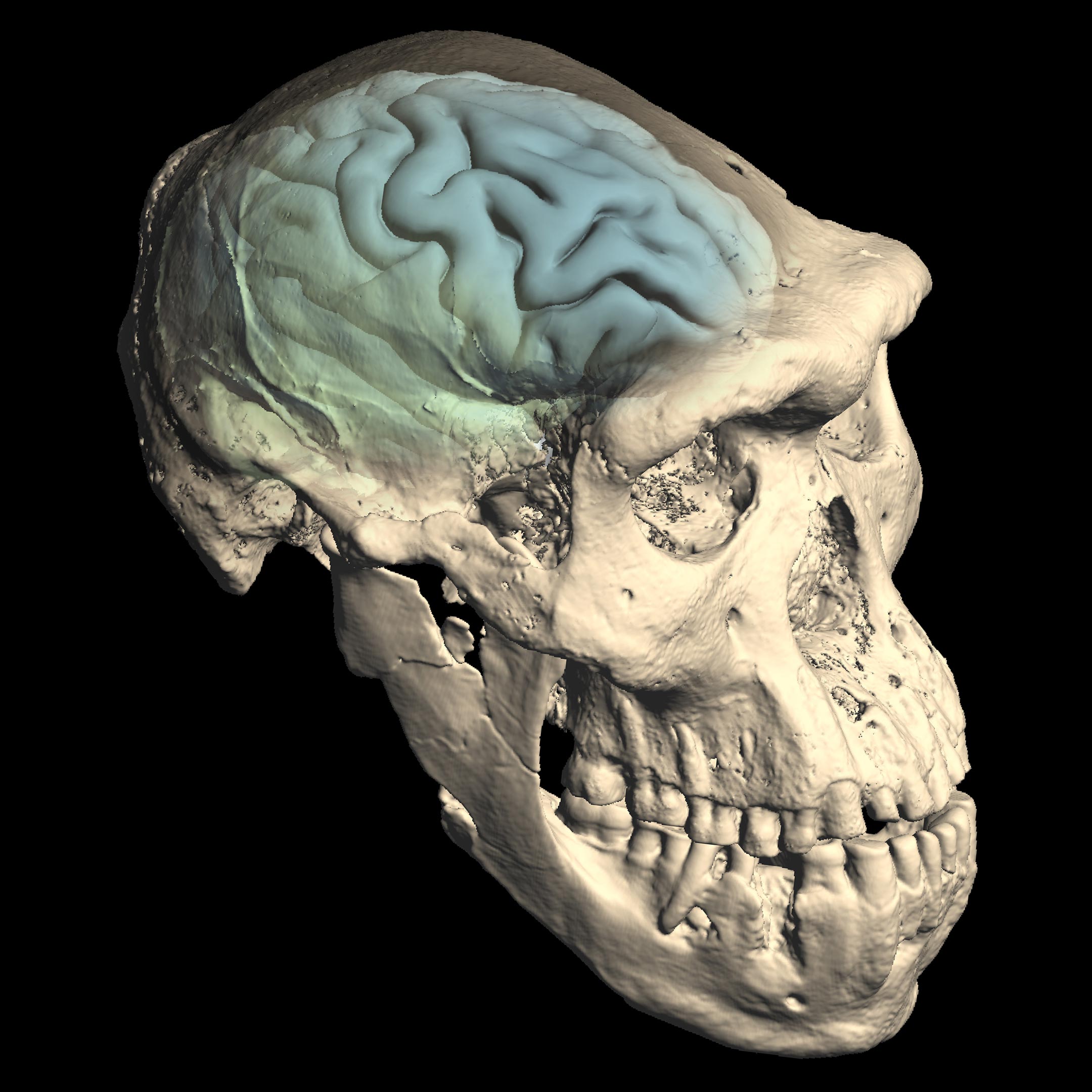
    Skull of Early Homo From Dmanisi, Georgia
    Skull of early Homo from Dmanisi, Georgia showing internal structure of the brain case, and inferred brain morphology. This has been revealed by computed tomography and virtual reconstruction. Credit: M. Ponce de León and Ch. Zollikofer, UZH

    Fossilized Skulls Reveal Brain Clues

    One of the major challenges in tracking brain evolution in early hominid species is that brain tissues rarely fossilize. As a result, much of what is known is derived from shape and structures on the surface of the brain cases of rare, fossilized skulls. Representations of these surfaces — or endocasts — can reveal patterned imprints representing the folds and indentations of the brain and its surrounding vasculature.

    Using a collection of well-preserved fossil Homo crania from the Dmanisi site in the modern-day nation of Georgia and a comparative sample of others from Africa and Southeast Asia, Marcia Ponce De León and colleagues tracked key changes in brain organization of early Homo from roughly 1.8 million years ago (Ma). They found that the structural innovations in the cerebral regions thought to allow for many of humans’ unique behaviors and abilities emerged later in the evolution of Homo.

    According to Ponce De León et al., the findings suggest that modern human-like brain reorganization — which was probably in place by 1.7-1.5 Ma — was neither a requisite trait for genus Homo, nor a prerequisite for early Homo’s dispersals into Europe and Asia. In a related Perspective, Amélie Beaudet discusses the study in greater detail.

    Read Earliest Homo Populations in Africa Had Primitive Ape-Like Brains for more on this study.

    Reference: “The primitive brain of early Homo” by Marcia S. Ponce de León, Thibault Bienvenu, Assaf Marom, Silvano Engel, Paul Tafforeau, José Luis Alatorre Warren, David Lordkipanidze, Iwan Kurniawan, Delta Bayu Murti, Rusyad Adi Suriyanto, Toetik Koesbardiati and Christoph P. E. Zollikofer, 9 April 2021, Science.
    DOI: 10.1126/science.aaz0032

    Never miss a breakthrough: Join the SciTechDaily newsletter.
    Follow us on Google and Google News.

    American Association for the Advancement of Science Anthropology Brain Evolution Paleontology
    Share. Facebook Twitter Pinterest LinkedIn Email Reddit

    Related Articles

    Ancient Human Discovery: New Fossils Reveal a Mysterious Hominin Lineage From the Levant

    First Tales of the Earliest Domesticated Goats Revealed by 10,000-Year-Old DNA

    Nuclear DNA From Cave Sediments Helps Unlock Ancient Human History

    Earliest Homo Populations in Africa Had Primitive Ape-Like Brains – Just Half the Size of Today’s Humans

    Crystals Reveal Early Humans in the Kalahari 105,000 Years Ago Were As Innovative as Their Coastal Neighbors

    A New Clue to the Timeline of Human Evolution

    Changing Landscapes, Changing Diets: Fossilized Teeth Reveal Dietary Shifts in Ancient Herbivores and Hominins

    Earliest Interbreeding Between Ancient Human Populations Discovered – Evolutionary Puzzle Solved

    New Evidence Shows Humans Mastered Fire Earlier Than Thought

    Leave A Reply Cancel Reply

    • Facebook
    • Twitter
    • Pinterest
    • YouTube

    Don't Miss a Discovery

    Subscribe for the Latest in Science & Tech!

    Trending News

    Scientists Warn That This Common Pet Fish Can Wreck Entire Ecosystems

    Scientists Make Breakthrough in Turning Plastic Trash Into Clean Fuel Using Sunlight

    This Popular Supplement May Interfere With Cancer Treatment, Scientists Warn

    Scientists Finally Solved One of Water’s Biggest Mysteries

    Could This New Weight-Loss Pill Disrupt the Entire Market? Here’s What You Should Know About Orforglipron

    Earth’s Crust Is Tearing Open in Africa, and It Could Form a New Ocean

    Breakthrough Bowel Cancer Trial Leaves Patients Cancer-Free for Nearly 3 Years

    Natural Compound Shows Powerful Potential Against Rheumatoid Arthritis

    Follow SciTechDaily
    • Facebook
    • Twitter
    • YouTube
    • Pinterest
    • Newsletter
    • RSS
    SciTech News
    • Biology News
    • Chemistry News
    • Earth News
    • Health News
    • Physics News
    • Science News
    • Space News
    • Technology News
    Recent Posts
    • Millions of People Have Osteopenia Without Realizing It – Here’s What You Need To Know
    • Researchers Discover Boosting a Single Protein Helps the Brain Fight Alzheimer’s
    • AI Detects “Invisible” Signs of Pancreatic Cancer Years Before Diagnosis
    • Kratom Use Explodes in the US, With Life-Changing Consequences
    • Scientists Uncover Fatal Weakness in “Zombie Cells” Linked to Cancer
    Copyright © 1998 - 2026 SciTechDaily. All Rights Reserved.
    • Science News
    • About
    • Contact
    • Editorial Board
    • Privacy Policy
    • Terms of Use

    Type above and press Enter to search. Press Esc to cancel.