

New approach to controlling moiré flatbands adjusts band offset of two photonic lattices.
When two lattices with distinct angles or periodicities come together, they conjure a moiré superlattice — a realm where astonishing phenomena like superconductivity and optical solitons spring to life. At the heart of this realm lies the moiré flatband, a key player in shaping advanced light–matter interactions, such as laser emission and second harmonic generation. In moiré physics and its relevant applications, wielding control over flatbands is a pivotal superpower.
Generating and Controlling Moiré Flatbands
Moiré flatbands are typically generated with special structures, often manipulated through a dance of rotation angles (magic angle) and spacings (magic distance) between the two lattice layers. Recently, a collaborative research team from University of Electronic Science and Technology of China, Anqing Normal University, Guangxi University, and Nankai University proposed a new way to control moiré flatbands, by adjusting the band offset of two photonic lattices in the parameter space.
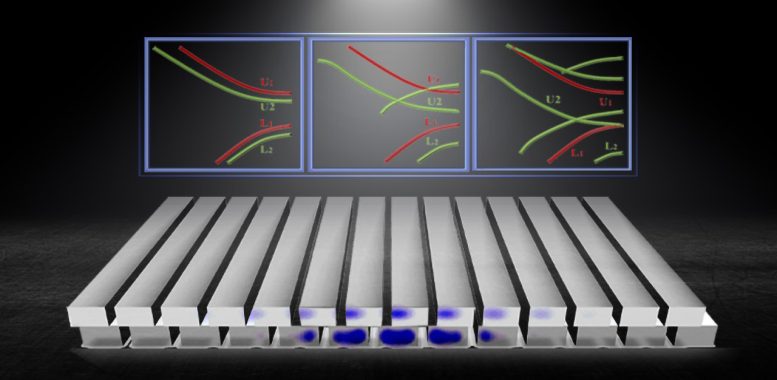
As reported in Advanced Photonics Nexus, the team discovered that, in addition to flatbands that wink in and out of existence as the band offset changes, two robust groups of flatbands can arise within a broad range of band offset. Their steady existence eases strict control of structural parameters for obtaining a nontrivial superlattice, opening new opportunities in moiré photonics. By altering structural parameters, the resonant frequencies of these robust flatbands can be adjusted, enabling the creation of novel multiresonant moiré devices.
The Research Methodology
How did they achieve this breakthrough? They started with a mismatched silicon-based bilayer moiré superlattice and adjusted the band offset by varying the thickness of one layer of the superlattices. Then, by calculating the superlattice band structure at different band offsets, they observed that band offset effectively controls the moiré flatbands, including appearance and disappearance of some flatbands in the superlattice. Simultaneously, they found that certain moiré flatbands stay steadily within a broad range of band offset.
Implications of Robust Flatbands
The robustness of these flatbands unveils a secret: crafting extraordinary moiré superlattices doesn’t require meticulous lattice control, yet it grants the power to tune moiré flatband resonance frequencies through band offset adjustments. As a testament to this power, the researchers systematically investigated the localized modes originating from the two groups of robust flatbands in moiré superlattices with finite size, confirming the feasibility of high-quality doubly resonant moiré superlattices.
Mechanism Behind Flatband Formation
To elucidate the mechanism behind robust flatband formation, the authors proposed a simple yet effective diagrammatic model based on the coupled-mode theory, taking into account the structural characteristics of the moiré superlattices. The model revealed the similarities and differences in the formation of these flatbands. For further confirmation, the authors incorporated full-wave calculations into the diagrammatic model, and successfully predicted the field distribution of these robust flatbands.
Conclusion and Future Prospects
This advance opens new horizons for uncharted paths in moiré physics: controlling moiré flatbands by tuning the band offset in parameter space is an elegantly simple method that holds the key to unlocking nontrivial superlattices and unraveling the mysteries of flatband emergence and disappearance. With the frequencies of these flatbands now under our command, a realm of multi-resonant and high-quality moiré superlattices emerges. But there’s more — the diagrammatic model isn’t just a tool; it’s a window into the world of flatband formation across diverse moiré superlattices. This research promises to inspire future explorations into innovative moiré devices and the captivating realm of moiré physics.
Reference: “Robust moiré flatbands within a broad band-offset range” by Peilong Hong, Yi Liang, Zhigang Chen, Guoquan Zhang , 28 September 2023, Advanced Photonics Nexus.
DOI: 10.1117/1.APN.2.6.066001
Never miss a breakthrough: Join the SciTechDaily newsletter.
Follow us on Google and Google News.