

Close Menu
    Facebook X (Twitter) Instagram
    SciTechDaily
    • Biology
    • Chemistry
    • Earth
    • Health
    • Physics
    • Science
    • Space
    • Technology
    Facebook X (Twitter) Pinterest YouTube RSS
    SciTechDaily
    Home»Physics»More Efficient Carbon Capture: Cleaning Up the Atmosphere With Quantum Computing
    Physics

    More Efficient Carbon Capture: Cleaning Up the Atmosphere With Quantum Computing

    By American Institute of PhysicsMarch 14, 2023No Comments3 Mins Read
    Facebook Twitter Pinterest Telegram LinkedIn WhatsApp Email Reddit
    Share
    Facebook Twitter LinkedIn Pinterest Telegram Email Reddit
    Earth Planet Atmosphere Carbon Capture Technology Illustration
    Scientists are attempting to use quantum computing technology to solve a practical environmental problem: reducing the amount of carbon dioxide in the atmosphere. They are using a quantum computer algorithm to find useful amine compounds for improved atmospheric carbon capture.

    A quantum computing algorithm could identify better compounds for more efficient carbon capture.

    The amount of carbon dioxide in the atmosphere increases daily with no sign of stopping or slowing. Too much of civilization depends on the burning of fossil fuels, and even if we can develop a replacement energy source, much of the damage has already been done. Without removal, the carbon dioxide already in the atmosphere will continue to wreak havoc for centuries.

    Atmospheric carbon capture is a potential remedy to this problem. It would pull carbon dioxide out of the air and store it permanently to reverse the effects of climate change. Practical carbon capture technologies are still in the early stages of development, with the most promising involving a class of compounds called amines that can chemically bind with carbon dioxide. Efficiency is paramount in these designs, and identifying even slightly better compounds could lead to the capture of billions of tons of additional carbon dioxide.
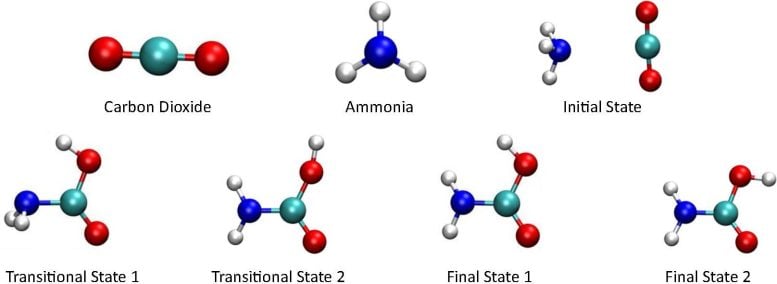
    Molecular Representations of Simple Reaction Involving Carbon Dioxide and Ammonia
    Molecular representations of a simple reaction involving carbon dioxide and ammonia. Credit: Nguyen et al.

    Quantum Computing to Accelerate Carbon Capture Research

    In AVS Quantum Science, by AIP Publishing, researchers from the National Energy Technology Laboratory and the University of Kentucky deployed an algorithm to study amine reactions through quantum computing. The algorithm can be run on an existing quantum computer to find useful amine compounds for carbon capture more quickly.

    “We are not satisfied with the current amine molecules that we use for this [carbon capture] process,” said author Qing Shao. “We can try to find a new molecule to do it, but if we want to test it using classical computing resources, it will be a very expensive calculation. Our hope is to have a fast algorithm that can screen thousands of new molecules and structures.”

    Any computer algorithm that simulates a chemical reaction needs to account for the interactions between every pair of atoms involved. Even a simple three-atom molecule like carbon dioxide bonding with the simplest amine, ammonia, which has four atoms, results in hundreds of atomic interactions. This problem vexes traditional computers but is exactly the sort of question at which quantum computers excel.

    Innovative Algorithms for Practical Quantum Applications

    However, quantum computers are still a developing technology and are not powerful enough to handle these kinds of simulations directly. This is where the group’s algorithm comes in: It allows existing quantum computers to analyze larger molecules and more complex reactions, which is vital for practical applications in fields like carbon capture.

    “We are trying to use the current quantum computing technology to solve a practical environmental problem,” said author Yuhua Duan.

    Reference: “Description of reaction and vibrational energetics of CO2-NH3 interaction using quantum computing algorithms” is authored by Manh Tien Nguyen, Yueh-Lin Lee, Dominic Alfonso, Qing Shao and Yuhua Duan, 14 March 2023, AVS Quantum Science.
    DOI: 10.1116/5.0137750

    Never miss a breakthrough: Join the SciTechDaily newsletter.
    Follow us on Google and Google News.

    Algorithm American Institute of Physics Atmospheric Science Carbon Capture Carbon Dioxide Quantum Computing
    Share. Facebook Twitter Pinterest LinkedIn Email Reddit

    Related Articles

    How Sonic Technology Is Advancing Wind Detection on Mars

    Magnesium Oxide: The Key to Efficient Carbon Capture?

    New Quantum Computer Algorithm Unlocks the Power of Atomic-Level Interactions

    Quantum Behavior of Massive Objects: Gravitational Wave Mirror Experiments Can Evolve Into Quantum Entities

    Capturing Atmospheric Carbon Dioxide and Transforming It Into Industrially Useful Materials

    Artificial Intelligence Algorithm Helps Unravel the Physics Underlying Quantum Systems

    How a Quantum Physicist Invented New Code to Achieve What Many Thought Was Impossible

    Galileo’s Jupiter Entry Probe Vaporized – New Gaps Revealed in Heat Shield Modeling

    Evidence of Elusive Majorana Fermions Raises Possibilities for Quantum Computing

    Leave A Reply Cancel Reply

    • Facebook
    • Twitter
    • Pinterest
    • YouTube

    Don't Miss a Discovery

    Subscribe for the Latest in Science & Tech!

    Trending News

    The Strange “Spacetime Crystal” That Can Suddenly Turn Into a Black Hole

    The Surprising Way Asteroids May Have Helped Life Begin on Earth

    Vast Hidden Structure Discovered Under Miles of Ice in East Antarctica

    A Surprising Discovery Suggests Autism Is Not One Condition

    New Alzheimer’s Discovery Could Change How Scientists Fight the Disease

    Yale Discovery Overturns Long-Held “Evolutionary Dead End” Theory

    UCLA Scientists Uncover a “Hidden Weakness” in Some of the World’s Deadliest Cancers

    Humpback Whale Stuns Scientists With 15,000 Kilometer Journey Across Oceans

    Follow SciTechDaily
    • Facebook
    • Twitter
    • YouTube
    • Pinterest
    • Newsletter
    • RSS
    SciTech News
    • Biology News
    • Chemistry News
    • Earth News
    • Health News
    • Physics News
    • Science News
    • Space News
    • Technology News
    Recent Posts
    • Is Planet Nine Real? New Discovery at the Edge of the Solar System Adds a Twist
    • AI Learned the Rules of the Universe and That Became a Problem
    • Scientists Mapped Every Neuron in a Fruit Fly and the Brain Wasn’t Running the Show
    • Stanford Scientists Discover Explosive New Type of Immune Cell
    • Scientists Found a Hidden Brain Signal That Predicts Social Behavior
    Copyright © 1998 - 2026 SciTechDaily. All Rights Reserved.
    • Science News
    • About
    • Contact
    • Editorial Board
    • Privacy Policy
    • Terms of Use

    Type above and press Enter to search. Press Esc to cancel.