
Close Menu
    Facebook X (Twitter) Instagram
    SciTechDaily
    • Biology
    • Chemistry
    • Earth
    • Health
    • Physics
    • Science
    • Space
    • Technology
    Facebook X (Twitter) Pinterest YouTube RSS
    SciTechDaily
    Home»Science»More Than 80 Feet Long – Newly Discovered Ichthyosaur May Be the Largest Marine Reptile Ever
    Science

    More Than 80 Feet Long – Newly Discovered Ichthyosaur May Be the Largest Marine Reptile Ever

    By PLOSApril 24, 20242 Comments3 Mins Read
    Facebook Twitter Pinterest Telegram LinkedIn WhatsApp Email Reddit
    Share
    Facebook Twitter LinkedIn Pinterest Telegram Email Reddit
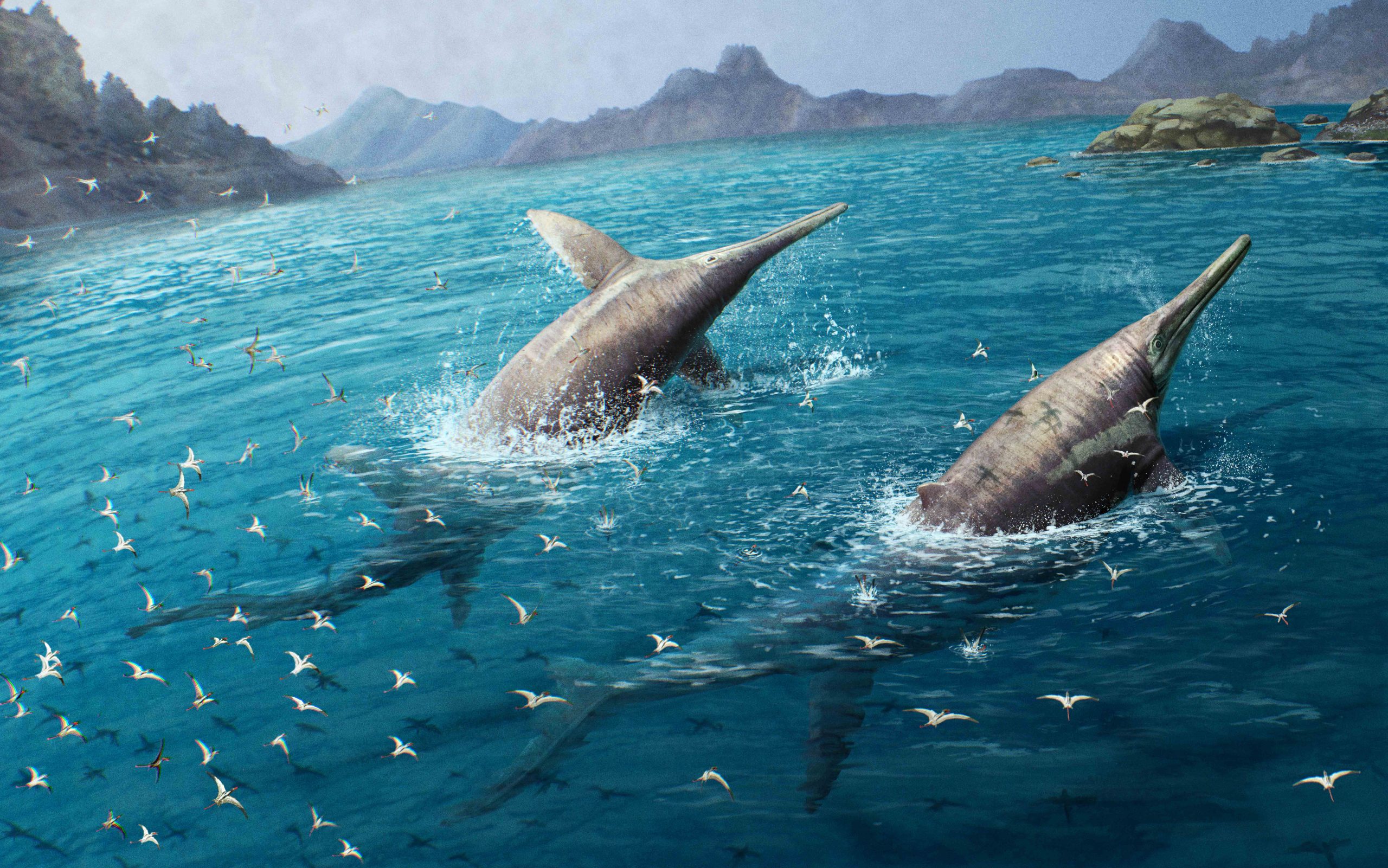
    Giant Pair of Swimming Ichthyotitan severnensis
    A new species of ichthyosaur, possibly the largest marine reptile ever, has been discovered in the UK. Named Ichthyotitan severnensis, it could have measured up to 25 meters in length, based on jawbone fragments found in Somerset. Further discoveries could provide more insights into these ancient giants. A giant pair of swimming Ichthyotitan severnensis. Credit: Gabriel Ugueto, CC-BY 4.0

    The enormous ichthyosaur could have reached lengths exceeding 80 feet (25 meters) and existed during the Late Triassic period.

    A recently identified ichthyosaur species may be the largest marine reptile ever recorded, suggests a study recently published in the open-access journal PLOS ONE. The research, conducted by Dean R. Lomax and his team from the University of Bristol and the University of Manchester, UK, adds significant insights into the dimensions of prehistoric marine life.

    Over the past few years, Lomax and his research team discovered and pieced together individual fragments of an ichthyosaur jawbone from the Westbury Mudstone Formation in Somerset, UK. The new bone was similar in size and shape to another jawbone collected from the same rock formation just a few miles away — and the researchers now believe these two jawbones belong to a previously undescribed species of ichthyosaur, a group of massive, ocean-dwelling reptiles from the age of the dinosaurs.

    The Size of Ichthyotitan severnensis

    Based on the length of these bones, the new species, named Ichthyotitan severnensis, may have been a whopping 25 meters (82 feet) long, or twice the length of a city bus. However, since the new species is being described solely via limited bone fragments, the study authors stress that further paleontological evidence is needed to confirm just how large I. severnensis likely was.
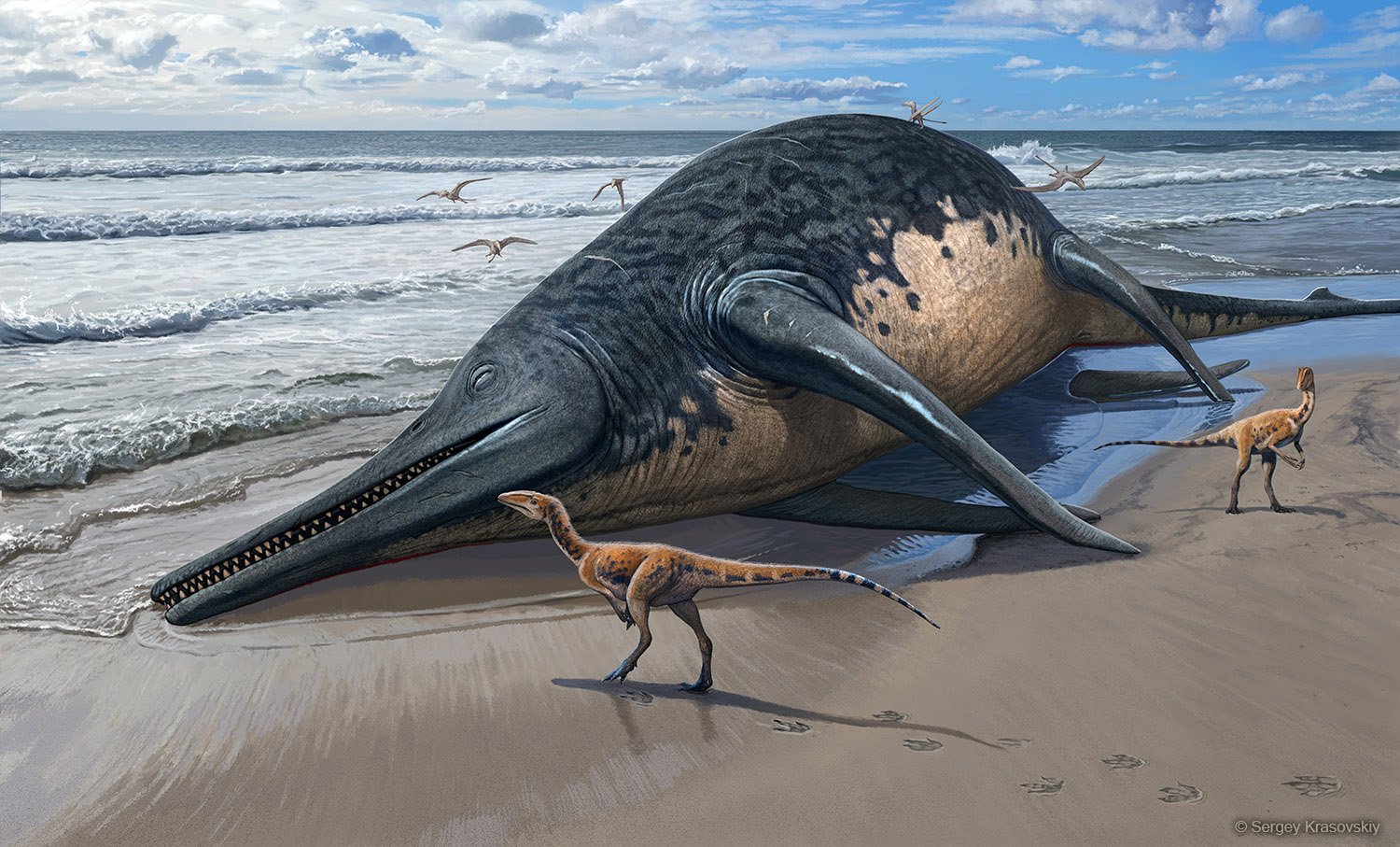
    Washed Up Ichthyotitan severnensis Carcass
    A washed-up Ichthyotitan severnensis carcass on the beach. Credit: Sergey Krasovskiy, CC-BY 4.0

    Ichthyosaurs, many of which looked like modern-day dolphins, first evolved during the early Triassic period around 250 million years ago. Within a few million years, some ichthyosaurs had evolved to reach at least 15 meters (49 feet) long, and by the Late Triassic (roughly 200 million years ago), the largest ichthyosaurs had evolved, including the newly described I. severnensis. This reign didn’t necessarily last long, however. While some species of ichthyosaur continued to roam the oceans for millions of years, these “giant ichthyosaurs” are believed to have gone extinct during the Triassic-Jurassic extinction event 200 million years ago — and this unique group of marine reptiles never again reached such a gargantuan size.

    Dr. Dean Lomax adds: “In 2018, my team (including Paul de la Salle) studied and described Paul’s giant jawbone and we had hoped that one day another would come to light. This new specimen is more complete, better preserved, and shows that we now have two of these giant bones (called a surangular) that have a unique shape and structure. It is quite remarkable to think that gigantic, blue whale-sized ichthyosaurs were swimming in the oceans around what was the UK during the Triassic Period. These jawbones provide tantalizing evidence that perhaps one day a complete skull or skeleton of one of these giants might be found. You never know.”

    Reference: “The last giants: New evidence for giant Late Triassic (Rhaetian) ichthyosaurs from the UK” by Dean R. Lomax, Paul de la Salle, Marcello Perillo, Justin Reynolds, Ruby Reynolds and James F. Waldron, 17 April 2024, PLOS ONE.
    DOI: 10.1371/journal.pone.0300289

    Never miss a breakthrough: Join the SciTechDaily newsletter.
    Follow us on Google and Google News.

    Fossils Ichthyosaurs Paleontology PLOS
    Share. Facebook Twitter Pinterest LinkedIn Email Reddit

    Related Articles

    Scientists Discover 82-Feet-Long Ancient “Giant Fish Lizard” in the UK

    Mystery Solved? Scientists Shed New Light on Mysterious Giant Bones That Have Puzzled Paleontologists for 150 Years

    Debunking the Myth: Was Spinosaurus Really a “7-Ton Heron From Hell?”

    Unveiling Europe’s Oldest Hippo: A Middle Pleistocene Mystery Solved

    Scientists Discover Ancient Parasites in 200-Million-Year-Old Fossil Poop

    Scientists Identify 240-Million-Year-Old Mystery Ancient Marine Reptile

    Dinosaur “Mummies” Might Not Be Unusual – Unhealed Carnivore Damage on Dinosaur Skin

    Scientists Discover Fish-Like Marine Reptile Buried in Its Own Blubber 150 Million Years Ago

    Surprising Diversity of Cretaceous Reptiles at Argentina Fossil Site – Revealed by Discovery of Ancient Teeth

    2 Comments

    1. Iuhnnhinuhnuhiniu on April 25, 2024 4:35 pm

      Hi, this is really amazing! We keep on discovering new species from the past!

      Reply
      • Joe Biden on April 25, 2024 4:36 pm

        True!

        Reply
    Leave A Reply Cancel Reply

    • Facebook
    • Twitter
    • Pinterest
    • YouTube

    Don't Miss a Discovery

    Subscribe for the Latest in Science & Tech!

    Trending News

    Bone-Strengthening Discovery Could Reverse Osteoporosis

    Scientists Uncover Hidden Trigger Behind Stem Cell Aging

    Scientists Find Way to Reverse Fatty Liver Disease Without Changing Diet

    Could Humans Regrow Limbs? New Study Reveals Promising Genetic Pathway

    Scientists Reveal Eating Fruits and Vegetables May Increase Your Risk of Lung Cancer

    Scientists Reverse Brain Aging With Simple Nasal Spray

    Scientists Uncover Potential Brain Risks of Popular Fish Oil Supplements

    Scientists Discover a Surprising Way To Make Bread Healthier and More Nutritious

    Follow SciTechDaily
    • Facebook
    • Twitter
    • YouTube
    • Pinterest
    • Newsletter
    • RSS
    SciTech News
    • Biology News
    • Chemistry News
    • Earth News
    • Health News
    • Physics News
    • Science News
    • Space News
    • Technology News
    Recent Posts
    • 5 Common Myths About Learning a New Language, Debunked
    • The Neanderthal “Love Story” Isn’t What It Seems
    • Scientists Unlock Hidden Secrets of 2,300-Year-Old Mummies Using Cutting-Edge CT Scanner
    • Men vs. Women: Scientists Uncover Dramatic Differences in How the Immune System Ages
    • Eating Chili Peppers Linked to Longer Life
    Copyright © 1998 - 2026 SciTechDaily. All Rights Reserved.
    • Science News
    • About
    • Contact
    • Editorial Board
    • Privacy Policy
    • Terms of Use

    Type above and press Enter to search. Press Esc to cancel.