
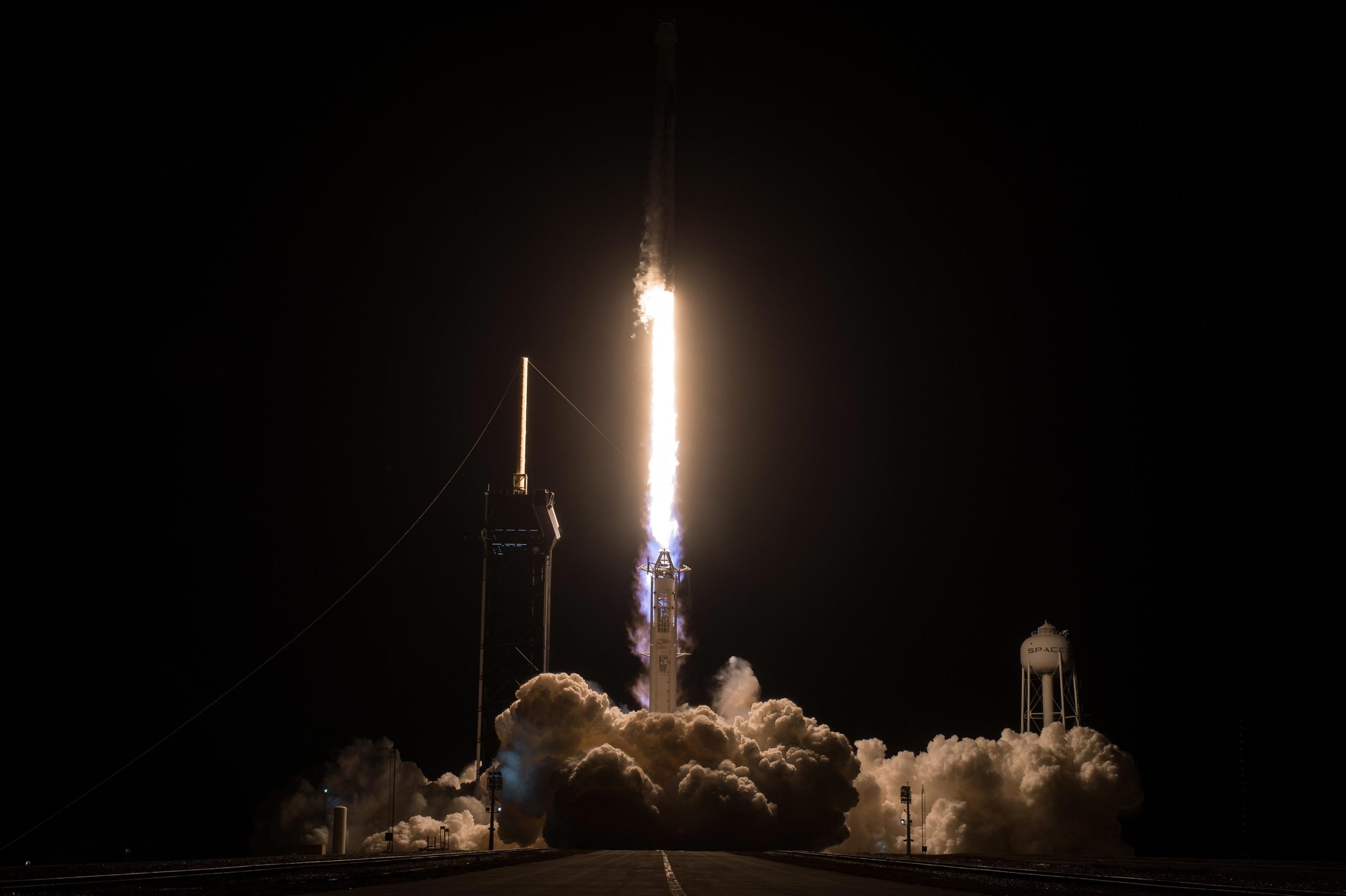
Crew-3 Launches to the Space Station
A SpaceX Falcon 9 rocket carrying the company’s Crew Dragon spacecraft is launched on NASA’s SpaceX Crew-3 mission to the International Space Station with NASA astronauts Raja Chari, Tom Marshburn, Kayla Barron, and ESA (European Space Agency) astronaut Matthias Maurer onboard, Wednesday, November 10, 2021, at NASA’s Kennedy Space Center in Florida. NASA’s SpaceX Crew-3 mission is the third crew rotation mission of the SpaceX Crew Dragon spacecraft and Falcon 9 rocket to the International Space Station as part of the agency’s Commercial Crew Program. Chari, Marshburn, Barron, Maurer launched at 9:03 p.m. EST from Launch Complex 39A at the Kennedy Space Center to begin a six month mission onboard the orbital outpost.

Mocha Swirls in Jupiter’s Turbulent Atmosphere
During its 36th low pass over Jupiter, NASA’s Juno spacecraft captured this view of striking cloud bands and swirls in the giant planet’s mid-southern latitudes. The dark, circular vortex near the center of the image is a cyclone that spans roughly 250 miles (about 400 kilometers). The color at its center is likely to be the result of descending winds that cleared out upper-level clouds, revealing darker material below.
Citizen scientist Brian Swift used a raw JunoCam image digitally projected onto a sphere to create this view. It has been rotated so that north is up. The original image was taken on September 2, 2021, at 4:09 p.m. PDT (7:09 p.m. EDT). At the time, the spacecraft was about 16,800 miles (about 27,000 kilometers) above Jupiter’s cloud tops, at a latitude of about 31 degrees south.
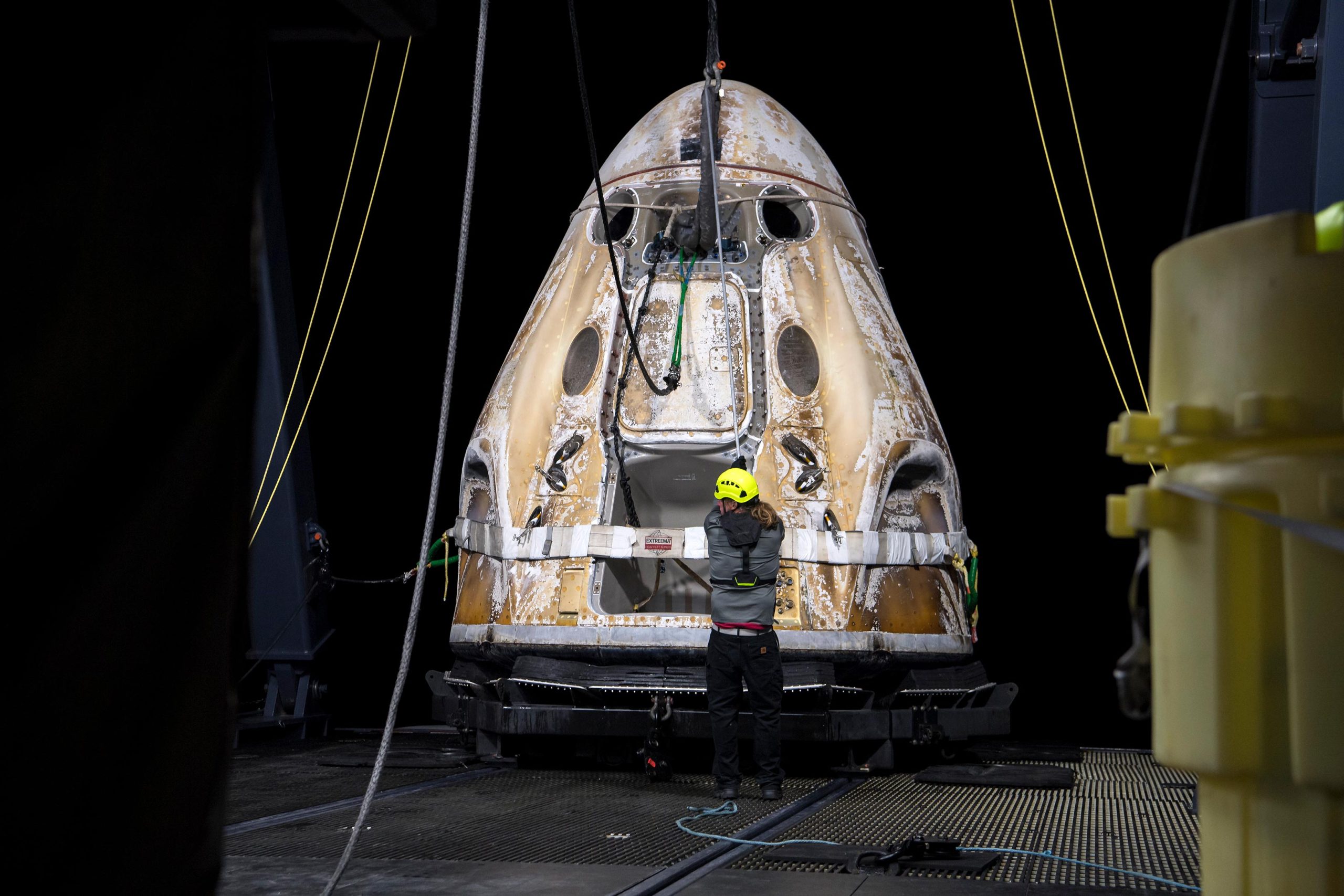
Crew Dragon Endeavour Recovered After a Successful Splashdown
The SpaceX Crew Dragon Endeavour spacecraft is lifted onto the GO Navigator recovery ship after it landed with NASA astronauts Shane Kimbrough and Megan McArthur, Japan Aerospace Exploration Agency (JAXA) astronaut Aki Hoshide, and ESA (European Space Agency) astronaut Thomas Pesquet in the Gulf of Mexico off the coast of Pensacola, Florida, Monday, November 8, 2021. Kimbrough, McArthur, Hoshide, and Pesquet traveled 84,653,119 statute miles during their mission, stayed 198 days aboard the space station, and completed 3,194 orbits around Earth.
NASA’s SpaceX Crew-2 mission is the second operational mission of the SpaceX Crew Dragon spacecraft and Falcon 9 rocket to the International Space Station as part of the agency’s Commercial Crew Program, which has worked with the U.S. aerospace industry to launch astronauts on American rockets and spacecraft from American soil to the space station. The splashdown of Crew-2 comes just before the launch of NASA’s SpaceX Crew-3 mission, which recently launched, on another long duration mission of approximately six months.

Spotted by Hubble: Dark Star-Hatching frEGGs
This image shows knots of cold, dense interstellar gas where new stars are forming. These Free-floating Evaporating Gaseous Globules (frEGGs) were first seen in Hubble’s famous 1995 image of the Eagle Nebula. Because these lumps of gas are dark, they are rarely seen by telescopes. They can be observed when the newly forming stars ignite, their intense ultraviolet radiation eroding the surrounding gas away and letting the denser, more resistant frEGGs remain. The frEGGs seen in this image are located in the Northern Coalsack Nebula in the direction of Cygnus, the Swan.
This Hubble image also features two giant stars. The left star is a rare, giant O-type star, which are very bright, blue-white stars known to be the hottest in the universe. These massive stars are 10,000 to a million times the brightness of the Sun and burn themselves out quickly, in a few million years. The right star is an even more massive supergiant B-type star. Supergiant stars also burn through their fuel quickly, anywhere between a few hundred thousand years to tens of millions of years, and die in titanic supernova explosions.

Particles From the Sun Produce Light Show on Earth
The aurora borealis glow on the northern horizon while stars wheel overhead in this long exposure, taken near the Bonneville Salt Flats in Utah on November 4, 2021. Sky watchers in many locations were treated to unusually intense light displays, thanks to a geomagnetic storm created when multiple coronal mass ejections (CMEs) of charged particles from the Sun interacted with Earth’s magnetic field.
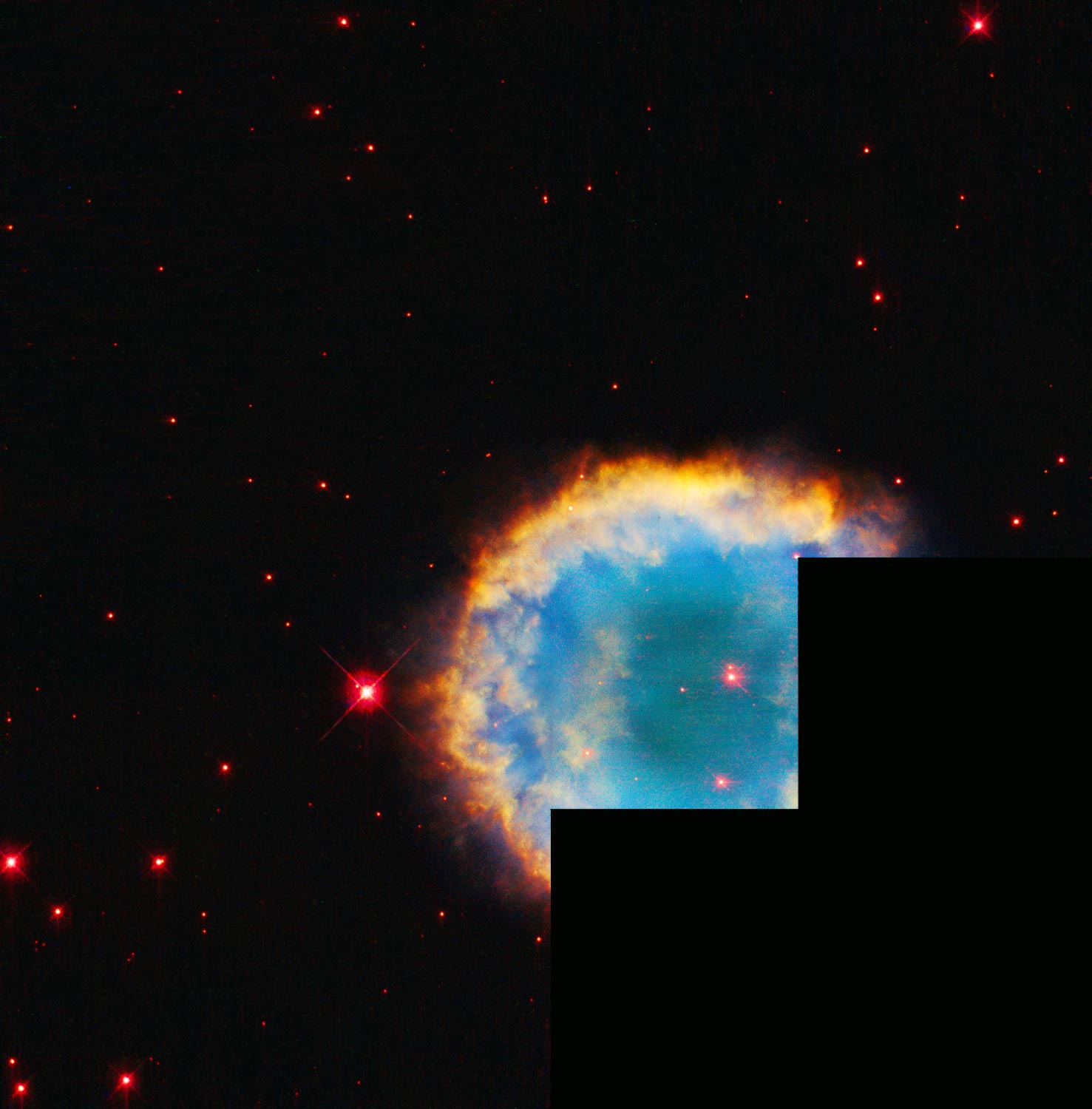
Hubble Images Colorful Planetary Nebula Ringed by Hazy Halo
NGC 2438 is a planetary nebula, formed after the death of a Sun-like star. The medium-sized star would have expelled its outer layers of gas into space as it died, leaving behind a white-dwarf core. A halo of glowing gas over 4.5 light-years across surrounds the nebula’s brighter inner ring. Many round or nearly round planetary nebulae display these halo structures, and astronomers have been investigating how they evolve. NGC 2438 was one of the nebulae studied, and researchers found that the nebula’s halo glows due to the ionizing radiation of the central white dwarf.
In this color-filled image, blue represents oxygen (O III), green is hydrogen (H-alpha), orange is nitrogen (N II), and red is sulfur (S II).
This Hubble Space Telescope image was captured by Hubble’s Wide Field and Planetary Camera 2, which gave it its distinctive stair-shape. One of the camera’s four detectors provided a magnified view, which would be shrunk down in the final image to match the other three, creating the unique shape.
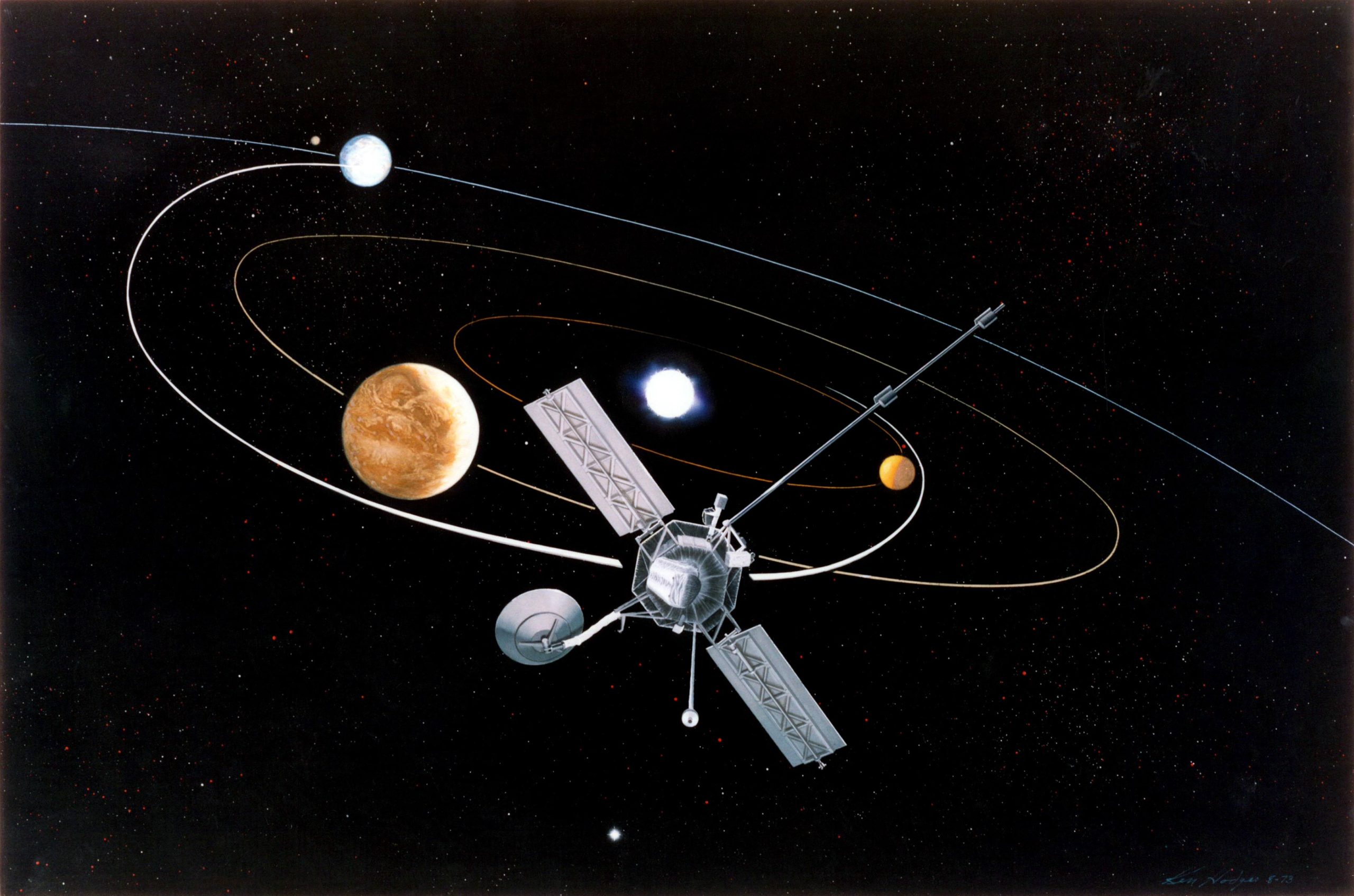
Mariner 10: First Mission to Use an Interplanetary Gravity Assist
This artists’ impression is of the Mariner 10 mission. Mariner 10, which launched on November 3, 1972, was the first mission to perform an interplanetary gravity assist, using a flyby of the planet Venus to alter its path to meet Mercury. This allowed the spacecraft to meet Mercury on three occasions in 1974 and 1975.

An Aurora Seen From Space
In this image taken on October 30, 2021, an aurora dimly intersected with Earth’s airglow as the International Space Station flew into an orbital sunrise 264 miles above the Pacific Ocean before crossing over Canada.
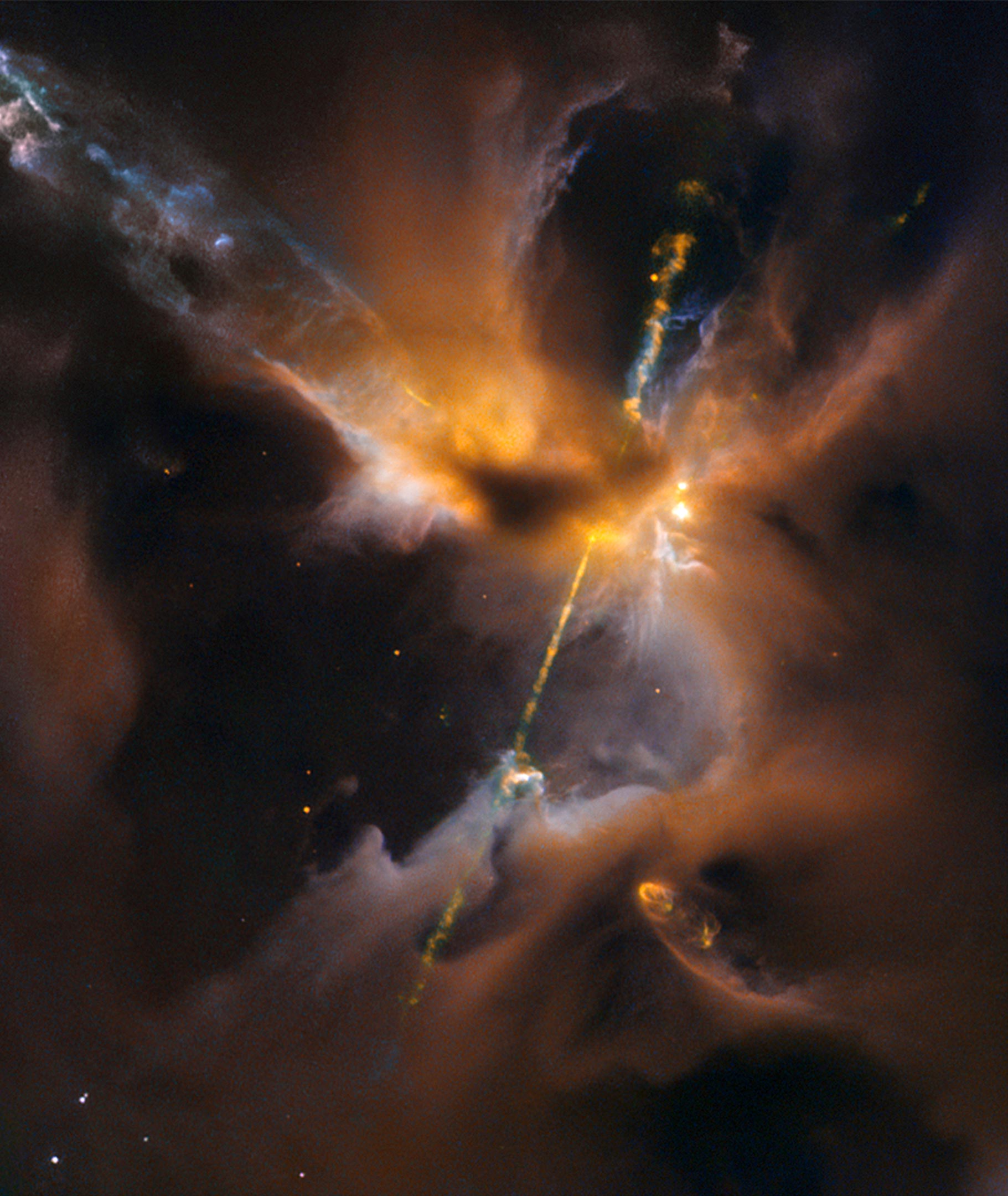
The Force Awakens in a Newborn Star
This celestial lightsaber does not lie in a galaxy far, far away, but rather inside our home galaxy, the Milky Way. It’s inside a turbulent birthing ground for new stars known as the Orion B molecular cloud complex, located 1,350 light-years away.
Never miss a breakthrough: Join the SciTechDaily newsletter.
Follow us on Google and Google News.
1 Comment
I enjoy cytec daily. Can I share this information?