
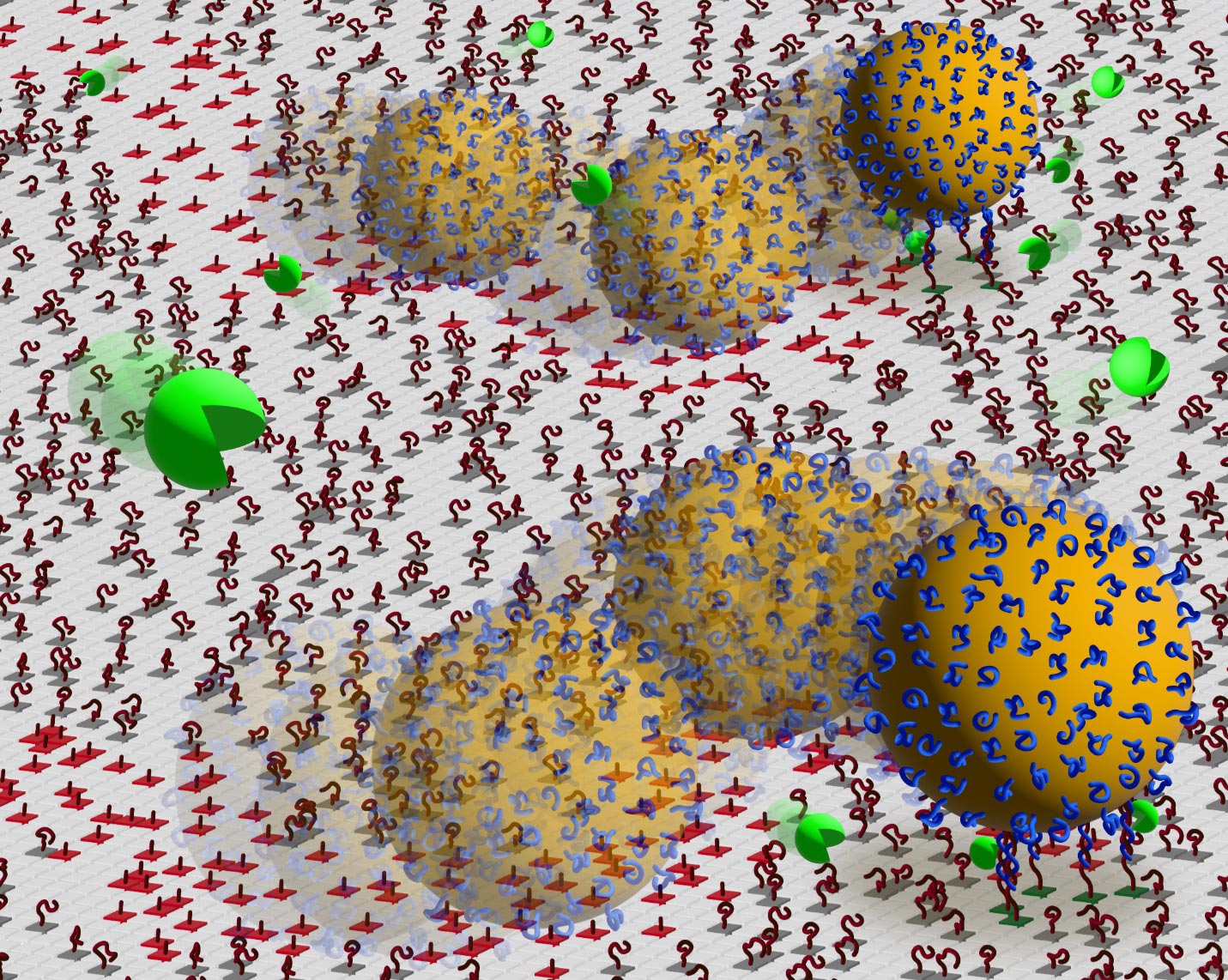
Researchers leverage their understanding of molecular motors to improve nanoscale artificial motors, aiming to bridge the speed gap between artificial motors and motor proteins.
DNA-nanoparticle motors are exactly what they sound like: tiny artificial motors that harness the structures of DNA and RNA to generate motion through enzymatic RNA degradation. In simple terms, they convert chemical energy into mechanical motion by biasing Brownian motion.
These motors operate via a mechanism known as the “burnt-bridge” Brownian ratchet. In this process, the motor moves forward as it “burns” the molecular bonds (or “bridges”) it encounters along its substrate. This degradation biases the random motion, effectively propelling the motor in one direction.
DNA-nanoparticle motors are highly programmable and have potential applications in molecular computation, diagnostics, and targeted transport. However, they lack the speed and efficiency of their natural counterparts, motor proteins, which presents a significant challenge.
This is where researchers come in to analyze, optimize, and rebuild a faster artificial motor using single-particle tracking experiment and geometry-based kinetic simulation.
The Speed Bottleneck
“Natural motor proteins play essential roles in biological processes, with a speed of 10-1000 nm/s. Until now, artificial molecular motors have struggled to approach these speeds, with most conventional designs achieving less than 1 nm/s,” said Takanori Harashima, researcher and first author of the study.
Researchers published their work in Nature Communications on January 16th, 2025, featuring a proposed solution to the most pressing issue of speed: switching the bottleneck.
The experiment and simulation revealed that the binding of RNase H is the bottleneck in which the entire process is slowed. RNase H is an enzyme involved in genome maintenance and breaks down RNA in RNA/DNA hybrids in the motor. The slower RNase H binding occurs, the longer the pauses in motion, which is what leads to a slower overall processing time. By increasing the concentration of RNase H, the speed was markedly improved, showing a decrease in pause lengths from 70 seconds to around 0.2 seconds.
However, increasing motor speed came at the cost of processivity (the number of steps before detachment) and run-length (the distance the motor travels before detachment). Researchers found that this trade-off between speed and processivity/run-length could be improved by a larger DNA/RNA hybridization rate, bringing the simulated performance closer to that of a motor protein.
Trade-Offs and Optimizations
The engineered motor, with redesigned DNA/RNA sequences and a 3.8-fold increase in hybridization rate, achieved a speed of 30 nm/s, 200 processivity, and a 3 μm run-length. These results demonstrate that the DNA-nanoparticle motor is now comparable to a motor protein in performance.
“Ultimately, we aim to develop artificial molecular motors that surpass natural motor proteins in performance,” said Harashima. These artificial motors can be very useful in molecular computations based on the motion of the motor, not to mention their merit in the diagnosis of infections or disease-related molecules with a high sensitivity.
The experiment and simulation done in this study provide an encouraging outlook for the future of DNA-nanoparticle and related artificial motors and their ability to measure up to motor proteins as well as their applications in nanotechnology.
Reference: “Rational engineering of DNA-nanoparticle motor with high speed and processivity comparable to motor proteins” by Takanori Harashima, Akihiro Otomo and Ryota Iino, 16 January 2025, Nature Communications.
DOI: 10.1038/s41467-025-56036-0
Takanori Harashima, Akihiro Otomo, and Ryota Iino of the Institute for Molecular Science at National Institutes of Natural Sciences and the Graduate Institute for Advanced Studies at SOKENDAI contributed to this research.
This work was supported by JSPS KAKENHI, Grants-in-Aid for Transformative Research Areas (A) (Publicly Offered Research) “Materials Science of Meso-Hierarchy” (24H01732) and “Molecular Cybernetics” (23H04434), Grant-in-Aid for Scientific Research on Innovative Areas “Molecular Engine” (18H05424), Grant-in-Aid for Early-Career Scientists (23K13645), JST ACT-X “Life and Information” (MJAX24LE), and Tsugawa foundation Research Grant for FY2023.
Never miss a breakthrough: Join the SciTechDaily newsletter.
Follow us on Google and Google News.