
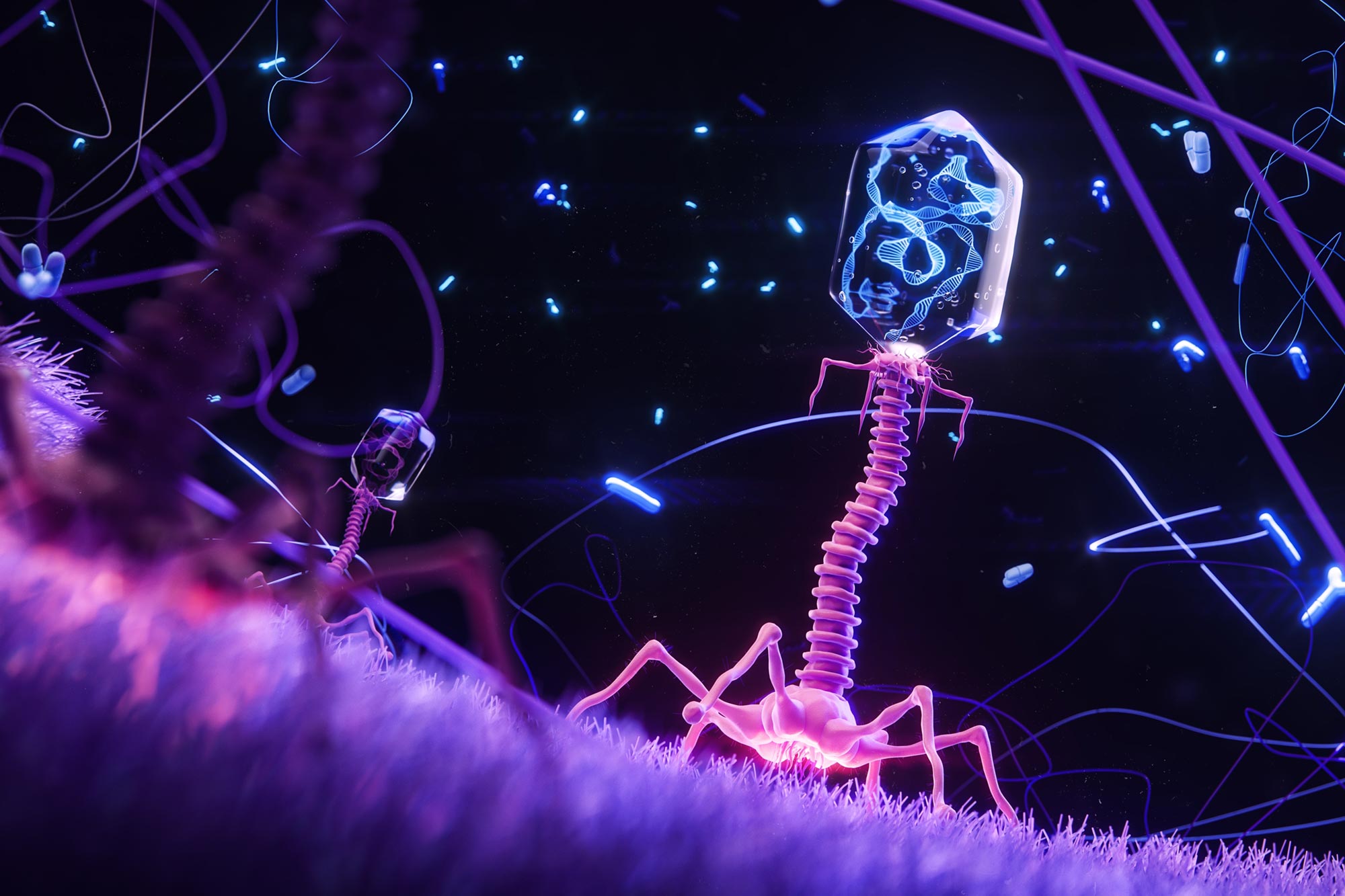
Scientists can now design bacteria-killing viruses from DNA, opening a faster path to fighting superbugs.
Bacteriophages have been used as treatments for bacterial infections for more than a century. Interest in these viruses is rising again as antibiotic-resistant infections become an increasing threat to public health. Even so, progress in the field has been slow. Most research has relied on naturally occurring phages because traditional engineering methods are time consuming and difficult, limiting the development of customized therapeutic viruses.
A Fully Synthetic Phage Engineering Breakthrough
In a new PNAS study, scientists from New England Biolabs (NEB) and Yale University describe the first fully synthetic system for engineering bacteriophages that target Pseudomonas aeruginosa, an antibiotic-resistant bacterium that poses a serious global health concern. The work is powered by NEB’s High-Complexity Golden Gate Assembly (HC-GGA) platform, which allows phages to be designed and built using DNA sequence information rather than physical virus samples.
Using this approach, the researchers constructed a P. aeruginosa phage from 28 synthetic DNA fragments. They then altered the virus by introducing point mutations along with DNA insertions and deletions. These changes allowed the team to modify which bacteria the phage could infect by swapping tail fiber genes and to add fluorescent reporters that made infections visible as they happened.
“Even in the best of cases, bacteriophage engineering has been extremely labor-intensive. Researchers spent entire careers developing processes to engineer specific model bacteriophages in host bacteria,” reflects Andy Sikkema, the paper’s co-first author and Research Scientist at NEB. “This synthetic method offers technological leaps in simplicity, safety, and speed, paving the way for biological discoveries and therapeutic development.”
Building Phages From Digital DNA
NEB’s Golden Gate Assembly platform makes it possible to assemble a complete phage genome outside the cell using synthetic DNA, with all planned genetic changes included from the start. Once assembled, the genome is introduced into a safe laboratory strain where it becomes an active bacteriophage.
This process removes many long-standing barriers in phage research. Scientists no longer need to maintain collections of fragile phage isolates or rely on specialized host bacteria, which is especially challenging for phages that infect dangerous human pathogens. The method also avoids the repeated screening and step-by-step genetic editing required by approaches that modify phages inside living cells.
Why Golden Gate Assembly Matters
Compared with DNA assembly techniques that use fewer but longer fragments, Golden Gate Assembly works with shorter DNA segments. These shorter pieces are easier to prepare, less harmful to host cells, and less likely to contain errors. The method is also more tolerant of repeated sequences and extreme GC content, features that are common in many phage genomes.
By simplifying the engineering process and expanding what can be built, the Golden Gate method greatly broadens the possibilities for scientists working to develop bacteriophages as tools to combat antibiotic resistance.
Collaboration Drives New Applications
The development of this rapid synthetic phage engineering approach required close collaboration between NEB scientists and bacteriophage researchers at Yale University. NEB researchers had already created the foundational tools needed to make Golden Gate Assembly reliable for large DNA targets made from many fragments. Yale researchers recognized the potential of these tools and initiated a partnership to explore more ambitious uses.
The method was first refined using a well-studied model virus, Escherichia coli phage T7. Since then, collaborative teams have expanded the approach to include non model bacteriophages that target highly antibiotic-resistant bacteria.
A related study using the Golden Gate method to build high GC content Mycobacterium phages was published in PNAS in November 2025 in collaboration with the Hatfull Lab at the University of Pittsburgh and Ansa Biotechnologies. In another project, researchers from Cornell University worked with NEB to develop synthetically engineered T7 bacteriophages that function as biosensors capable of detecting E. coli in drinking water, described in a December 2025 ACS study.
“My lab builds ‘weird hammers’ and then looks for the right nails,” said Greg Lohman, Senior Principal Investigator at NEB and co-author on the study. “In this case, the phage therapy community told us, ‘That’s exactly the hammer we’ve been waiting for.’”
Reference: “A fully synthetic Golden Gate assembly system for engineering a Pseudomonas aeruginosa phiKMV-like phage” by Andrew P. Sikkema, Kaitlyn E. Kortright, Hemaa Selvakumar, Jyot Antani, Benjamin K. Chan, Matthew Davidson, Max Hopkins, Benjamin Newman, Vladimir Potapov, Cecilia A. Silva-Valenzuela, S. Kasra Tabatabaei, Robert McBride, Paul E. Turner and Gregory J. S. Lohman, 23 January 2026, Proceedings of the National Academy of Sciences.
DOI: 10.1073/pnas.2525963123
Never miss a breakthrough: Join the SciTechDaily newsletter.
Follow us on Google and Google News.
4 Comments
Sounds great. What could possibly go wrong?
Good gosh this is irresponsible.
/sarcasm
Yes please inject me with a living virus created, by man, from from spliced DNA fragments.
Sounds super safe and logical.
/end sarcasm
As one person said…what could possibly go wrong? Merely knowing how to do this is dangerous.
I’ve read this book before. A few times.