
Close Menu
    Facebook X (Twitter) Instagram
    SciTechDaily
    • Biology
    • Chemistry
    • Earth
    • Health
    • Physics
    • Science
    • Space
    • Technology
    Facebook X (Twitter) Pinterest YouTube RSS
    SciTechDaily
    Home»Biology»Breakthrough Technique Uses Nanoparticles to Combat Cancer Drug Resistance
    Biology

    Breakthrough Technique Uses Nanoparticles to Combat Cancer Drug Resistance

    By Alyssa Wolice, University of MarylandFebruary 8, 2018No Comments5 Mins Read
    Facebook Twitter Pinterest Telegram LinkedIn WhatsApp Email Reddit
    Share
    Facebook Twitter LinkedIn Pinterest Telegram Email Reddit
    Researchers Turn Off Cancer Drug Resistance
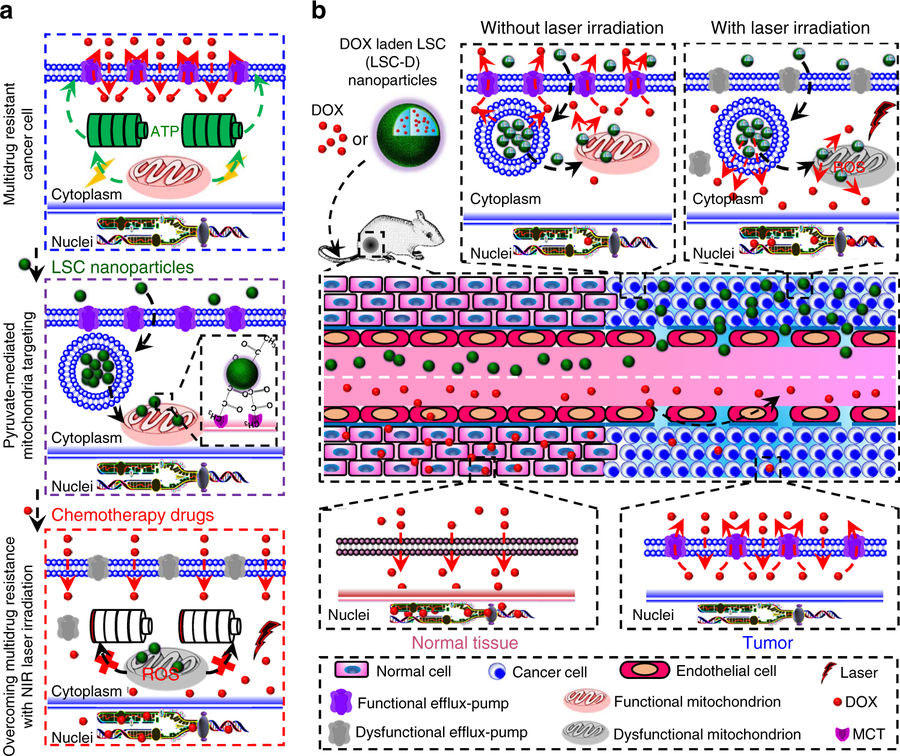
    A schematic illustration of the strategy for overcoming cancer drug resistance. a The transmembrane P-glycoprotein (P-gp) efflux pump driven by adenosine triphosphate (ATP) is a major mechanism of cancer multidrug resistance. In this study, a novel lipid membrane-coated silica-carbon (LSC) nanoparticle is designed to target the monocarboxylate transporters (MCTs) on mitochondria through the pyruvate groups on the surface of the LSC nanoparticle. With near infrared (NIR, 800 nm) laser irradiation, the LSC nanoparticles produce reactive oxygen species (ROS) to oxidize NADH into NAD+ in mitochondria, which compromises ATP production. This results in dysfunction of the P-gp efflux pumps. In addition, the treatment of LSC nanoparticles with NIR laser irradiation (LSC + L) leads to not only transmembrane but also intracellular distribution of the P-gp efflux pumps, although the total amount of the efflux pumps is only slightly (albeit significantly) reduced. Collectively, the LSC + L treatment can be used to overcome the multidrug resistance of cancer cells, which is demonstrated using three different chemotherapy drugs in this study: doxorubicin hydrochloride (DOX), paclitaxel (PTX), and irinotecan (CPT-11). b Owing to their nanoscale size (~45 nm), the DOX-laden LSC (LSC-D) nanoparticles can preferentially accumulate in tumor as a result of the enhanced permeability and retention (EPR) effect of tumor but not normal vasculature to minimize systemic toxicity of the chemotherapy drug. After arriving in tumor, the LSC-D nanoparticles can be taken up by multidrug-resistant cancer cells, but the DOX released out of the nanoparticles can still be pumped out of the cells for the LSC-D treatment alone. Importantly, with NIR laser irradiation, the drug resistance of the multidrug-resistant cancer cells can be overcome and effective tumor destruction ensues. In contrast, free DOX can diffuse into both normal tissue (which causes systemic toxicity) and the multidrug-resistant tumor. Moreover, free DOX can be pumped out of the multidrug-resistant cancer cells and further diffuse back into blood perfusion, leading to ineffective cancer therapy. Hai Wang, et al.

    The ability for cancer cells to develop resistance to chemotherapy drugs – known as multi-drug resistance – remains a leading cause for tumor recurrence and cancer metastasis, but recent findings offer hope that oncologists could one day direct cancer cells to “turn off” their resistance capabilities.

    New findings put forth by University of Maryland Fischell Department of Bioengineering Professor Xiaoming “Shawn” He and researchers from five other academic institutions point to a technique that uses specially designed nanoparticles and near infrared laser treatment to cause cancer cells to lose their multidrug resistance capabilities for days at a time. This creates a therapeutic window for chemotherapy to combat even the most drug-resistant cells left behind after surgery or earlier treatment. The group’s findings were published today in Nature Communications.

    “By administering chemotherapy within this ‘therapeutic window,’ oncologists could apply a lower dose of chemotherapy drugs to patients, with the potential for an improved treatment outcome – all while minimizing drug toxicity to healthy organs,” He said.

    One of the primary reasons cancer cells develop resistance is the overexpression of what are known as efflux pumps – proteins that protect a cell by pumping out unwanted toxic substances before they can reach their intended target. In the same way that efflux pumps work hard to protect against toxins, they also expel virtually all clinically relevant chemotherapy drugs.

    Fortunately, efflux pumps require a source of chemical energy to perform their function. As such, by cutting off the energy supply to the efflux pumps, oncologists could lower – or even eliminate – a cell’s resistance to drugs, such as those administered for chemotherapy. Recognizing this, He and his research team developed a way to reduce the amount of chemical energy – adenosine triphosphate (ATP) – available to the efflux pumps in cancer cells.

    The team – which also included researchers from Ohio State University, University of Virginia, University of Missouri School of Medicine, Shanghai University of Traditional Chinese Medicine, and Indiana University School of Medicine – targeted a specially designed nanoparticle to the mitochondrion, the cell’s power generator wherein the cell converts oxygen and nutrients into ATP. Once the nanoparticles reach the cancer cells’ mitochondria, the researchers apply near infrared laser treatment to trigger a chemical reaction that reduces the amount of ATP available to the pumps and, thus, cuts off their power supply. Such treatment both reduces the expression of the efflux pumps and decreases their distribution on the cell plasma membrane.

    The research team’s findings demonstrate that the drug-laden nanoparticles – in combination with near infrared laser treatment – can effectively inhibit the growth of multidrug-resistant tumors with no evident systemic toxicity.

    While researchers have long worked with nanoparticles for drug delivery, the findings put forth by He and his team represent a crucial breakthrough in addressing multidrug resistance in cancer cells.

    “For years, researchers have focused on delivering more chemotherapy drugs into cancer cells using nanoparticles, without targeting the root of drug resistance,” He said. “This meant that the cancer cells maintained their ability to expel the chemotherapy drugs, which limited any enhancement of the cancer therapy. To address this challenge, our research group is using nanoparticles not only to deliver more chemotherapy drugs to the target site within cancer cells, but also to compromise the function of the efflux pumps and thereby significantly improve safety and efficacy of cancer therapy.”

    Publication: Hai Wang, et al., “Targeted production of reactive oxygen species in mitochondria to overcome cancer drug resistance,” Nature Communications, volume 9, Article number: 562 (2018) doi:10.1038/s41467-018-02915-8

    Never miss a breakthrough: Join the SciTechDaily newsletter.
    Follow us on Google and Google News.

    Biomedical Engineering Biotechnology Cancer Disease Drugs Medicine Nanoparticles Nanotechnology Oncology University of Maryland
    Share. Facebook Twitter Pinterest LinkedIn Email Reddit

    Related Articles

    MIT Develops Nanoparticles That Cross the Blood-Brain Barrier To Treat Cancer Tumors

    Quantum Physics Helps Break DNA and Destroy Cancer Cells

    Fully Autonomous Cancer-Fighting Nanorobots Seek and Destroy Tumors

    Researchers Use CRISPR-Carrying Nanoparticles To Edit Genomes

    Two-Pronged Immune Response Destroys Tumors

    Searching for the Best Shape for Cancer Fighting Nanoparticles

    Staggered Delivery of Cancer Drugs Increases Cancer Cell Death

    New Drug CD47 Could Potentially Shrink and Cure All Tumors

    Cancer-Causing Mutations Disrupt Cells’ Ability to Differentiate

    Leave A Reply Cancel Reply

    • Facebook
    • Twitter
    • Pinterest
    • YouTube

    Don't Miss a Discovery

    Subscribe for the Latest in Science & Tech!

    Trending News

    Artificial Sweeteners May Harm Future Generations, Study Suggests

    Splashdown! NASA Artemis II Returns From Record-Breaking Moon Mission

    What If Consciousness Exists Beyond Your Brain

    Scientists Finally Crack the 100-Million-Year Evolutionary Mystery of Squid and Cuttlefish

    Beyond “Safe Levels”: Study Challenges What We Know About Pesticides and Cancer

    Researchers Have Found a Dietary Compound That Increases Longevity

    Scientists Baffled by Bizarre “Living Fossil” From 275 Million Years Ago

    Your IQ at 23 Could Predict Your Wealth at 27, Study Finds

    Follow SciTechDaily
    • Facebook
    • Twitter
    • YouTube
    • Pinterest
    • Newsletter
    • RSS
    SciTech News
    • Biology News
    • Chemistry News
    • Earth News
    • Health News
    • Physics News
    • Science News
    • Space News
    • Technology News
    Recent Posts
    • What if Dark Matter Has Two Forms? Bold New Hypothesis Could Explain a Cosmic Mystery
    • Researchers Expose Hidden Chemistry of “Ore-Forming” Elements in Biology
    • Geologists Reveal the Americas Collided Earlier Than We Thought
    • 20x Difference: Study Reveals True Source of Airborne Microplastics
    • Scientists Uncover Hidden Force Powering Yellowstone’s Supervolcano
    Copyright © 1998 - 2026 SciTechDaily. All Rights Reserved.
    • Science News
    • About
    • Contact
    • Editorial Board
    • Privacy Policy
    • Terms of Use

    Type above and press Enter to search. Press Esc to cancel.