
Close Menu
    Facebook X (Twitter) Instagram
    SciTechDaily
    • Biology
    • Chemistry
    • Earth
    • Health
    • Physics
    • Science
    • Space
    • Technology
    Facebook X (Twitter) Pinterest YouTube RSS
    SciTechDaily
    Home»Biology»Striking Discovery: Multidrug-Resistant Bacteria Are Not As Recent As We Thought
    Biology

    Striking Discovery: Multidrug-Resistant Bacteria Are Not As Recent As We Thought

    By Osaka UniversitySeptember 15, 2019No Comments4 Mins Read
    Facebook Twitter Pinterest Telegram LinkedIn WhatsApp Email Reddit
    Share
    Facebook Twitter LinkedIn Pinterest Telegram Email Reddit
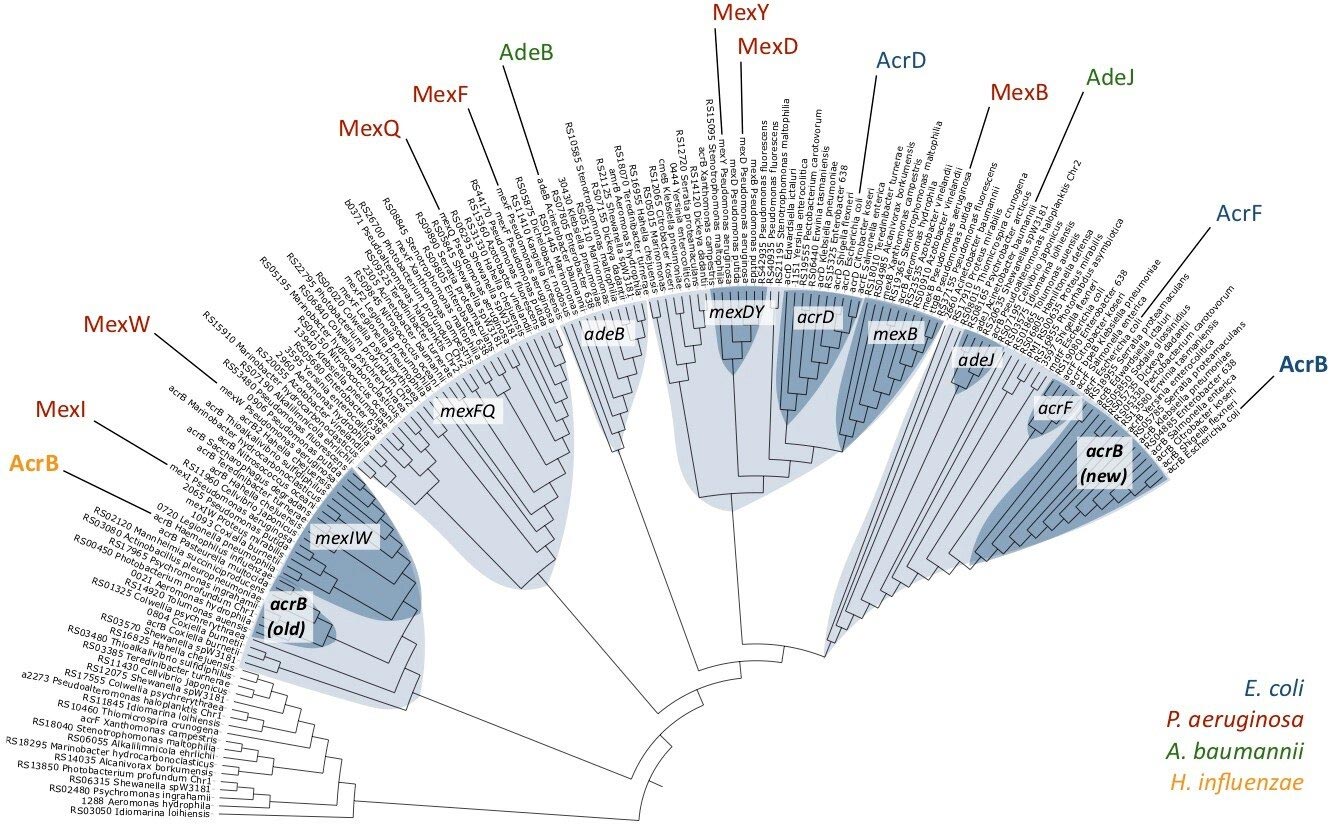
    Phylogenetic relationships among a selection of RND-type MDR transporters
    Phylogenetic relationships among a selection of RND-type MDR transporters. Different clusters are shown in blue, and sub-clusters in dark blue. AcrB-Hi is on the left, and AcrB-Ec on the far right. Credit: Osaka University

    Researchers from Osaka University find that a relatively ancient drug efflux pump in Haemophilus influenzae confers resistance to the same drugs as its more evolved counterparts, and is only mitigated by a slightly leaky membrane channel.

    Researchers from Osaka University have made the striking discovery that multidrug-resistant bacteria may have been around longer than we thought.

    In findings published this month in Communications Biology, the researchers investigated the evolutionary relationships among hundreds of RND-type efflux pumps–specialized proteins that pump multiple different types of antibiotics out of a bacterial cell, making it multidrug-resistant.

    “Interestingly, we found that RND efflux pump AcrB from H. influenzae was relatively ancient but exported the same antibiotics as its more evolved counterpart from Escherichia coli,” explains lead author of the study Martijn Zwama. “What it couldn’t do well was export bile salts, which are not something that H. influenzae encounters in its normal habitat but are common components of the gut, where E. coli resides.”
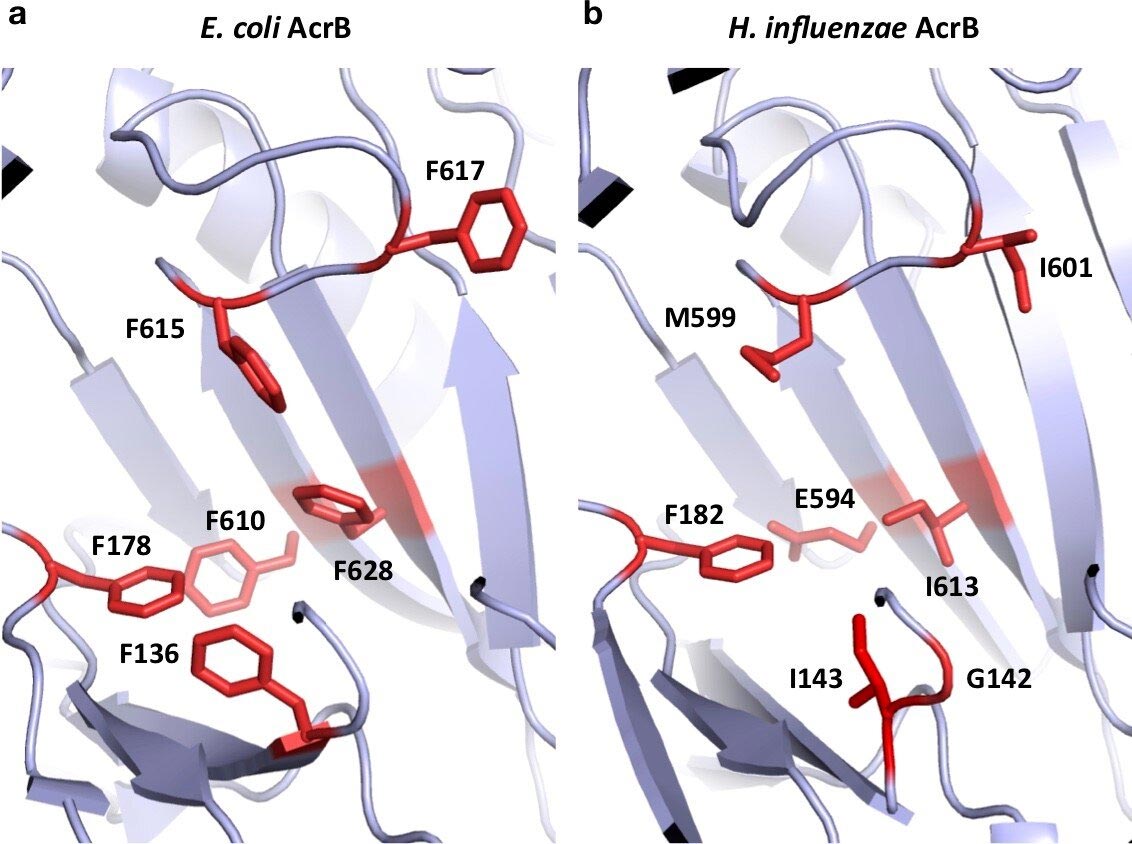
    Evolved Phe-rich pit of AcrB-Ec compared with that of the relatively ancient AcrB-Hi
    Evolved Phe-rich pit of AcrB-Ec compared with that of the relatively ancient AcrB-Hi. Credit: Osaka University

    While this pointed to the evolution of the pumps in their natural environments, it also suggested that multidrug recognition is an ancient trait. This is an important distinction because most bacteria acquire resistance genes or mutations in the face of selective pressure from the environment.

    But while AcrB protects H. influenzae from several different classes of antibiotics, the pathogen remains susceptible to β-lactams and novobiocin, something that researchers have previously not been able to explain.

    “Bacterial membranes contain channels that selectively let different substrates into the cell,” says co-author Akihito Yamaguchi. “We found that in H. influenzae, one of these channels, OmpP2, was slightly leaky. This meant that some of the smaller drugs pumped out of the cell by AcrB could seep back inside, where they went to work killing the bacterium.”

    Multidrug-resistant bacteria have devastating–and often lethal–effects in infected patients. And with new strains constantly emerging, these super pathogens are arguably the biggest threat to human health today. Therefore, drugs targeting efflux pumps have been developed. However, the researchers found that these drugs had no effect on H. influenzae.
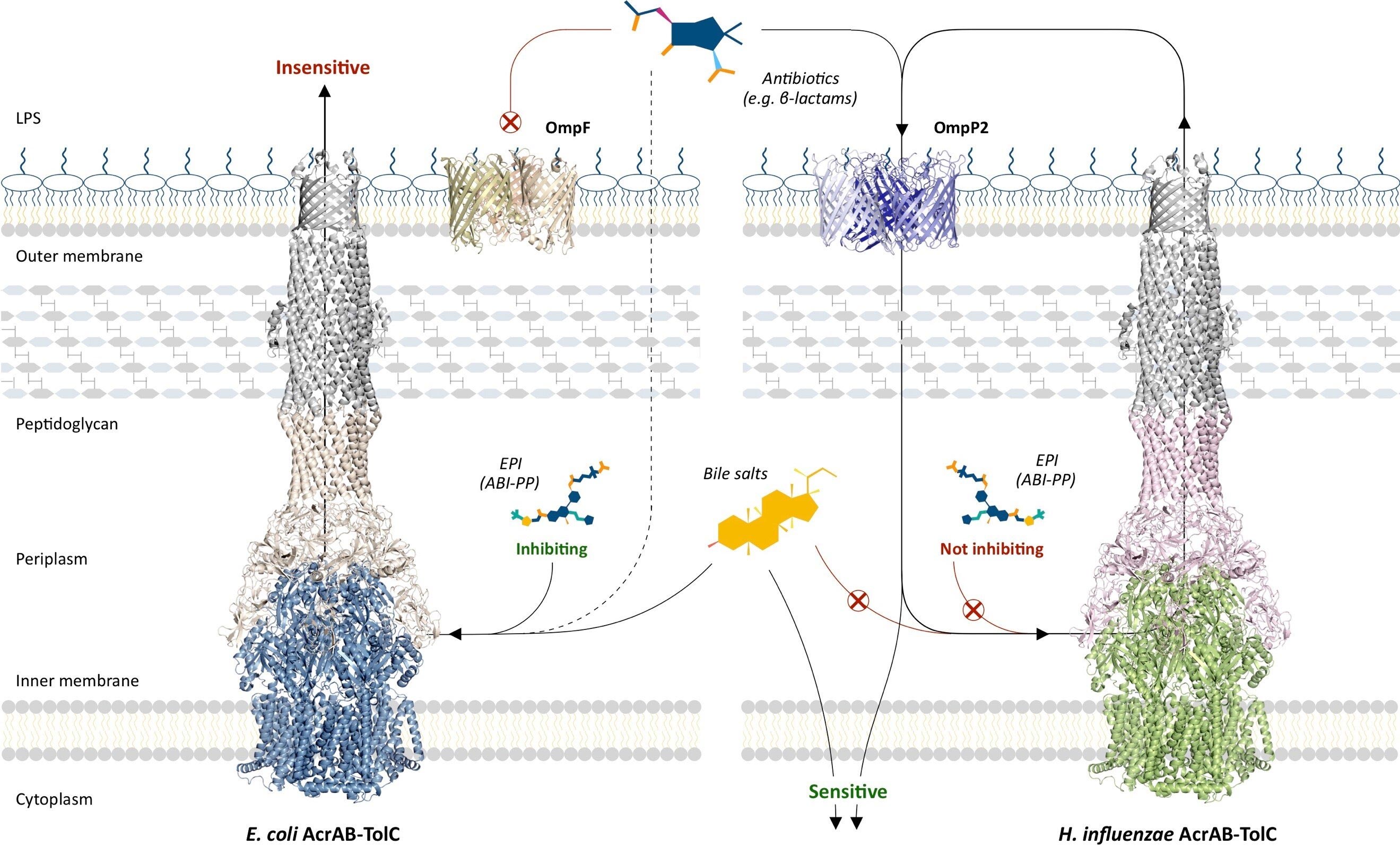
    Interplay between the efflux pumps and porins from E. coli and H. influenzae
    Interplay between the efflux pumps and porins from E. coli and H. influenzae. AcrB efflux pumps can actively transport antibiotics out of the periplasm and cytoplasm of bacterial cells, rendering them ineffective. AcrB-Ec can also export bile salts, which are present in the enteric environment where E. coli is found. In comparison, AcrB-Hi showed only weak export of bile salts. Additionally, the efflux pump inhibitor ABI-PP did not affect AcrB-Hi but completely inhibited the efflux ability of AcrB-Ec. The wide OmpP2 outer-membrane porin from H. influenzae leaks small and elongated antibiotics such as β-lactams and novobiocin back into the cells, making Hib cells sensitive to these antibiotics. Credit: Osaka University

    “Efflux pump inhibitors bind to a phenylalanine-rich pocket in AcrB. Unfortunately, these drugs were designed to target the more evolved proteins in species like E. coli,” explains study corresponding author Professor Kunihiko Nishino. “Because H. influenzae AcrB is more ancient, we found that it does not contain the same pocket configuration and is therefore unaffected by the efflux pump inhibitors.”

    Uncovering these evolutionary differences has shown that a “one size fits all” approach is not suitable to address RND-type efflux pumps. This research provides a more accurate picture of the evolution and mechanism of multidrug efflux systems, which will assist the development of new antibiotics to more effectively target specific multidrug-resistant pathogens.

    ###

    Reference: “Phylogenetic and functional characterization of the Haemophilus influenzae multidrug efflux pump AcrB” by Martijn Zwama, Akihito Yamaguchi and Kunihiko Nishino, 13 September 2019, Communications Biology.
    DOI: 10.1038/s42003-019-0564-6

    Never miss a breakthrough: Join the SciTechDaily newsletter.
    Follow us on Google and Google News.

    Bacteria Drugs University of Osaka
    Share. Facebook Twitter Pinterest LinkedIn Email Reddit

    Related Articles

    The World’s Smallest Universal Joints in Unprecedented Resolution

    Prevalence of Multi-Drug Resistant E. Coli Rising ICAAC 2 Reports

    Genetically Modified Mosquitoes to Fight Diseases

    MicroCHIPS Wireless Drug Implant Releases Timed Dosed Injections

    Highest Recorded Rates of Drug Resistant Tuberculosis

    Antibiotic-Free Meat Might Still Be Contaminated with Drug Resistant Bacteria

    NDM-1 Super Bacteria Scares Medical Community in India

    Viruses Use Bacteria for Reproduction

    Autistic Children Have Different Gastrointestinal Bacteria

    Leave A Reply Cancel Reply

    • Facebook
    • Twitter
    • Pinterest
    • YouTube

    Don't Miss a Discovery

    Subscribe for the Latest in Science & Tech!

    Trending News

    New Pill Lowers Stubborn Blood Pressure and Protects the Kidneys

    Humans May Have Hidden Regenerative Powers, New Study Suggests

    Scientists Just Solved the Mystery of Why Crabs Walk Sideways

    Doctors Are Surprised by What This Vaccine Is Doing to the Heart

    This Popular Supplement May Boost Your Brain, Not Just Your Muscles

    Scientists Say This Simple Supplement May Actually Reverse Heart Disease

    Warming Oceans Could Trigger a Dangerous Methane Surge

    This Simple Movement Could Be Secretly Cleaning Your Brain

    Follow SciTechDaily
    • Facebook
    • Twitter
    • YouTube
    • Pinterest
    • Newsletter
    • RSS
    SciTech News
    • Biology News
    • Chemistry News
    • Earth News
    • Health News
    • Physics News
    • Science News
    • Space News
    • Technology News
    Recent Posts
    • Researchers Discover Efficient New Way To Split Hydrogen From Water for Energy
    • This Korean Skincare Ingredient Could Help Fight Deadly Superbugs
    • Giant Squid Detected off Western Australia in Stunning Deep-Sea Discovery
    • Popular Sugar-Free Sweetener Linked to Liver Disease, Study Warns
    • Why Weight Loss Isn’t Enough for Everyone at Risk of Diabetes
    Copyright © 1998 - 2026 SciTechDaily. All Rights Reserved.
    • Science News
    • About
    • Contact
    • Editorial Board
    • Privacy Policy
    • Terms of Use

    Type above and press Enter to search. Press Esc to cancel.