
Close Menu
    Facebook X (Twitter) Instagram
    SciTechDaily
    • Biology
    • Chemistry
    • Earth
    • Health
    • Physics
    • Science
    • Space
    • Technology
    Facebook X (Twitter) Pinterest YouTube RSS
    SciTechDaily
    Home»Technology»Nanotechnology Used to Create “Magnetic Domain-Wall Ratchet” Memory
    Technology

    Nanotechnology Used to Create “Magnetic Domain-Wall Ratchet” Memory

    By Eindhoven University of TechnologyJuly 23, 2012No Comments3 Mins Read
    Facebook Twitter Pinterest Telegram LinkedIn WhatsApp Email Reddit
    Share
    Facebook Twitter LinkedIn Pinterest Telegram Email Reddit
    computer memory that is built up from moving bits of magnetized areas
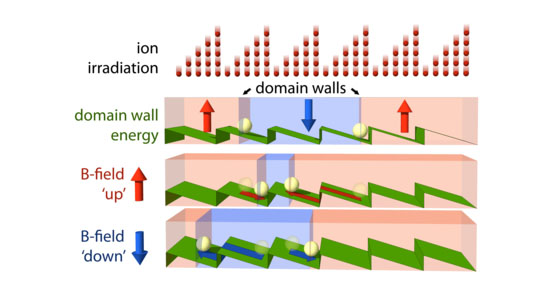
    Ion irradiation creates an asymmetric potential or ‘ratchet’ for the main walls (visualized as light-yellow spheres). The bit with a magnetic coating is shifted one position to the left by sequentially positioning a field upwards and downwards. Credit: Eindhoven University of Technology

    A newly published study details how scientists at the Eindhoven University of Technology developed “magnetic domain-wall ratchet” memory, computer memory that is built up from moving bits of magnetized areas.

    Researchers from TU/e and the FOM Foundation have successfully made a ‘magnetic domain-wall ratchet’ memory, a computer memory that is built up from moving bits of magnetized areas. This memory potentially offers many advantages compared to standard hard disks, such as a higher speed, lower electricity consumption and much longer life. Using concentrated ion bundles the researchers have influenced the magnetic wires the bits move through, and they have successfully controlled bits at the nanometer scale and subsequently constructed a new memory. The research results were published online by Nature Nanotechnology on Sunday, July 15.

    The bits in a nanowire can be conceptualized as areas that can have two possible magnetic directions, a 0 or a 1. Usually, all of the bits are simultaneously set at either 0 or 1 during the construction as they reverse like compass needles. The researchers have now demonstrated that bits can be coherently transferred without the information they contain being lost. This method of magnetic data transport is radically different from that in current computers, where rotating magnetic disks are mechanically moved to address data.

    Sawtooth

    By cleverly varying how the ions are fired across a nanowire, a repeating, saw-tooth-shaped energy landscape is created. This asymmetric saw tooth is crucial: it forces a domain wall, the boundary between bits, to move in a single direction under a variable magnetic field. Due to the variable magnetic field the force on the domain wall continually reverses and this is alternately pushed over the incline and then subsequently pushed back against the sharp edge (see Figure). After one cycle of the magnetic field two domain walls are pushed up by exactly one position. This net transfer of a bit would be impossible without saw-tooth potential.

    The researchers used a circular magnetic wire. By using this circle the domain walls can always rotate and the bits are retained. This one-way traffic of the domains is a movement comparable to that of a rattle or ‘ratchet’.

    Unique opportunities

    The discovery offers unique opportunities for the development of alternative memory concepts. After the proof-of-principle experiments the scientists will focus on a next generation ratchet. This will be based on radical new effects such as the use of spin currents generated in the neighboring non-magnetic layers or the use of electric fields to influence the domain or movement.

    Reference: “Shift registers based on magnetic domain wall ratchets with perpendicular anisotropy” by J. H. Franken, H. J. M. Swagten and B. Koopmans, 15 July 2012, Nature Nanotechnology.
    DOI: 10.1038/nnano.2012.111

    Never miss a breakthrough: Join the SciTechDaily newsletter.
    Follow us on Google and Google News.

    Computer Science Eindhoven University of Technology Memory Nanomaterials Nanotechnology
    Share. Facebook Twitter Pinterest LinkedIn Email Reddit

    Related Articles

    Graphene Hot Electron Bolometer May Outperform Existing Technologies

    Ion bombardment Model Could Lead to New Technologies

    Balancing Between Life and Research

    Automated System Has Promising Uses in Battery and Fuel Cell Production

    Exploring Graphene-Based THz Devices

    Graphene Center Laboratory is State of the Art “Nano-Factory”

    Nanosponges May Help With Environmental Cleanup

    Analyzing the Environmental Costs and Impacts of Technology

    Nanoparticles in 3-D Atomic-Scale Resolution

    Leave A Reply Cancel Reply

    • Facebook
    • Twitter
    • Pinterest
    • YouTube

    Don't Miss a Discovery

    Subscribe for the Latest in Science & Tech!

    Trending News

    Popular Vitamin B3 Supplements May Help Cancer Cells Survive, Scientists Warn

    Scientists Discover Strange Property of Rice and Turn It Into a Smart Material

    NASA Artemis II Skips Burn As Astronaut Captures Stunning View of Earth

    NASA’s Artemis II: Humans Just Left Earth Orbit for the First Time Since 1972

    What Causes Chronic Pain? Scientists Identify Key Culprit in the Brain

    Semaglutide Shows Surprising Mental Health Benefits in Massive 100,000-Person Study

    This Liquid Snapped Instead of Flowing and Scientists Were Shocked

    Breakthrough Alzheimer’s Drug Rewires the Brain Instead of Just Clearing Plaques

    Follow SciTechDaily
    • Facebook
    • Twitter
    • YouTube
    • Pinterest
    • Newsletter
    • RSS
    SciTech News
    • Biology News
    • Chemistry News
    • Earth News
    • Health News
    • Physics News
    • Science News
    • Space News
    • Technology News
    Recent Posts
    • Stanford Scientists Discover Hidden Brain Circuit That Fuels Chronic Pain
    • Johns Hopkins Scientists Develop Nasal DNA Vaccine for Tuberculosis
    • New Study Reveals Why Ozempic Works Better for Some People Than Others
    • Scientists Uncover the Secret “Glue” That Helps Soil Hold Water
    • Climate Change Is Altering a Key Greenhouse Gas in a Way Scientists Didn’t Expect
    Copyright © 1998 - 2026 SciTechDaily. All Rights Reserved.
    • Science News
    • About
    • Contact
    • Editorial Board
    • Privacy Policy
    • Terms of Use

    Type above and press Enter to search. Press Esc to cancel.