
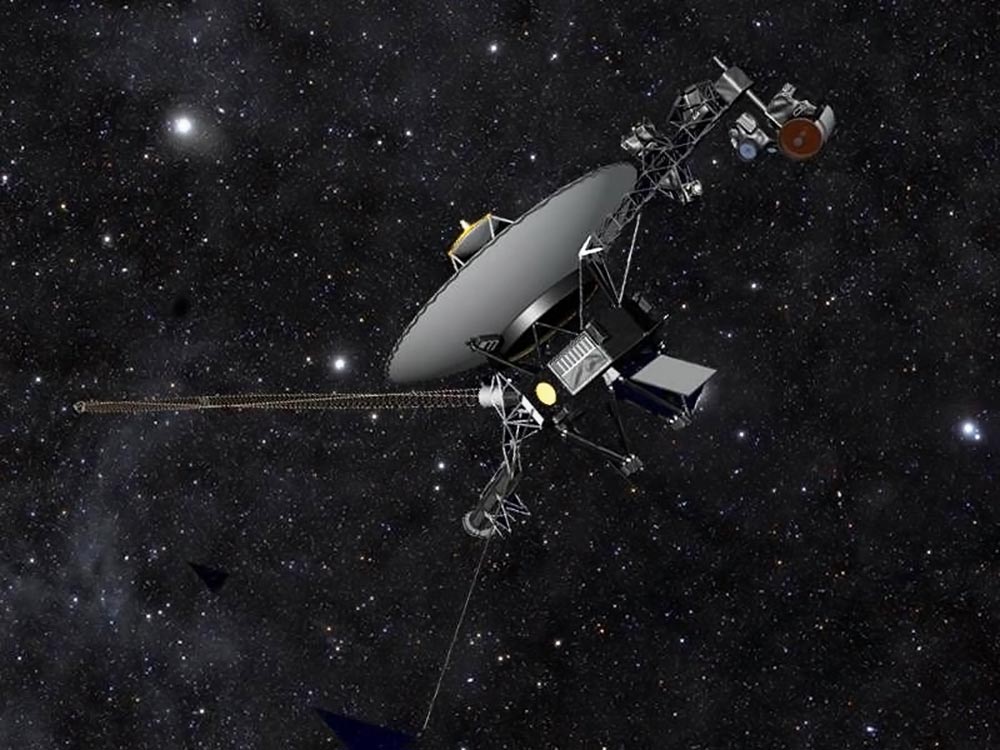
NASA’s Voyager 1 team tackled complex challenges by successfully switching to backup thrusters after the primary ones became clogged with silicon dioxide.
The spacecraft uses its thrusters to stay pointed at Earth, but after 47 years in space some of the fuel tubes have become clogged. This adaptation was complicated as the spacecraft, now in interstellar space, continues its journey on dwindling power.
Resolving Thruster Issues on Voyager 1
Engineers working on NASA’s Voyager 1 probe have successfully mitigated an issue with the spacecraft’s thrusters, which keep the distant explorer pointed at Earth so that it can receive commands, send engineering data, and provide the unique science data it is gathering.
After 47 years, a fuel tube inside the thrusters has become clogged with silicon dioxide, a byproduct that appears with age from a rubber diaphragm in the spacecraft’s fuel tank. The clogging reduces how efficiently the thrusters can generate force. After weeks of careful planning, the team switched the spacecraft to a different set of thrusters.
The thrusters are fueled by liquid hydrazine, which is turned into gases and released in tens-of-milliseconds-long puffs to gently tilt the spacecraft’s antenna toward Earth. If the clogged thruster were healthy it would need to conduct about 40 of these short pulses per day.

Adapting to Challenges Beyond Our Solar System
Both Voyager probes feature three sets, or branches, of thrusters: two sets of attitude propulsion thrusters and one set of trajectory correction maneuver thrusters. During the mission’s planetary flybys, both types of thrusters were used for different purposes. But as Voyager 1 travels on an unchanging path out of the solar system, its thruster needs are simpler, and either thruster branch can be used to point the spacecraft at Earth.
In 2002 the mission’s engineering team, based at NASA’s Jet Propulsion Laboratory in Southern California, noticed some fuel tubes in the attitude propulsion thruster branch being used for pointing were clogging, so the team switched to the second branch. When that branch showed signs of clogging in 2017, the team switched to the trajectory correction maneuver thrusters and have been using that branch since then.
Now those trajectory correction thruster tubes are even more clogged than the original branches were when the team swapped them in 2018. The clogged tubes are located inside the thrusters and direct fuel to the catalyst beds, where it is turned into gases. (These are different than the fuel tubes that send hydrazine to the thrusters.) Where the tube opening was originally only 0.01 inches (0.25 millimeters) in diameter, the clogging has reduced it to 0.0015 inches (0.035 mm), or about half the width of a human hair. As a result, the team needed to switch back to one of the attitude propulsion thruster branches.
Innovating Solutions Amidst Power Constraints
Switching to different thrusters would have been a relatively simple operation for the mission in 1980 or even 2002. But the spacecraft’s age has introduced new challenges, primarily related to power supply and temperature. The mission has turned off all non-essential onboard systems, including some heaters, on both spacecraft to conserve their gradually shrinking electrical power supply, which is generated by decaying plutonium.

While those steps have worked to reduce power, they have also led to the spacecraft growing colder, an effect compounded by the loss of other non-essential systems that produced heat. Consequently, the attitude propulsion thruster branches have grown cold, and turning them on in that state could damage them, making the thrusters unusable.
The team determined that the best option would be to warm the thrusters before the switch by turning on what had been deemed non-essential heaters. However, as with so many challenges the Voyager team has faced, this presented a puzzle: The spacecraft’s power supply is so low that turning on non-essential heaters would require the mission to turn off something else to provide the heaters adequate electricity, and everything that’s currently operating is considered essential.
Studying the issue, they ruled out turning off one of the still-operating science instruments for a limited time because there’s a risk that the instrument would not come back online. After additional study and planning, the engineering team determined they could safely turn off one of the spacecraft’s main heaters for up to an hour, freeing up enough power to turn on the thruster heaters.
Ensuring Longevity in Uncharted Space
It worked. On August 27, they confirmed that the needed thruster branch was back in action, helping point Voyager 1 toward Earth.
“All the decisions we will have to make going forward are going to require a lot more analysis and caution than they once did,” said Suzanne Dodd, Voyager’s project manager at the Jet Propulsion Laboratory which manages Voyager for NASA.
The spacecraft are exploring interstellar space, the region outside the bubble of particles and magnetic fields created by the Sun, where no other spacecraft are likely to visit for a long time. The mission science team is working to keep the Voyagers going for as long as possible, so they can continue to reveal what the interstellar environment is like.
Never miss a breakthrough: Join the SciTechDaily newsletter.
Follow us on Google and Google News.
3 Comments
It’s all well and good, but I still can’t see the wisdom in it carrying a message to the extraterrestrials about where the Earth is.
Nothing good can come out of that other than an “Independence Day” or a “V’Ger” scenario.
Yup..don’t want Purple People Eaters to know they have neighbors.
You must be factually sure they exist,right? What facts are there for you in your world?
If they’re even looking, they won’t need either Voyager to find us.