
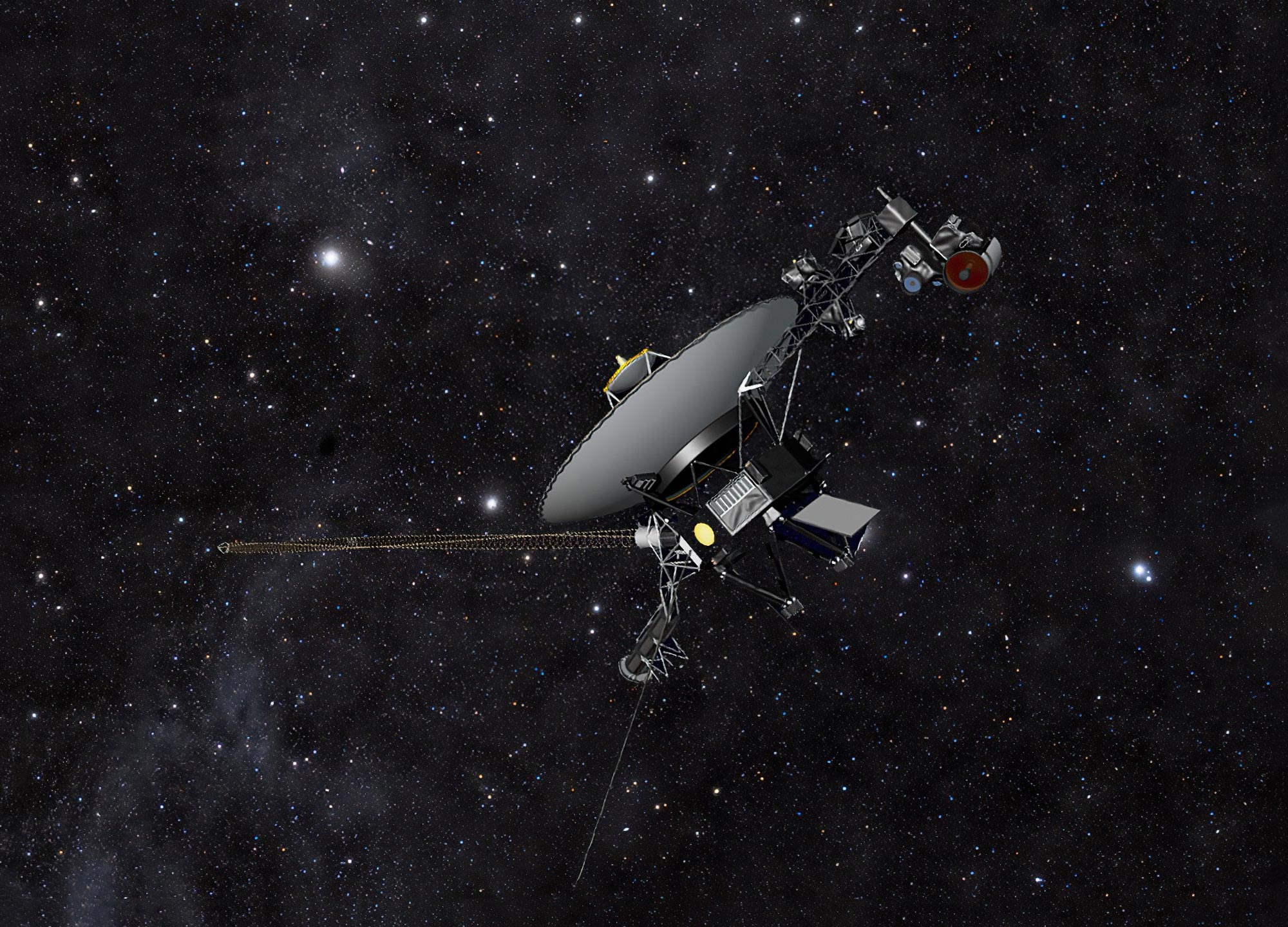
After a temporary communication breakdown last month, NASA’s Voyager 1 spacecraft has resumed normal operations.
The team successfully reactivated its primary radio transmitter and resumed data collection from its four active science instruments, despite ongoing power management challenges due to the spacecraft’s advanced age and limited power supply.
Voyager 1’s Communication Recovery
NASA’s Voyager 1 has returned to normal operations after a temporary communication disruption last month. The spacecraft unexpectedly switched off its primary X-band radio transmitter and activated the weaker S-band transmitter. Because Voyager 1 is about 15.4 billion miles (24.9 billion kilometers) from Earth, this change made it impossible for the mission team to receive scientific data or updates on the spacecraft’s engineering status.
Reactivation of Voyager’s Instruments
Earlier this month, engineers successfully reactivated the X-band transmitter and resumed collecting data from Voyager 1’s four operational science instruments during the week of November 18. The team is now finalizing a few tasks to fully restore the probe to its previous operational state, including resetting the system that synchronizes its three onboard computers.
Power Management Challenges
The X-band transmitter had been shut off by the spacecraft’s fault protection system when engineers activated a heater on the spacecraft. Historically, if the fault protection system sensed that the probe had too little power available, it would automatically turn off systems not essential for keeping the spacecraft flying in order to keep power flowing to the critical systems. But the probes have already turned off all nonessential systems except for the science instruments. So the fault protection system turned off the X-band transmitter and turned on the S-band transmitter, which uses less power.

Credit: NASA/JPL-Caltech
Voyager’s Long-Term Operations
The mission is working with extremely small power margins on both Voyager probes. Powered by heat from decaying plutonium that is converted into electricity, the spacecraft lose about 4 watts of power each year. About five years ago — some 41 years after the Voyager spacecraft launched — the team began turning off any remaining systems not critical to keeping the probes flying, including heaters for some of the science instruments. To the mission team’s surprise, all of those instruments continued to operate despite reaching temperatures lower than what they had been tested at.
The team has computer models designed to predict how much power various systems, such as heaters and instruments, are expected to use. But a variety of factors contribute to uncertainty in those models, including the age of the components and the fact that hardware doesn’t always behave as expected.
The Current State of Voyager Probes
With power levels being measured to fractions of a watt, the team also adjusted how both probes monitor voltage. But earlier this year, the declining power supply required the team to turn off a science instrument on Voyager 2. The mission shut off multiple instruments on Voyager 1 in 1990 to conserve energy, but those instruments were no longer in use after the probe flew past Jupiter and Saturn. Of the 10 science instruments on each spacecraft, four are now being used to study the particles, plasma, and magnetic fields in interstellar space.
Voyagers 1 and 2 have been flying for more than 47 years and are the only two spacecraft to operate in interstellar space. Their advanced age has meant an increase in the frequency and complexity of technical issues and new challenges for the mission engineering team.
Never miss a breakthrough: Join the SciTechDaily newsletter.
Follow us on Google and Google News.
7 Comments
Please undubscribe me.
It’s a mind blowing process and shows the complexity of the power of God.
My fad worked on both voyager 1 & 2 ..he died in 1996 ..its kind of a legacy that what he worked is still exploring space long after his passing ..
Dad
That is just amazing and almost beyond my comprehension. That has to be something you can be so proud of, to know what your Dad worked on is still out there working away… A.
I’ve aleays been interested in space travel, and to hear that one of the Voyagers is still sending data from this HUGE distance is amazing. That the technicians 47 years ago put together this amazing craft, and to last nearly half a century is also amazing!
It’s really a blast from the past. Human ingenuity has triumphed, bringing the spacecraft back from the brink. It’s a huge gift to mankind. Voyager 1, the Earth’s sentinel in deep space.