
Close Menu
    Facebook X (Twitter) Instagram
    SciTechDaily
    • Biology
    • Chemistry
    • Earth
    • Health
    • Physics
    • Science
    • Space
    • Technology
    Facebook X (Twitter) Pinterest YouTube RSS
    SciTechDaily
    Home»Space»NASA Confirms Extra Time for Dawn to Explore Vesta
    Space

    NASA Confirms Extra Time for Dawn to Explore Vesta

    By Jia-Rui C. Cook, Jet Propulsion LaboratoryApril 20, 2012No Comments3 Mins Read
    Facebook Twitter Pinterest Telegram LinkedIn WhatsApp Email Reddit
    Share
    Facebook Twitter LinkedIn Pinterest Telegram Email Reddit
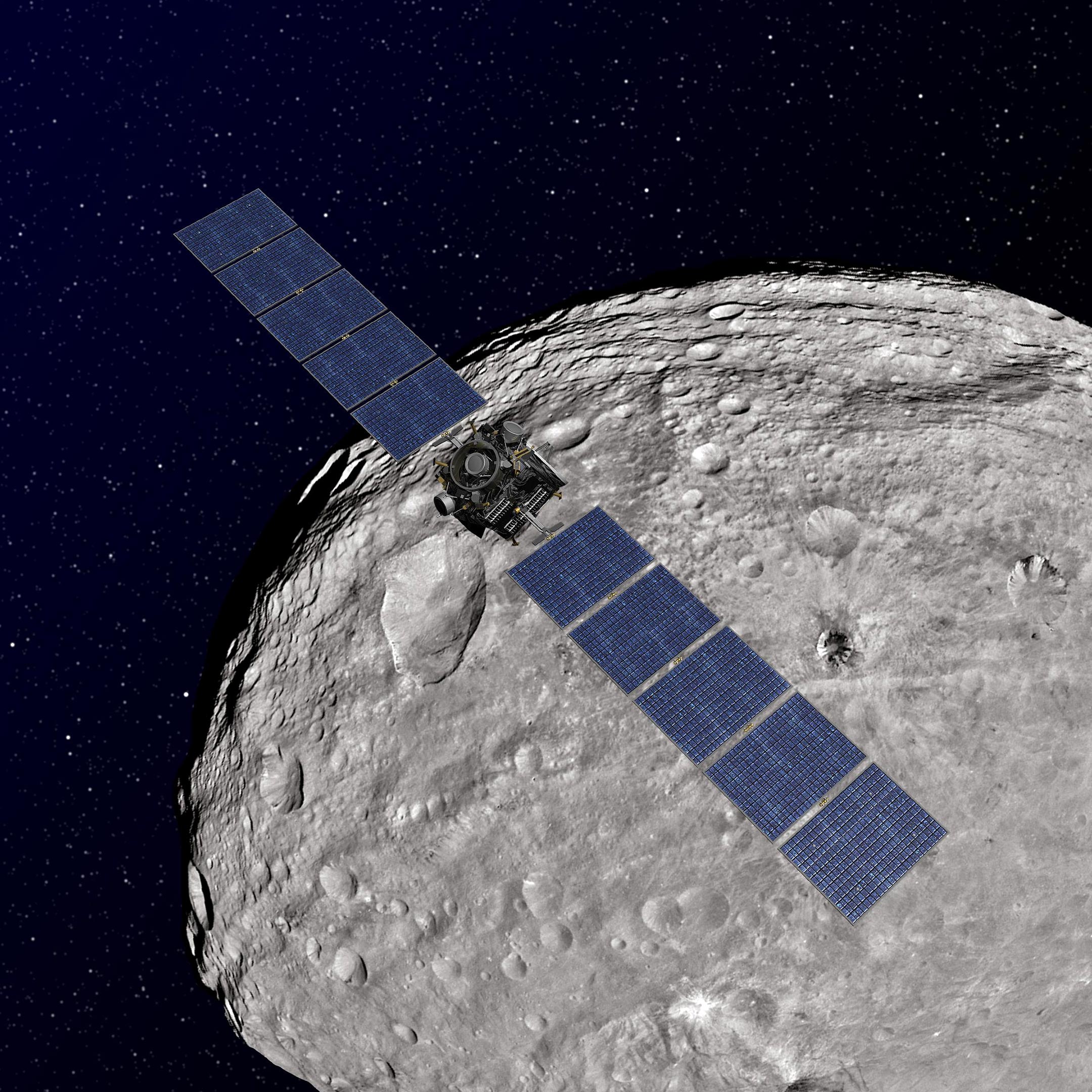
    NASA Dawn Spacecraft Orbiting Vesta
    This artist’s concept shows NASA’s Dawn spacecraft orbiting the giant asteroid Vesta. The depiction of Vesta is based on images obtained by Dawn’s framing cameras. Credit: NASA/JPL-Caltech

    The NASA Dawn mission is receiving 40 extra days to explore Vesta and scientists plan to make the most out of it. They hope to learn more about this mysterious asteroid while extending the observations at Dawn’s current low-altitude mapping orbit and building the best possible maps of the elemental composition of Vesta’s surface.

    NASA’s Dawn mission has received official confirmation that 40 extra days have been added to its exploration of the giant asteroid Vesta, the second most massive object in the main asteroid belt. The mission extension allows Dawn to continue its scientific observations at Vesta until August 26, while still arriving at the dwarf planet Ceres at the same originally scheduled target date in February 2015.

    “We are leveraging our smooth and successful operations at Vesta to provide for even more scientific discoveries for NASA and the world,” said Robert Mase, Dawn project manager based at NASA’s Jet Propulsion Laboratory, Pasadena, California. “This extra time will allow us to extend our scientific investigation and learn more about this mysterious world.”

    The extension will not require any new funding, and will draw on financial reserves that have been carefully managed by the Dawn project. The flexibility provided by the spacecraft’s use of efficient ion propulsion system allows it to maintain its originally planned Ceres arrival.

    The extension allows for extra observations at Dawn’s current low-altitude mapping orbit (average altitude 130 miles or 210 kilometers), which will now last until May 1. The additional time enables the gamma-ray and neutron detector to build the best possible maps of the elemental composition of Vesta’s surface and improve data for the gravity experiment, the two primary scientific investigations at the low-altitude orbit. The spacecraft’s camera and spectrometer are also obtaining additional high-resolution images.

    Additional time will also be spent in the planned second high-altitude mapping orbit later this summer. When Dawn arrived at Vesta in July 2011, much of the northern hemisphere was in shadow. But with the passage of time, more of that area will bask in sunshine.

    “Dawn has beamed back to us such dazzling Vestan vistas that we are happy to stay a little longer and learn more about this special world,” said Christopher Russell, Dawn’s principal investigator at UCLA. “While we have this one-of-a-kind opportunity to orbit Vesta, we want to make the best and most complete datasets that we can.”

    Never miss a breakthrough: Join the SciTechDaily newsletter.
    Follow us on Google and Google News.

    Dawn Spacecraft Exploration JPL NASA Spacecraft Vesta
    Share. Facebook Twitter Pinterest LinkedIn Email Reddit

    Related Articles

    NASA’s Dawn Mission Reveals Hydrated Minerals on Vesta

    Dawn Leaves Vesta, NASA Releases Highlight Video of Its Accomplishments

    New Video Highlights Asteroid Vesta’s Surface Composition in Many Colors

    Dawn Mission Reveals the Inner Secrets of Vesta

    Dawn Images Shine New Light on Vesta

    Juno Spacecraft Completes First Trajectory Correction Maneuver

    Orion Mockup Takes Final Splash Test

    NASA Plans Trajectory Maneuver for Mars Science Laboratory Spacecraft

    NASA Probe Takes Close-Up Photos of Giant Vesta Asteroid

    Leave A Reply Cancel Reply

    • Facebook
    • Twitter
    • Pinterest
    • YouTube

    Don't Miss a Discovery

    Subscribe for the Latest in Science & Tech!

    Trending News

    Scientists Call for a Complete Rethink of Alzheimer’s Treatment

    Scientists Identify Molecular Switch That Lets Exercise Reverse Muscle Aging

    Why Your Most Vivid Dreams Might Be the Key to Deep, Restful Sleep

    A Bright Star Hid a Massive Secret for 50 Years: Mystery of Gamma Cassiopeiae Finally Solved

    Scientists Identify Protein That Slows Key Effects of Aging

    Revolutionary Submarine Mysteriously Disappears Without a Trace – Scientists Are Now Preparing for a Bold Return

    Why Drinking More Water Isn’t Enough To Stop Kidney Stones

    New Study Reveals Surprising Effect of Drinking Coffee at Night

    Follow SciTechDaily
    • Facebook
    • Twitter
    • YouTube
    • Pinterest
    • Newsletter
    • RSS
    SciTech News
    • Biology News
    • Chemistry News
    • Earth News
    • Health News
    • Physics News
    • Science News
    • Space News
    • Technology News
    Recent Posts
    • Why Aging Lungs Turn Mild Infections Into Life-Threatening Illness
    • Lost Bronze Age Mines Unearthed in Spain Transform Bronze Age History
    • First New Dinosaur Species Found in Korea in 15 Years Surprises Scientists
    • Tyrannosaurus Tooth Found Embedded in Dinosaur Skull Reveals Brutal Prehistoric Attack
    • This Supervolcano Is Refilling With Magma After 7,300 Years
    Copyright © 1998 - 2026 SciTechDaily. All Rights Reserved.
    • Science News
    • About
    • Contact
    • Editorial Board
    • Privacy Policy
    • Terms of Use

    Type above and press Enter to search. Press Esc to cancel.