

NASA’s Goddard Space Flight Center has received funding to advance a CubeSat mission concept revealing the nature of the mysterious ultraviolet absorber in the uppermost cloud layer of Venus.
Venus looks bland and featureless in visible light, but change the filter to ultraviolet, and Earth’s twin suddenly looks like a different planet. Dark and light areas stripe the sphere, indicating that something is absorbing ultraviolet wavelengths in the planet’s cloud tops.
A team of scientists and engineers working at NASA’s Goddard Space Flight Center in Greenbelt, Maryland, has received funding from the agency’s Planetary Science Deep Space SmallSat Studies, or PSDS3, program to advance a CubeSat mission concept revealing the nature of this mysterious absorber situated within the planet’s uppermost cloud layer.
Called the CubeSat UV Experiment, or CUVE, the mission would investigate Venus’ atmosphere using ultraviolet-sensitive instruments and a novel, carbon-nanotube light-gathering mirror.
Similar in structure and size to Earth, Venus spins slowly in the opposite direction of most planets. Its thick atmosphere, consisting mainly of carbon dioxide, with clouds of sulfuric acid droplets, traps heat in a runaway greenhouse effect, making it the hottest planet in our solar system with surface temperatures hot enough to melt lead.
Although NASA and other international space programs have dispatched multiple missions to Venus, “the exact nature of the cloud top absorber has not been established,” said CUVE Principal Investigator Valeria Cottini, a researcher at the University of Maryland who is leading a team of experts in the composition, chemistry, dynamics, and radiative transfer of the planet’s atmosphere. “This is one of the unanswered questions and it’s an important one,” she added.
Past observations of Venus show that half of the solar energy is absorbed in the ultraviolet by an upper layer of the sulfuric-acid clouds, giving the planet its striped dark and light features. Other wavelengths are scattered or reflected into space, which explains why the planet looks like a featureless, yellowish-white sphere in the optical — wavelengths visible to the human eye.
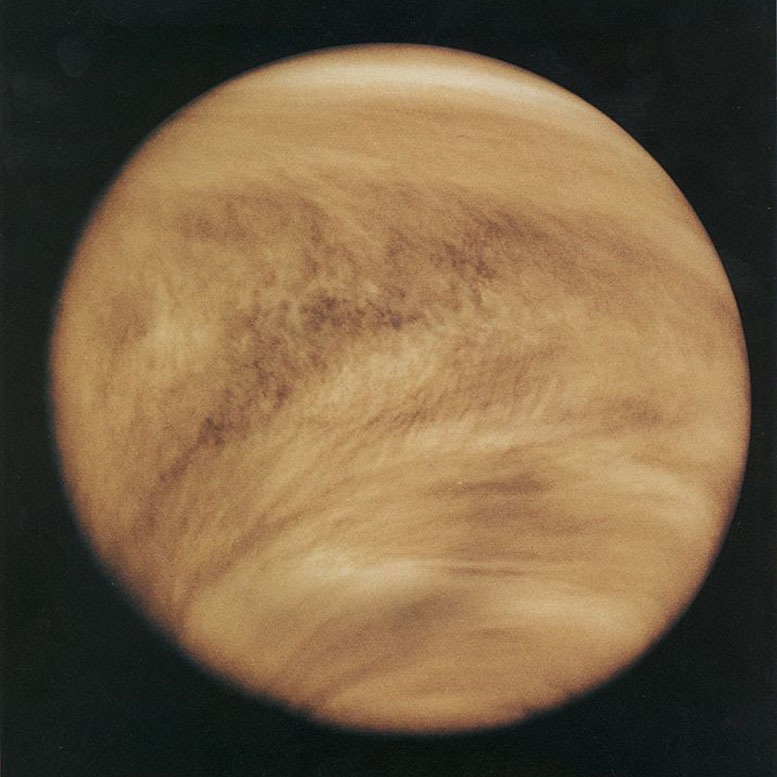
Theories abound as to what causes these streaked, contrasting features, Cottini said. One explanation is that convective processes dredge the absorber from deep within Venus’ thick cloud cover, transporting the substance to the cloud tops. Local winds disperse the material in the direction of the wind, creating the long streaks. Scientists theorize the bright areas as observed in the ultraviolet are probably stable against convection and do not contain the absorber, while the dark areas do.
“Since the maximum absorption of solar energy by Venus occurs in the ultraviolet, determining the nature, concentration, and distribution of the unknown absorber is fundamental,” Cottini said. “This is a highly-focused mission — perfect for a CubeSat application.”
To learn more about the absorber, the CUVE team, which includes Goddard scientists as well researchers affiliated with the University of Maryland and Catholic University, is leveraging investments Goddard has made in miniaturized instruments and other technologies. In addition to flying a miniaturized ultraviolet camera to add contextual information and capture the contrast features, CUVE would carry a Goddard-developed spectrometer to analyze light over a broad spectral band — 190-570 nanometers — covering the ultraviolet and visible. The team also plans to leverage investments in CubeSat navigation, electronics, and flight software.
“A lot of these concepts are driven by important Goddard research-and-development investments,” said Tilak Hewagama, a CUVE team member who has worked with Goddard scientists Shahid Aslam, Nicolas Gorius, and others to demonstrate a CubeSat-compatible spectrometer. “That’s what got us started.”
One of the other novel CUVE adaptations is the potential use of a lightweight telescope equipped with a mirror made of carbon nanotubes in an epoxy resin. To date, no one has been able to make a mirror using this resin.
Such optics offer several advantages. In addition to being lightweight and highly stable, they are relatively easy to reproduce. They do not require polishing — a time-consuming and often-times expensive process that assures a smooth, perfectly shaped surface.
Developed by Goddard contractor Peter Chen, the mirror is made by pouring a mixture of epoxy and carbon nanotubes into a mandrel, or mold, fashioned to meet a specific optical prescription. Technicians then heat the mold to cure and harden the epoxy. Once set, the mirror is coated with a reflective material made of aluminum and silicon dioxide.
Study Objectives
The team plans to further enhance the mission’s technologies and evaluate technical requirements to reach a polar orbit around Venus as a secondary payload. The team believes it would take CUVE one-and-a-half years to reach its destination. Once in orbit, the team would gather data for about six months.
“CUVE is a targeted mission, with a dedicated science payload and a compact bus to maximize flight opportunities such as a ride-share with another mission to Venus or to a different target,” Cottini said. “CUVE would complement past, current, and future Venus missions and provide great science return at lower cost.”
Small satellites, including CubeSats, are playing an increasingly larger role in exploration, technology demonstration, scientific research, and educational investigations at NASA, including: planetary space exploration; Earth observations; fundamental Earth and space science; and developing precursor science instruments like cutting-edge laser communications, satellite-to-satellite communications, and autonomous movement capabilities.
Never miss a breakthrough: Join the SciTechDaily newsletter.
Follow us on Google and Google News.