

Close Menu
    Facebook X (Twitter) Instagram
    SciTechDaily
    • Biology
    • Chemistry
    • Earth
    • Health
    • Physics
    • Science
    • Space
    • Technology
    Facebook X (Twitter) Pinterest YouTube RSS
    SciTechDaily
    Home»Space»NASA Emergency Beacons Saved 330 Lives in 2021
    Space

    NASA Emergency Beacons Saved 330 Lives in 2021

    By Danny Baird, ​NASA's Goddard Space Flight CenterJanuary 25, 2022No Comments2 Mins Read
    Facebook Twitter Pinterest Telegram LinkedIn WhatsApp Email Reddit
    Share
    Facebook Twitter LinkedIn Pinterest Telegram Email Reddit
    Ocean Rescue
    Ocean Rescue

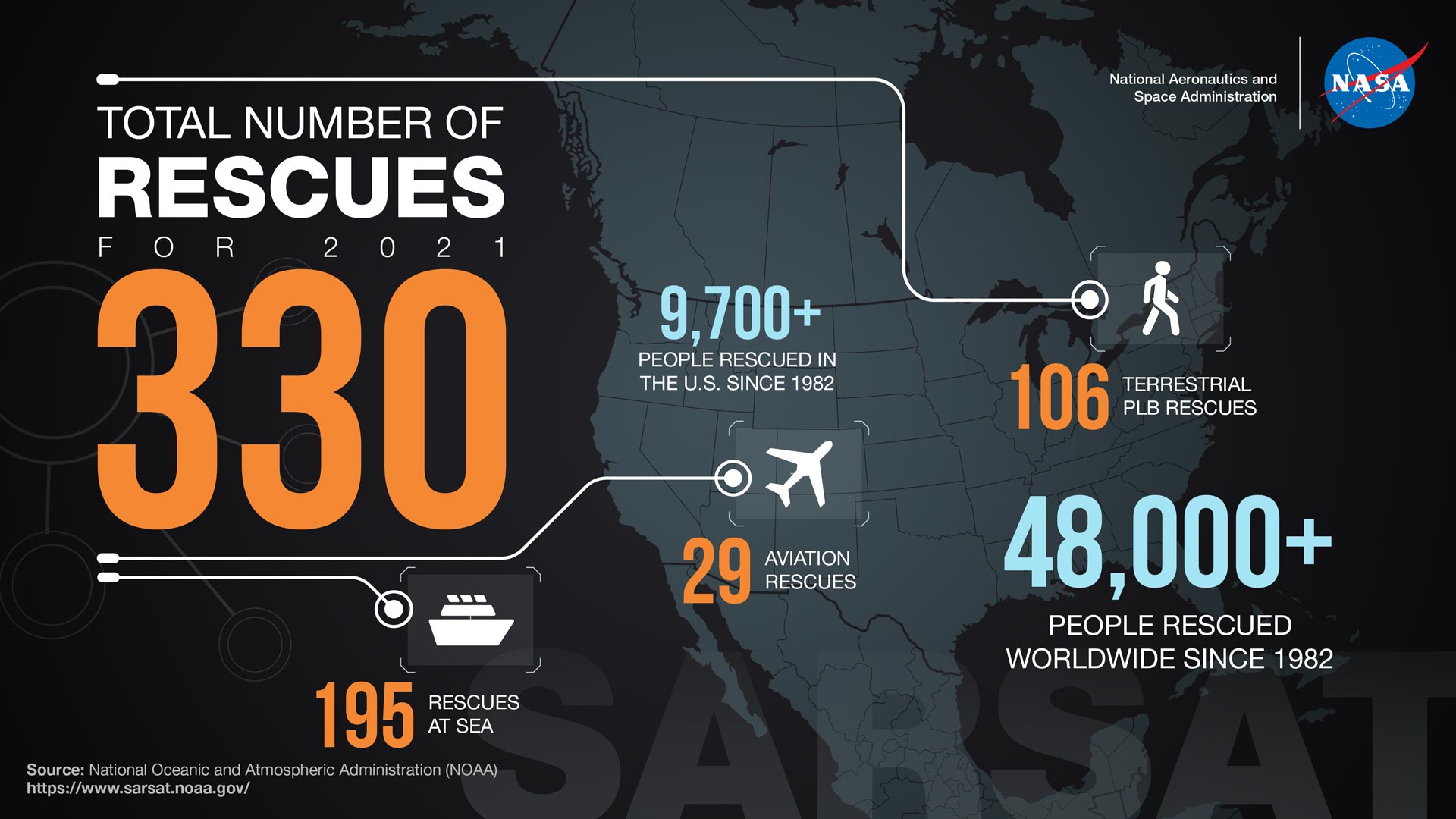
    The Cospas-Sarsat program, supported by NASA technology, saved 330 lives in 2021 using emergency beacons that provide accurate location information to first responders. NASA’s ongoing enhancements to the system include next-generation beacon technology and concepts for lunar search and rescue.

    In 2021, NASA technology saved 330 lives in the U.S. network region of the international satellite-aided search and rescue effort, Cospas-Sarsat. NASA has lent technical expertise to the Cospas-Sarsat program since its founding, aiding in the rescue of over 48,000 individuals globally. 

    Users purchasing commercially available 406 MHz frequency Cospas-Sarsat beacons have free access to the network, which provides accurate and reliable emergency location services. When users activate these beacons, they send signals through satellite instruments to ground stations that can calculate their position. The network then alerts first responders to the location and nature of the emergency.
    NASA Emergency Beacons Save Lives in 2021

    Beacons are available in three types: Personal Locator Beacons (PLBs), for use by hikers and other explorers; Emergency Position Indicating Radio Beacons (EPIRBs), designed for maritime use; and Emergency Locator Transmitters (ELTs) for aviation. In 2021, 106 rescues were PLBs, 195 were EPIRBS, and 29 were ELTs.

    In recent years, NASA’s Search and Rescue (SAR) office has helped Cospas-Sarsat to enhance its network with aviation studies, next-generation beacon technology, and new capabilities for Artemis astronauts. The office is also working on a lunar search and rescue concept, or LunaSAR, as part of NASA’s lunar network development effort, LunaNet.

    The National Oceanic and Atmospheric Administration (NOAA) manages the U.S. network region for Cospas-Sarsat, which relies on flight and ground technologies developed by SAR at NASA’s Goddard Space Flight Center in Greenbelt, Maryland. NASA’s Space Communications and Navigation (SCaN) program at NASA Headquarters provides strategic oversight to the SAR office. Saves are made by the U.S. Coast Guard, U.S. Air Force, and local rescue authorities.

    Never miss a breakthrough: Join the SciTechDaily newsletter.
    Follow us on Google and Google News.

    NASA NASA Goddard Space Flight Center
    Share. Facebook Twitter Pinterest LinkedIn Email Reddit

    Related Articles

    NASA’s DAVINCI Mission: A Daring Dive Into Venus’ Inferno

    Life on Mars? NASA’s Curiosity Rover Finds Prebiotic Clues in a 3.7-Billion-Year-Old Rock

    NASA’s Parker Solar Probe: The Fastest Spacecraft Ever Just Skimmed the Sun at 430,000 MPH

    The Andromeda Mystery: Hubble Discovers Strange Galactic Behavior

    NASA’s EZIE Mission Will Track Earth’s Hidden Electric Highways to Predict Space Storms

    3.7 Billion Miles Away: Hubble Uncovers a Hidden Trio That Could Rewrite Kuiper Belt History

    NASA’s PUNCH Is About to Capture Solar Storms Like Never Before

    Massive Solar Storm Unleashes Mysterious New Radiation Belts

    NASA Spots a Star and Planet Racing at 1.2 Million MPH – A Record-Breaking Discovery

    Leave A Reply Cancel Reply

    • Facebook
    • Twitter
    • Pinterest
    • YouTube

    Don't Miss a Discovery

    Subscribe for the Latest in Science & Tech!

    Trending News

    Scientists May Have Found the Key to Jupiter and Saturn’s Moon Mystery

    Scientists Uncover Brain Changes That Link Pain to Depression

    Saunas May Do More Than Raise Body Temperature – They Activate Your Immune System

    Exercise in a Pill? Metformin Shows Surprising Effects in Cancer Patients

    Hidden Oceans of Magma Could Be Protecting Alien Life

    New Study Challenges Alzheimer’s Theories: It’s Not Just About Plaques

    Artificial Sweeteners May Harm Future Generations, Study Suggests

    Splashdown! NASA Artemis II Returns From Record-Breaking Moon Mission

    Follow SciTechDaily
    • Facebook
    • Twitter
    • YouTube
    • Pinterest
    • Newsletter
    • RSS
    SciTech News
    • Biology News
    • Chemistry News
    • Earth News
    • Health News
    • Physics News
    • Science News
    • Space News
    • Technology News
    Recent Posts
    • Ancient DNA Reveals Irish Goats Have a 3,000-Year-Old Lineage Still Alive Today
    • Historians Reveal Secrets of the Strange Hat Wars That Shook Early Modern England
    • “A Plague Is Upon Us”: The Mass Death That Changed an Ancient City Forever
    • This Strange Material Can Turn Superconductivity on and off Like a Switch
    • Scientists Discover Game-Changing New Way To Treat High Cholesterol
    Copyright © 1998 - 2026 SciTechDaily. All Rights Reserved.
    • Science News
    • About
    • Contact
    • Editorial Board
    • Privacy Policy
    • Terms of Use

    Type above and press Enter to search. Press Esc to cancel.