
Close Menu
    Facebook X (Twitter) Instagram
    SciTechDaily
    • Biology
    • Chemistry
    • Earth
    • Health
    • Physics
    • Science
    • Space
    • Technology
    Facebook X (Twitter) Pinterest YouTube RSS
    SciTechDaily
    Home»Space»NASA Image of the Day Shows Light Echoes From V838 Mon
    Space

    NASA Image of the Day Shows Light Echoes From V838 Mon

    By NASA; Hubble Space TeelsciopeMarch 18, 2013No Comments4 Mins Read
    Facebook Twitter Pinterest Telegram LinkedIn WhatsApp Email Reddit
    Share
    Facebook Twitter LinkedIn Pinterest Telegram Email Reddit
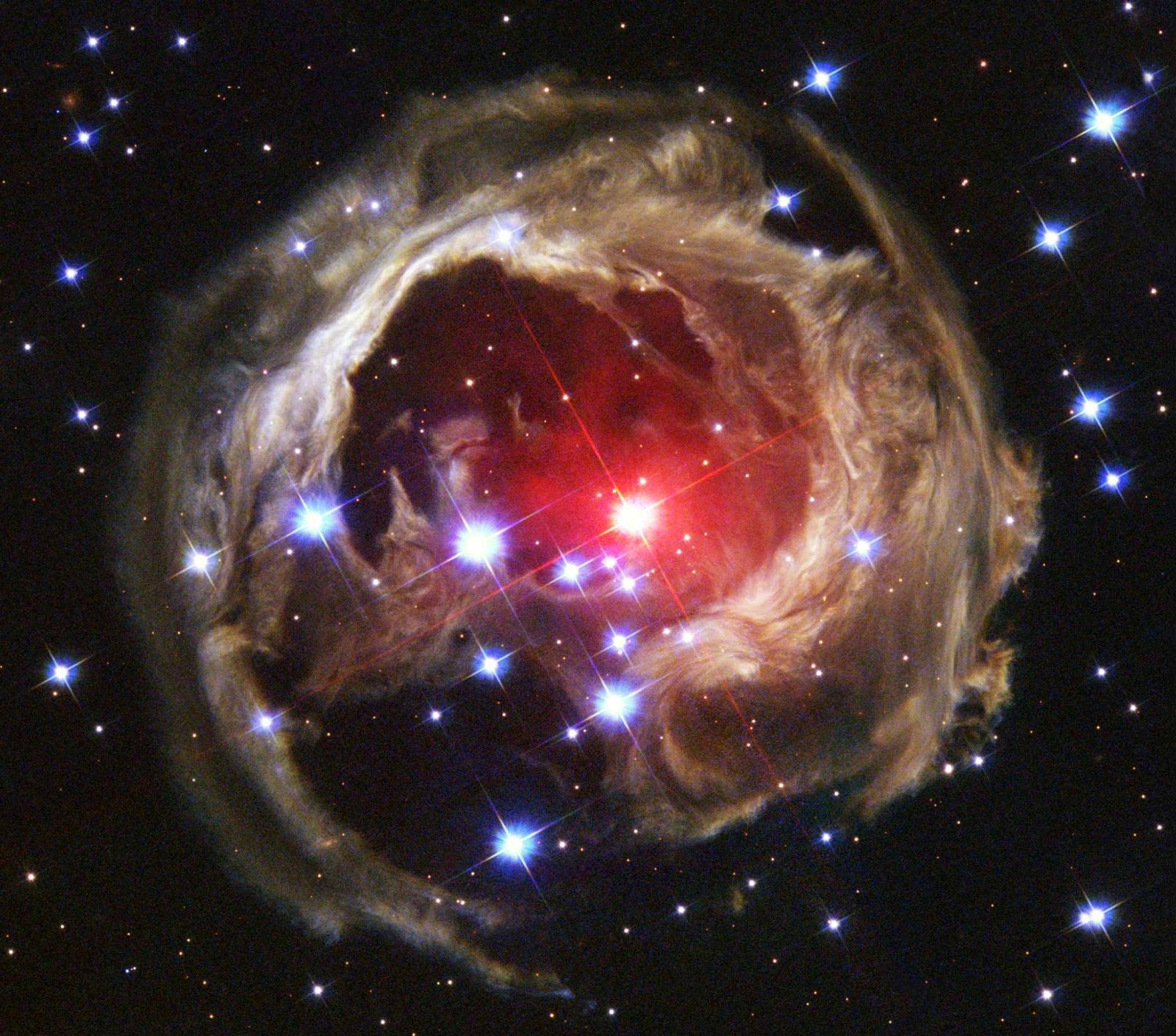
    V838 Monocerotis Light Echo
    Light Echoes from V838 Mon. Credit: NASA and the Hubble Heritage Team (AURA/STScI)

    This NASA image of the day shows the star V838 Monocerotis (V838 Mon) and its light echo.

    Light Echoes from V838 Mon

    What caused this outburst of V838 Mon? For reasons unknown, star V838 Mon’s outer surface suddenly greatly expanded with the result that it became the brightest star in the entire Milky Way Galaxy in January 2002. Then, just as suddenly, it faded. A stellar flash like this had never been seen before — supernovas and novas expel matter out into space. Although the V838 Mon flash appears to expel material into space, what is seen in the above image from the Hubble Space Telescope is actually an outwardly moving light echo of the bright flash.

    In a light echo, light from the flash is reflected by successively more distant rings in the complex array of ambient interstellar dust that already surrounded the star. V838 Mon lies about 20,000 light-years away toward the constellation of the unicorn (Monoceros), while the light echo above spans about six light-years in diameter.

    More information
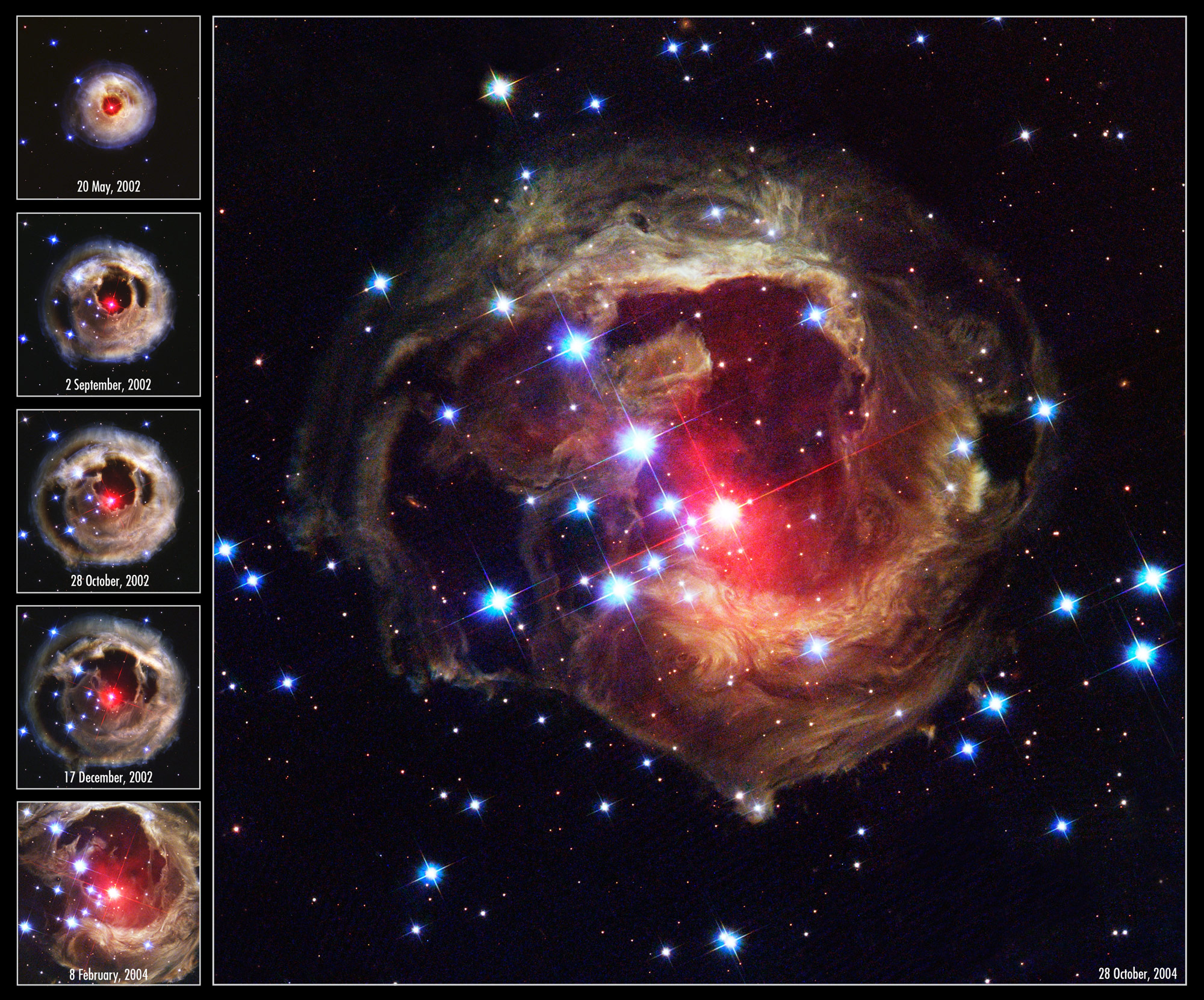
    Image of the Star V838 Monocerotis
    The Hubble Space Telescope’s latest image of the star V838 Monocerotis (V838 Mon) reveals dramatic changes in the illumination of surrounding dusty cloud structures. The effect, called a light echo, has been unveiling never-before-seen dust patterns ever since the star suddenly brightened for several weeks in early 2002. Credit: NASA and the Hubble Heritage Team (AURA/STScI)

    This Hubble Space Telescope image of the star V838 Monocerotis (V838 Mon) reveals dramatic changes in the illumination of surrounding dusty cloud structures. The effect, called a light echo, has been unveiling never-before-seen dust patterns ever since the star suddenly brightened for several weeks in early 2002.

    The illumination of interstellar dust comes from the red supergiant star in the middle of the image, which gave off a pulse of light three years ago, somewhat similar to setting off a flashbulb in a darkened room. The dust surrounding V838 Mon may have been ejected from the star during a previous explosion, similar to the 2002 event.

    The echoing of light through space is similar to the echoing of sound through air. As light from the stellar explosion continues to propagate outwards, different parts of the surrounding dust are illuminated, just as a sound echo bounces off of objects near the source, and later, objects further from the source. Eventually, when light from the back side of the nebula begins to arrive, the light echo will give the illusion of contracting, and finally it will disappear.

    V838 Mon is located about 20,000 light-years away from Earth in the direction of the constellation Monoceros, placing the star at the outer edge of our Milky Way galaxy. The Hubble telescope has imaged V838 Mon and its light echo several times since the star’s outburst. Each time Hubble observes the event, different thin sections of the dust are seen as the pulse of illumination continues to expand away from the star at the speed of light, producing a constantly changing appearance. During the outburst event whose light reached Earth in 2002, the normally faint star suddenly brightened, becoming 600,000 times more luminous than our Sun.

    The image of V838 Mon, taken in October 2004 with Hubble’s Advanced Camera for Surveys, was prepared from images obtained through filters that isolate blue, green, and infrared light. These images have been combined to produce a full-color picture that approximates the true colors of the light echo and the very red star near the center.

    Reference: “Light echo of V838 Monocerotis: properties of the echoing medium” by Romuald Tylenda and Tomasz Kaminski, 14 November 2012, Astronomy & Astrophysics.
    DOI: 10.1051/0004-6361/201219858

    Never miss a breakthrough: Join the SciTechDaily newsletter.
    Follow us on Google and Google News.

    Astronomy Astrophysics Hubble Space Telescope NASA
    Share. Facebook Twitter Pinterest LinkedIn Email Reddit

    Related Articles

    The Andromeda Mystery: Hubble Discovers Strange Galactic Behavior

    3.7 Billion Miles Away: Hubble Uncovers a Hidden Trio That Could Rewrite Kuiper Belt History

    Hubble Captures a Cosmic Bullseye, Revealing a Stunning Nine-Ring Galaxy

    Hubble Reveals a Star Disk Three Times Hotter Than the Sun’s Surface

    A Star’s Unexpected Heatwave: FU Orionis Challenges Astrophysics Models

    Legendary Star’s Smooth Disk Mystifies Astronomers, Challenges Planet Formation Theories

    Astronomers Baffled by Black Hole Jets Igniting Star Explosions

    The Big Bang’s Dark Legacy Revealed by Hubble: Unexpected Black Holes

    Historic Discovery: Twin Titans Clash As NASA Unveils Closest Supermassive Black Hole Duo

    Leave A Reply Cancel Reply

    • Facebook
    • Twitter
    • Pinterest
    • YouTube

    Don't Miss a Discovery

    Subscribe for the Latest in Science & Tech!

    Trending News

    Your Blood Pressure Reading Could Be Wrong Because of One Simple Mistake

    Astronomers Stunned by Ancient Galaxy With No Spin

    Physicists May Be on the Verge of Discovering “New Physics” at CERN

    Scientists Solve 320-Million-Year Mystery of Reptile Skin Armor

    Scientists Say This Daily Walking Habit May Be the Secret to Keeping Weight Off After Dieting

    New Therapy Rewires the Brain To Restore Joy in Depression Patients

    Giant Squid Detected off Western Australia in Stunning Deep-Sea Discovery

    Popular Sugar-Free Sweetener Linked to Liver Disease, Study Warns

    Follow SciTechDaily
    • Facebook
    • Twitter
    • YouTube
    • Pinterest
    • Newsletter
    • RSS
    SciTech News
    • Biology News
    • Chemistry News
    • Earth News
    • Health News
    • Physics News
    • Science News
    • Space News
    • Technology News
    Recent Posts
    • A Crucial Atlantic Current Is Weakening and Weather Could Change Worldwide
    • Scientists Stunned As Volcano Removes Methane From the Air
    • Scientists Discover Signs Africa May Be Splitting Apart Beneath Zambia
    • New Stroke Study Challenges Decades-Old Medical Beliefs
    • These Simple Plant Foods Are Linked to Lower Blood Pressure
    Copyright © 1998 - 2026 SciTechDaily. All Rights Reserved.
    • Science News
    • About
    • Contact
    • Editorial Board
    • Privacy Policy
    • Terms of Use

    Type above and press Enter to search. Press Esc to cancel.