
Close Menu
    Facebook X (Twitter) Instagram
    SciTechDaily
    • Biology
    • Chemistry
    • Earth
    • Health
    • Physics
    • Science
    • Space
    • Technology
    Facebook X (Twitter) Pinterest YouTube RSS
    SciTechDaily
    Home»Technology»NASA Runs First-Ever Test of New “Propulsor” Jet Engine Tech
    Technology

    NASA Runs First-Ever Test of New “Propulsor” Jet Engine Tech

    By Jan Wittry, NASA Glenn Research CenterDecember 7, 2016No Comments3 Mins Read
    Facebook Twitter Pinterest Telegram LinkedIn WhatsApp Email Reddit
    Share
    Facebook Twitter LinkedIn Pinterest Telegram Email Reddit
    NASA Tests New Jet Engine Tech
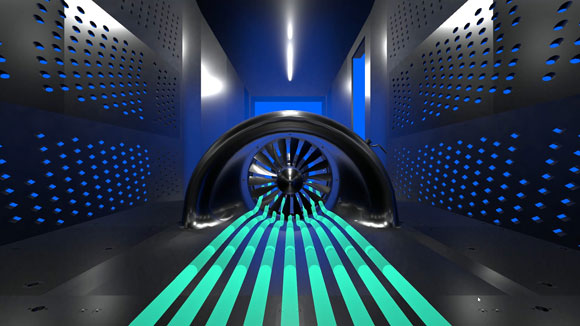
    Aerospace engineers are exploring the idea of embedding jet aircraft engines into the aircraft’s surfaces to reduce fuel burn by ingesting the boundary layer airflow that develops along the surfaces of the aircraft.

    Aerospace engineers believe that fuel consumption can be reduced by embedding an aircraft’s engines into the boundary layer and ingesting the airflow.

    Car, truck, train, and aircraft manufacturers have made great strides in recent years to reduce fuel consumption, resulting in consumer savings and lower emissions. With NASA’s help, the aircraft industry is striving to increase fuel efficiency even more.

    One way to do that is to create new aircraft engine designs. Engineers at NASA’s Glenn Research Center in Cleveland are testing a new fan and inlet design, commonly called a propulsor, which could increase fuel efficiency by four to eight percent more than the advanced engine designs airlines are beginning to use.

    On today’s jet aircraft, the engines are typically located away from the aircraft’s body to avoid ingesting the layer of slower flowing air that develops along the aircraft’s surfaces, called the boundary layer. Aerospace engineers believe they can reduce fuel burn by embedding an aircraft’s engines into these surfaces and ingesting the boundary layer airflow to propel the aircraft through its mission.

    It sounds like a simple design change, but it’s actually quite challenging. Boundary layer air flow is highly distorted, and that distortion affects the way the fan performs and operates. These new designs require a stronger fan.

    To address these challenges, NASA Glenn is testing a new propulsor in its 8’ x 6’ Transonic Wind Tunnel. Designed by the United Technologies Research Center with research conducted by Virginia Polytechnic and State University, the rugged boundary layer ingesting (BLI) inlet-fan combination is the first of its kind ever to be tested.


    This animation shows an engine fan and inlet ingesting boundary layer air in a wind tunnel. (no sound)

    “Studies backed by more detailed analyses have shown that boundary layer ingesting propulsors have the potential to significantly improve aircraft fuel efficiency,” said David Arend, a BLI propulsion expert at NASA Glenn. “If this new design and its enabling technologies can be made to work, the BLI propulsor will produce the required thrust with less propulsive power input. Additional aircraft drag and weight reduction benefits have also been identified.”

    The highly experimental tests required years of preparation. Many industry, NASA and academic experts contributed to the design and analysis of the propulsor. NASA Glenn engineers also modified the wind tunnel to accept a larger model, a boundary layer control system, and a way to power the experiment.

    “We have generated a unique test capability that doesn’t exist anywhere in the country for testing boundary layer ingesting propulsors,” said Jim Heidmann, manager of NASA’s Advanced Air Transport Technologies project.

    Throughout testing, the team will change the wind speed and vary the boundary layer thickness and fan operation to see how these changes affect the propulsor’s performance, operability, and structure. Results of the tests will be applicable to multiple cutting-edge aircraft designs being pursued by NASA as well as by its academic and private industry partners.

    Never miss a breakthrough: Join the SciTechDaily newsletter.
    Follow us on Google and Google News.

    Aeronautics Engineering NASA
    Share. Facebook Twitter Pinterest LinkedIn Email Reddit

    Related Articles

    New “Morphing” Wing Could Enable More Efficient Plane Flight

    NASA to Begin Historic New Era of X-Plane Research

    NASA Engineers Successfully Test Heat Shield for Future Mars Exploration Vehicles

    Engineers Developing ‘Hedgehog’ Robots That Hop and Tumble in Microgravity

    “Windbots” – The Future Explorers of Planetary Skies?

    Distributed Electric Propulsion May Usher in a New Era of Flight

    Testing Environment for Future Astronaut Expeditions into Deep Space

    NASA Begins Testing Electric Propulsion Technologies

    NASA to Test Jet Engine With a Helping of Cereal and Crayons

    Leave A Reply Cancel Reply

    • Facebook
    • Twitter
    • Pinterest
    • YouTube

    Don't Miss a Discovery

    Subscribe for the Latest in Science & Tech!

    Trending News

    Don’t Miss: A Brilliant Venus and Glowing Harvest Moon Light Up the Sky

    New Twist on the Einstein Problem Reveals Unexpected Physics

    JWST Captures Stunning Evidence of How Supermassive Black Holes Feed

    Early Exercise May Permanently Change How Much Energy the Body Uses To Move

    New Molecule Wipes Out Aggressive Lymphoma Tumors in Mice in Just 11 Days

    The Human Family Tree May Need a Major Rewrite

    Scientists Find a Surprising Cancer-Fighting Effect in Dark Sweet Cherries

    New AI Detects Hidden Warning Signs of Solar Eruptions Hours Before They Emerge

    Follow SciTechDaily
    • Facebook
    • Twitter
    • YouTube
    • Pinterest
    • Newsletter
    • RSS
    SciTech News
    • Biology News
    • Chemistry News
    • Earth News
    • Health News
    • Physics News
    • Science News
    • Space News
    • Technology News
    Recent Posts
    • Africa’s Giant Herbivores Were Disappearing Millions of Years Before Humans Could Hunt Them
    • This Utah Mountain Is Hiding Enough Ice To Fill 600 Olympic Pools
    • Vagus Nerve Stimulation Could Unlock the Brain’s Hidden Learning Potential
    • Your Mother’s Age May Leave a Biological Mark That Lasts for Generations
    • Women Who Ate More Antioxidants Had Strikingly Lower Rates of Cervical Cancer
    Copyright © 1998 - 2026 SciTechDaily. All Rights Reserved.
    • Science News
    • About
    • Contact
    • Editorial Board
    • Privacy Policy
    • Terms of Use

    Type above and press Enter to search. Press Esc to cancel.