
Close Menu
    Facebook X (Twitter) Instagram
    SciTechDaily
    • Biology
    • Chemistry
    • Earth
    • Health
    • Physics
    • Science
    • Space
    • Technology
    Facebook X (Twitter) Pinterest YouTube RSS
    SciTechDaily
    Home»Earth»NASA Satellite’s Infrared Eye Analyzes Typhoon Lingling
    Earth

    NASA Satellite’s Infrared Eye Analyzes Typhoon Lingling

    By Rob Gutro, NASA’s Goddard Space Flight CenterSeptember 3, 2019No Comments2 Mins Read
    Facebook Twitter Pinterest Telegram LinkedIn WhatsApp Email Reddit
    Share
    Facebook Twitter LinkedIn Pinterest Telegram Email Reddit
    NASA Terra MODIS Typhoon Lingling
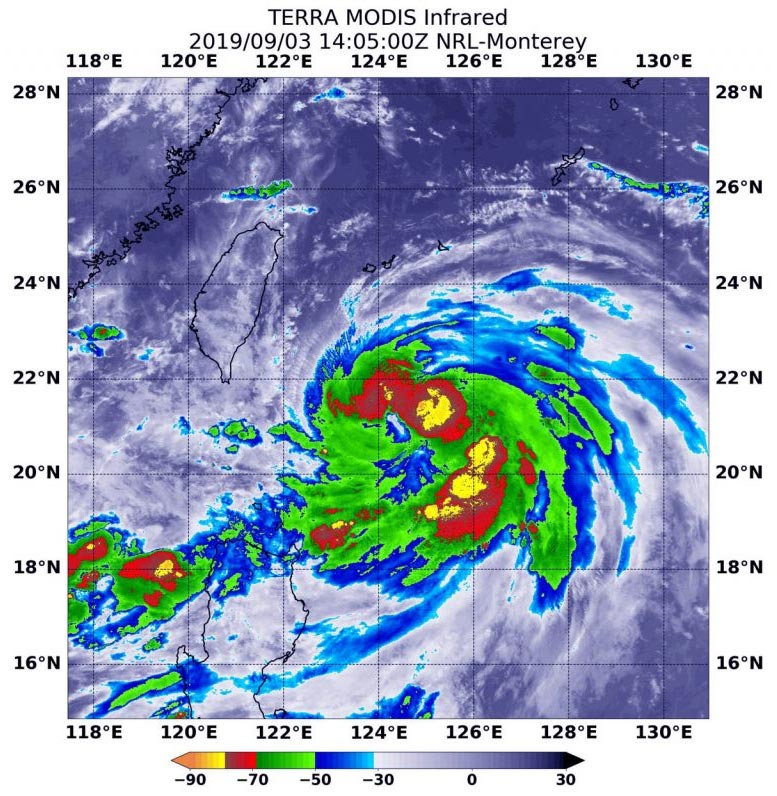
    On September 3 at 12:05 p.m. EDT (1405 UTC) the MODIS instrument that flies aboard NASA’s Terra satellite showed areas northeast and southeast of Typhoon Lingling’s center where cloud top temperatures were as cold as minus 80 degrees Fahrenheit (minus 62.2 Celsius). Credit: NASA/NRL

    The storm that became Typhoon Lingling strengthened very quickly in the Northwestern Pacific Ocean and infrared imagery from NASA revealed the powerful thunderstorms fueling that intensification.

    Lingling formed on September 2 as Tropical Depression 15W and strengthened quickly into a tropical storm and then a typhoon. Although Lingling is to the northeast of Luzon, northern Philippines, there are still some warning signals in effect on September 3. Tropical cyclone wind signal #1 is in effect over the Luzon province of Batanes.

    On September 3 at 12:05 p.m. EDT (1405 UTC), the Moderate Imaging Spectroradiometer or MODIS instrument that flies aboard NASA’s Terra satellite used infrared light to analyze the strength of storms within the typhoon. NASA researches these storms to determine how they rapidly intensify, develop and behave.

    Tropical cyclones are made of up hundreds of thunderstorms, and infrared data can show where the strongest storms are located. They can do that because infrared data provides temperature information, and the strongest thunderstorms that reach highest into the atmosphere have the coldest cloud top temperatures.

    MODIS found those strongest storms were northeast and southeast of the center of circulation where cloud top temperatures were as cold as minus 80 degrees Fahrenheit (minus 62.2 Celsius). NASA research has found that cloud top temperatures that cold indicate strong storms with the potential to generate heavy rainfall.

    At 11 a.m. EDT (1500 UTC), the Joint Typhoon Warning Center or JTWC said that Typhoon Lingling, known locally in the Philippines as Liwayway was located near 21.4 degrees north latitude and 124.2 degrees east longitude. That is 364 nautical miles southwest of Kadena Air Base, Okinawa, Japan. Lingling was moving to the north and had maximum sustained winds near 65 knots (75 mph/120.3 kph).

    JTWC forecasters said that Lingling is moving north and is expected to intensify to 100 knots (115 mph/185 kph) upon passing east of Taiwan. The system will then weaken on approach to the Korean peninsula, but still be at typhoon strength.

    Never miss a breakthrough: Join the SciTechDaily newsletter.
    Follow us on Google and Google News.

    NASA NASA Goddard Space Flight Center Typhoon
    Share. Facebook Twitter Pinterest LinkedIn Email Reddit

    Related Articles

    NASA Satellite Finds Haishen Now a Super Typhoon – With a 31 Mile-Wide Eye

    NASA Estimates Hurricane Dorian’s Rain Using Data From a Fleet of Satellites

    NASA Analyzes Tropical Storm Dorian Day and Night

    NASA Satellite Image: Amazon Fires Shroud South America in Smoke

    Astronomers Track the Source of Slow Solar Wind

    MMS Mission to Give Unique Look at Magnetic Reconnection

    Dynamic Earth Excerpt and Visuals

    NASA Study Reveals Multi-Year Ice Declining Faster than Perennial Ice that Surrounds It

    NASA’s GISS Releases Data Showing 2011 was Ninth-Warmest Year on Record

    Leave A Reply Cancel Reply

    • Facebook
    • Twitter
    • Pinterest
    • YouTube

    Don't Miss a Discovery

    Subscribe for the Latest in Science & Tech!

    Trending News

    Scientists Discover Bizarre 100-Million-Year-Old Insect With Giant Claws

    Scientists Discover “Good” Gut Microbes That Could Protect Against Autism and ADHD

    Scientists Reveal That Eating Almonds Every Day Could Transform Your Gut, Metabolism, and Appetite

    Scientists May Have Solved Two of Fusion Energy’s Biggest Problems at Once

    Scientists Discover Hidden “Switch” That Burns Fat and Could Treat Bone Disease

    After 50 Years of Mystery, Researchers Identify New Human Blood Group

    Beyond Pain Relief: Scientists Discover a Protein That Could Stop Osteoarthritis in Its Tracks

    Scientists Discover Why Alcohol Prevents the Liver From Healing, Even After You Quit

    Follow SciTechDaily
    • Facebook
    • Twitter
    • YouTube
    • Pinterest
    • Newsletter
    • RSS
    SciTech News
    • Biology News
    • Chemistry News
    • Earth News
    • Health News
    • Physics News
    • Science News
    • Space News
    • Technology News
    Recent Posts
    • Earth’s Upper Atmosphere Is Cooling Fast and Scientists Finally Know Why
    • 32,000 Olympic Pools of Magma Nearly Erupted Beneath Atlantic Island
    • Scientists May Have Found Dark Matter’s Fingerprint in a Black Hole Collision
    • Exercise Changes the Heart in a Way Researchers Never Expected
    • Scientists Warn Ultra-Processed Foods Could Be Hurting Your Brain
    Copyright © 1998 - 2026 SciTechDaily. All Rights Reserved.
    • Science News
    • About
    • Contact
    • Editorial Board
    • Privacy Policy
    • Terms of Use

    Type above and press Enter to search. Press Esc to cancel.