
Close Menu
    Facebook X (Twitter) Instagram
    SciTechDaily
    • Biology
    • Chemistry
    • Earth
    • Health
    • Physics
    • Science
    • Space
    • Technology
    Facebook X (Twitter) Pinterest YouTube RSS
    SciTechDaily
    Home»Space»NASA To Launch Double Asteroid Redirection Test Mission – Preventing a Hazardous Asteroid From Striking Earth
    Space

    NASA To Launch Double Asteroid Redirection Test Mission – Preventing a Hazardous Asteroid From Striking Earth

    By NASAOctober 5, 2021No Comments4 Mins Read
    Facebook Twitter Pinterest Telegram LinkedIn WhatsApp Email Reddit
    Share
    Facebook Twitter LinkedIn Pinterest Telegram Email Reddit
    Double Asteroid Redirection Test Illustration
    Illustration of NASA’s DART spacecraft and the Italian Space Agency’s (ASI) LICIACube prior to impact at the Didymos binary system. Credit: NASA/Johns Hopkins, APL/Steve Gribben

    NASA’s DART mission will test asteroid deflection by crashing into Didymos’ moonlet at high speed. The mission will measure how the collision changes the moonlet’s orbit, serving as a planetary defense trial and a showcase for new space propulsion technology.

    NASA is ready for the upcoming launch of NASA’s Double Asteroid Redirection Test (DART) mission, an evaluation of technologies for preventing a hazardous asteroid from striking Earth.

    DART is targeted to launch at 10:20 p.m. PST, November 23, 2021, (1:20 a.m. EST, November 24), aboard a SpaceX Falcon 9 rocket from Vandenberg Space Force Base in California. Live coverage of the launch will air on NASA TV, the NASA app, and the agency’s website.

    DART will be the first demonstration of the kinetic impactor technique, which involves sending one or more large, high-speed spacecraft into the path of an asteroid in space to change its motion. Its target is the binary near-Earth asteroid Didymos and its moonlet.
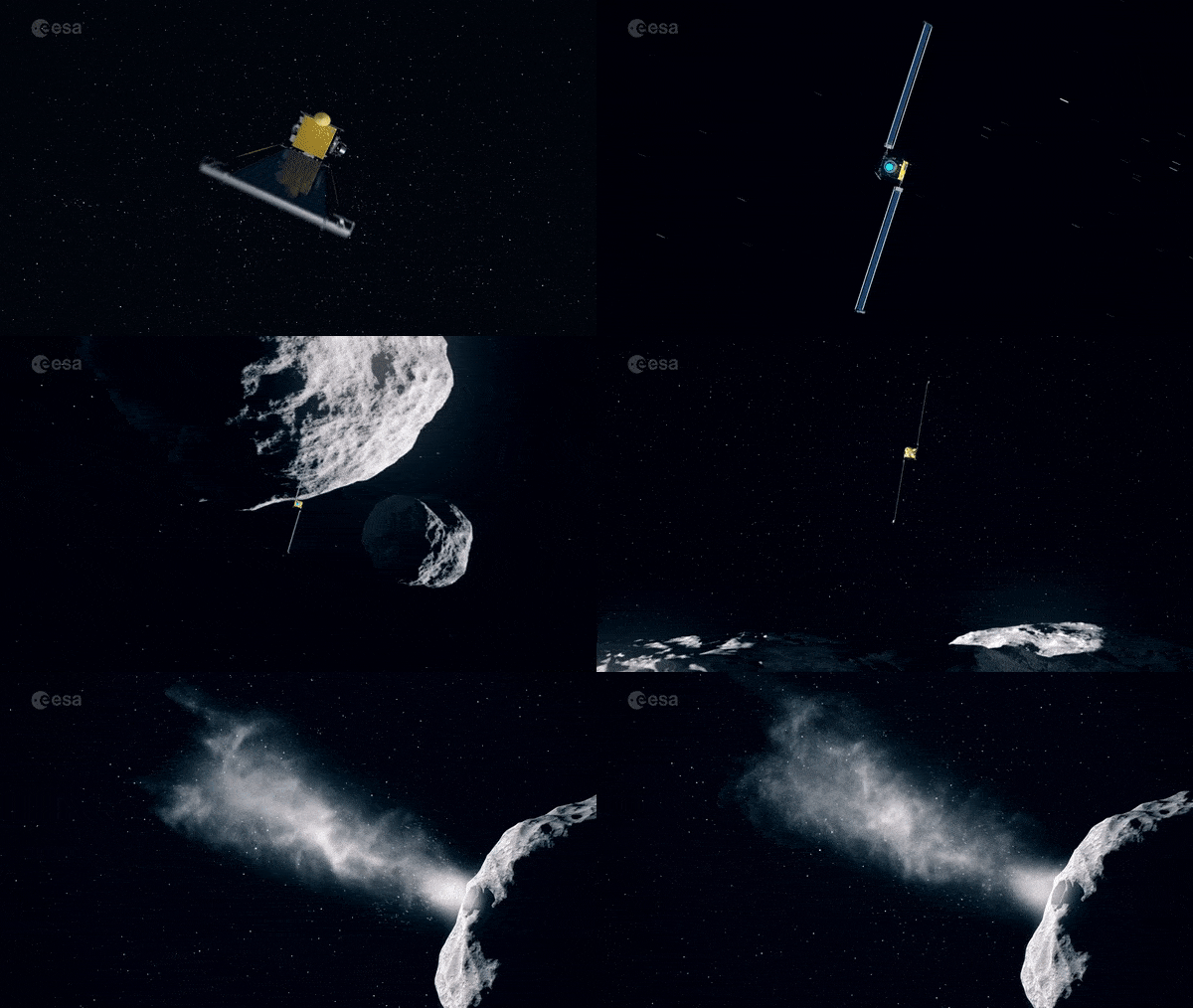
    NASA DART Impacting Asteroid
    NASA’s Double Asteroid Redirect Test, DART, mission is intended to collide with the smaller of two bodies of the Didymos binary asteroid system in autumn 2022. Credit: ESA

    DART is a planetary defense-driven test of technologies for preventing an impact of Earth by a hazardous asteroid. DART will be the first demonstration of the kinetic impactor technique to change the motion of an asteroid in space.

    The binary near-Earth asteroid (65803) Didymos is the target for the DART demonstration. While the Didymos primary body is approximately 780 meters (2,560 feet) across, its secondary body (or “moonlet”) is about 160 meters (525 feet) in size, which is more typical of the size of asteroids that could pose the most likely significant threat to Earth. The Didymos binary is being intensely observed using telescopes on Earth to precisely measure its properties before DART arrives.

    The DART spacecraft will achieve the kinetic impact deflection by deliberately crashing itself into the moonlet at a speed of approximately 6.6 km/s (4.1 mi/s), with the aid of an onboard camera (named DRACO) and sophisticated autonomous navigation software. The collision will change the speed of the moonlet in its orbit around the main body by a fraction of one percent, but this will change the orbital period of the moonlet by several minutes – enough to be observed and measured using telescopes on Earth.
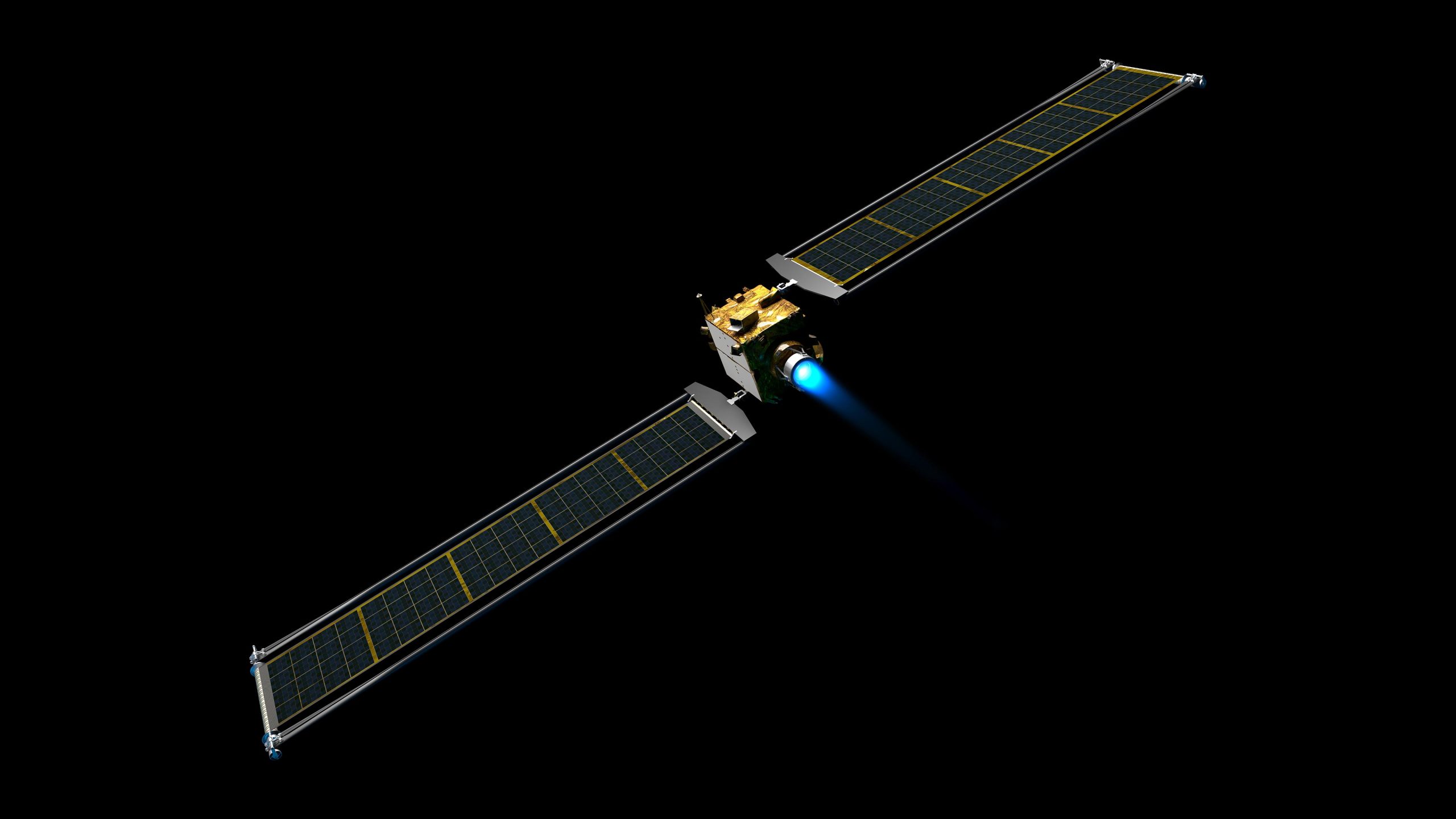
    DART Spacecraft With ROSA Arrays
    Illustration of the DART spacecraft with the Roll Out Solar Arrays (ROSA) extended. Each of the two ROSA arrays is 8.6 meters by 2.3 meters (28.2 feet by 7.5 feet). Credit: NASA

    Once launched, DART will deploy Roll Out Solar Arrays (ROSA) to provide the solar power needed for DART’s electric propulsion system. The DART spacecraft will demonstrate the NASA Evolutionary Xenon Thruster – Commercial (NEXT-C) solar electric propulsion system as part of its in-space propulsion. NEXT-C is a next-generation system based on the Dawn spacecraft propulsion system, and was developed at NASA’s Glenn Research Center in Cleveland, Ohio. By utilizing electric propulsion, DART could benefit from significant flexibility to the mission timeline while demonstrating the next generation of ion engine technology, with applications to potential future NASA missions.

    DART will launch aboard a SpaceX Falcon 9 rocket from Vandenberg Air Force Base, California. After separation from the launch vehicle and over a year of cruise it will intercept Didymos’ moonlet in late September 2022, when the Didymos system is within 11 million kilometers of Earth, enabling observations by ground-based telescopes and planetary radar to measure the change in momentum imparted to the moonlet.

    Never miss a breakthrough: Join the SciTechDaily newsletter.
    Follow us on Google and Google News.

    Asteroid Kennedy Space Center NASA NASA DART Planetary Defense Popular
    Share. Facebook Twitter Pinterest LinkedIn Email Reddit

    Related Articles

    Planetary Defense Success! NASA’s DART Data Validates Asteroid Kinetic Impact Method

    Success! Stunning NASA Dart Imagery Confirms Target Asteroid Orbit Changed

    Successful Impact! NASA’s DART Mission Hits Asteroid in Historic Planetary Defense Test

    See DART’s Final Images Before Asteroid Impact

    NASA’s Planetary Defense Test: DART About To Impact an Asteroid

    NASA’s DART Spacecraft Sets Sights on Asteroid Target

    NASA’s DART Confirmed on Target To Impact Asteroid Dimorphos

    Planetary Defense: Study Finds That NASA’s DART Spacecraft Could Obliterate Asteroids

    We Asked a NASA Scientist: What if an Asteroid Was Going To Hit Earth? [Video]

    Leave A Reply Cancel Reply

    • Facebook
    • Twitter
    • Pinterest
    • YouTube

    Don't Miss a Discovery

    Subscribe for the Latest in Science & Tech!

    Trending News

    Scientists Say This Simple Supplement May Actually Reverse Heart Disease

    Warming Oceans Could Trigger a Dangerous Methane Surge

    This Simple Movement Could Be Secretly Cleaning Your Brain

    Male Birth Control Breakthrough: Scientists Find Way To Turn Sperm Production Off and Back On

    A Common Vitamin Could Hold the Key to Treating Fatty Liver Disease

    New Research Shows Vitamin B12 May Hold the Key to Healthy Aging

    These Simple Daily Habits Can Quickly Improve Blood Pressure and Heart Risk Factors

    A Common Nutrient May Play a Surprising Role in Anxiety

    Follow SciTechDaily
    • Facebook
    • Twitter
    • YouTube
    • Pinterest
    • Newsletter
    • RSS
    SciTech News
    • Biology News
    • Chemistry News
    • Earth News
    • Health News
    • Physics News
    • Science News
    • Space News
    • Technology News
    Recent Posts
    • Scientists Just Exposed a 300 Million-Year-Old Fossil Mistake
    • Ravens Don’t Follow Wolves, They Predict Them
    • This Common Knee Surgery May Be Doing More Harm Than Good
    • Scientists Discover a New Way To Control Metals at the Atomic Scale
    • Scientists Create “Quantum Sound” Device That Works Near Absolute Zero
    Copyright © 1998 - 2026 SciTechDaily. All Rights Reserved.
    • Science News
    • About
    • Contact
    • Editorial Board
    • Privacy Policy
    • Terms of Use

    Type above and press Enter to search. Press Esc to cancel.