
NASA’s innovative propulsion technology propels small spacecraft exploration and extends satellite lifetimes, supporting U.S. leadership in space technology.
NASA has developed an advanced propulsion technology to facilitate future planetary exploration missions using small spacecraft. Not only will this technology enable new types of planetary science missions, one of NASA’s commercial partners is already preparing to use it for another purpose—to extend the lifetimes of spacecraft that are already in orbit. Identifying the opportunity for industry to use this new technology not only advances NASA’s goal of technology commercialization, it could potentially create a path for NASA to acquire this important technology from industry for use in future planetary missions.
The New Technology
Planetary science missions using small spacecraft will be required to perform challenging propulsive maneuvers—such as achieving planetary escape velocities, orbit capture, and more—that require a velocity change (delta-v) capability well in excess of typical commercial needs and the current state-of-the-art. Therefore, the #1 enabling technology for these small spacecraft missions is an electric propulsion system that can execute these high-delta-v maneuvers. The propulsion system must operate using low power (sub-kilowatt) and have high-propellant throughput (i.e., the capability to use a high total mass of propellant over its lifetime) to enable the impulse required to execute these maneuvers.
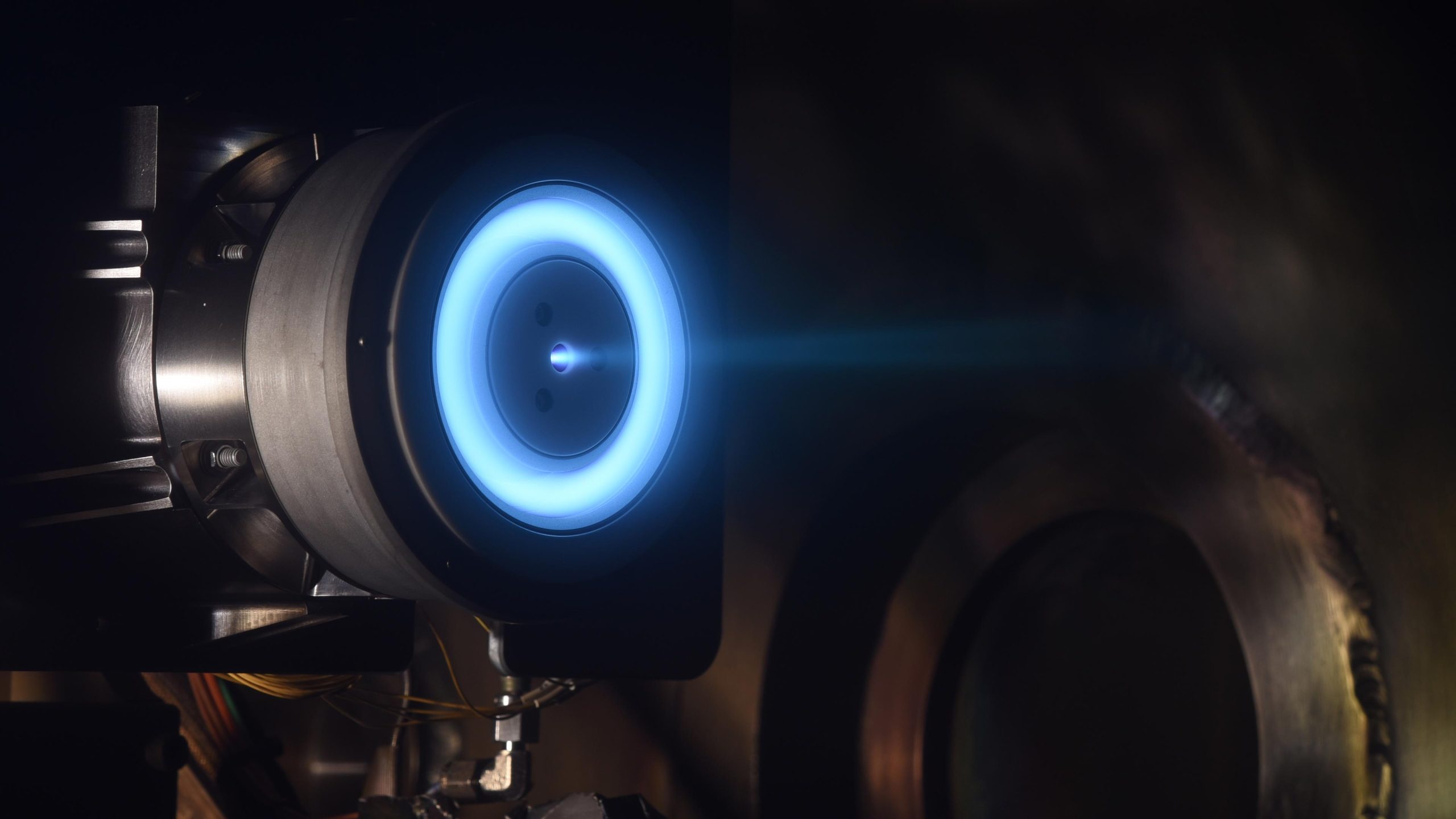
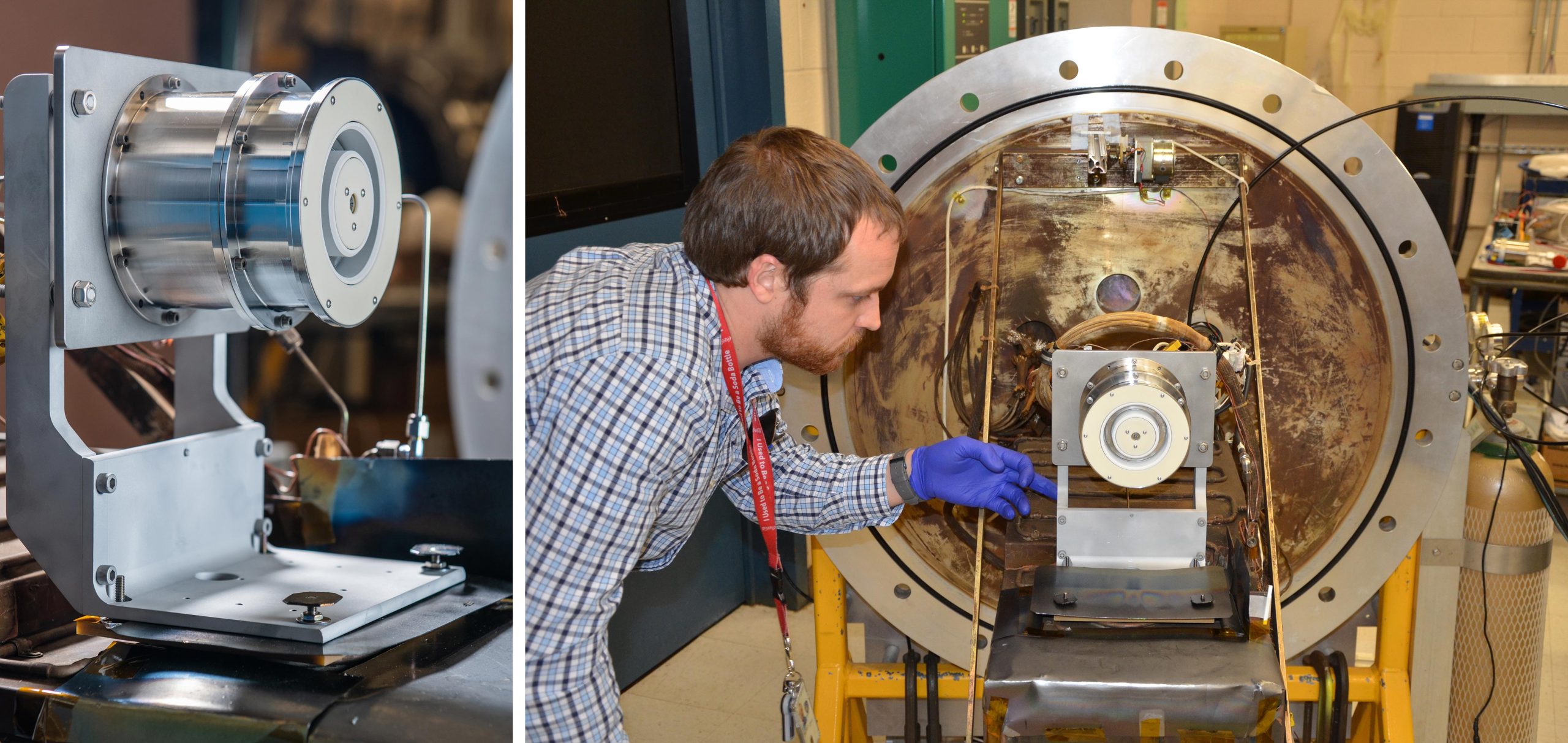
After many years of research and development, researchers at NASA Glenn Research Center (GRC) have created a small spacecraft electric propulsion system to meet these needs—the NASA-H71M sub-kilowatt Hall-effect thruster. In addition, the successful commercialization of this new thruster will soon provide at least one such solution to enable the next generation of small spacecraft science missions requiring up to an amazing 8 km/s of delta-v. This technical feat was accomplished by the miniaturization of many advanced high-power solar electric propulsion technologies developed over the last decade for applications such as the Power and Propulsion Element of Gateway, humanity’s first space station around the Moon.
Benefits of This Technology for Planetary Exploration
Small spacecraft using the NASA-H71M electric propulsion technology will be able to independently maneuver from low-Earth orbit (LEO) to the Moon or even from a geosynchronous transfer orbit (GTO) to Mars. This capability is especially remarkable because commercial launch opportunities to LEO and GTO have become routine, and the excess launch capacity of such missions is often sold at low cost to deploy secondary spacecraft. The ability to conduct missions that originate from these near-Earth orbits can greatly increase the cadence and lower the cost of lunar and Mars science missions.
This propulsion capability will also increase the reach of secondary spacecraft, which have been historically limited to scientific targets that align with the primary mission’s launch trajectory. This new technology will enable secondary missions to substantially deviate from the primary mission’s trajectory, which will facilitate exploration of a wider range of scientific targets.
In addition, these secondary spacecraft science missions would typically have only a short period of time to collect data during a high-speed flyby of a distant body. This greater propulsive capability will allow deceleration and orbital insertion at planetoids for long-term scientific study.
Furthermore, small spacecraft outfitted with such significant propulsive capability will be better equipped to manage late-stage changes to the primary mission’s launch trajectory. Such changes are frequently a top risk for small spacecraft science missions with limited onboard propulsive capability that depend on the initial launch trajectory to reach their science target.
Commercial Applications
The megaconstellations of small spacecraft now forming in low-Earth orbits have made low-power Hall-effect thrusters the most abundant electric propulsion system used in space today. These systems use propellant very efficiently, which allows for orbit insertion, de-orbiting, and many years of collision avoidance and re-phasing. However, the cost-conscious design of these commercial electric propulsion systems has inevitably limited their lifetime capability to typically less than a few thousand hours of operation and these systems can only process about 10% or less of a small spacecraft’s initial mass in propellant.
By contrast, planetary science missions benefiting from the NASA-H71M electric propulsion system technology could operate for 15,000 hours and process over 30% of the small spacecraft’s initial mass in propellant. This game-changing capability is well beyond the needs of most commercial LEO missions and comes at a cost premium that makes commercialization for such applications unlikely. Therefore, NASA sought and continues to seek partnerships with companies developing innovative commercial small spacecraft mission concepts with unusually large propellant throughput requirements.

One partner that will soon use the licensed NASA electric propulsion technology in a commercial small spacecraft application is SpaceLogistics, a wholly-owned subsidiary of Northrop Grumman. The Mission Extension Pod (MEP) satellite servicing vehicle is equipped with a pair of Northrop Grumman NGHT-1X Hall-effect thrusters, whose design is based on the NASA-H71M. The small spacecraft’s large propulsive capability will allow it to reach geosynchronous Earth orbit (GEO) where it will be mounted on a far larger satellite. Once installed, the MEP will serve as a “propulsion jet pack” to extend the life of its host spacecraft for at least six years.
Northrop Grumman is currently conducting a long duration wear test (LDWT) of the NGHT-1X in GRC’s Vacuum Facility 11 to demonstrate its full lifetime operational capability. The LDWT is funded by Northrop Grumman through a fully reimbursable Space Act Agreement. The first MEP spacecraft are expected to launch in 2025, where they will extend the life of three GEO communication satellites.
Collaborating with U.S. industry to find small spacecraft applications with propulsive requirements similar to future NASA planetary science missions not only supports U.S. industry in remaining a global leader in commercial space systems but creates new commercial opportunities for NASA to acquire these important technologies as planetary missions require them.
NASA continues to mature the H71M electric propulsion technologies to expand the range of data and documentation available to U.S. industry for the purpose of developing similarly advanced and highly capable low-power electric propulsion devices.
Never miss a breakthrough: Join the SciTechDaily newsletter.
Follow us on Google and Google News.
6 Comments
I’m still waiting for a propulsion system that can take spacecraft to the outer planets in weeks instead of years.
First, we build factories, on the Moon, underground factory. Then will build something the size of an Aircraft Carrier in Space and a space Station in the moons orbit. The Sides can hold water which will prevent radiation.
Use say a Number of small Nuclear Reactors, then use those to power say 1000 ION thrusters.
We should have been launching new versions of Voyager in all directions for the last 20 years and launching Communication Relays to exist on the edge of our space. We are running out of time.
Where is Zefrem Cochran when we need him?
Is not “velocity change (delta-v) capability a complicated way, probably coined by an advertising guru, of saying “acceleration”?
I found something about the above at https://science.nasa.gov/science-research/science-enabling-technology/pushing-the-limits-of-sub-kilowatt-electric-propulsion-technology-to-enable-planetary-exploration-and-commercial-mission-concepts/.
I like the information