
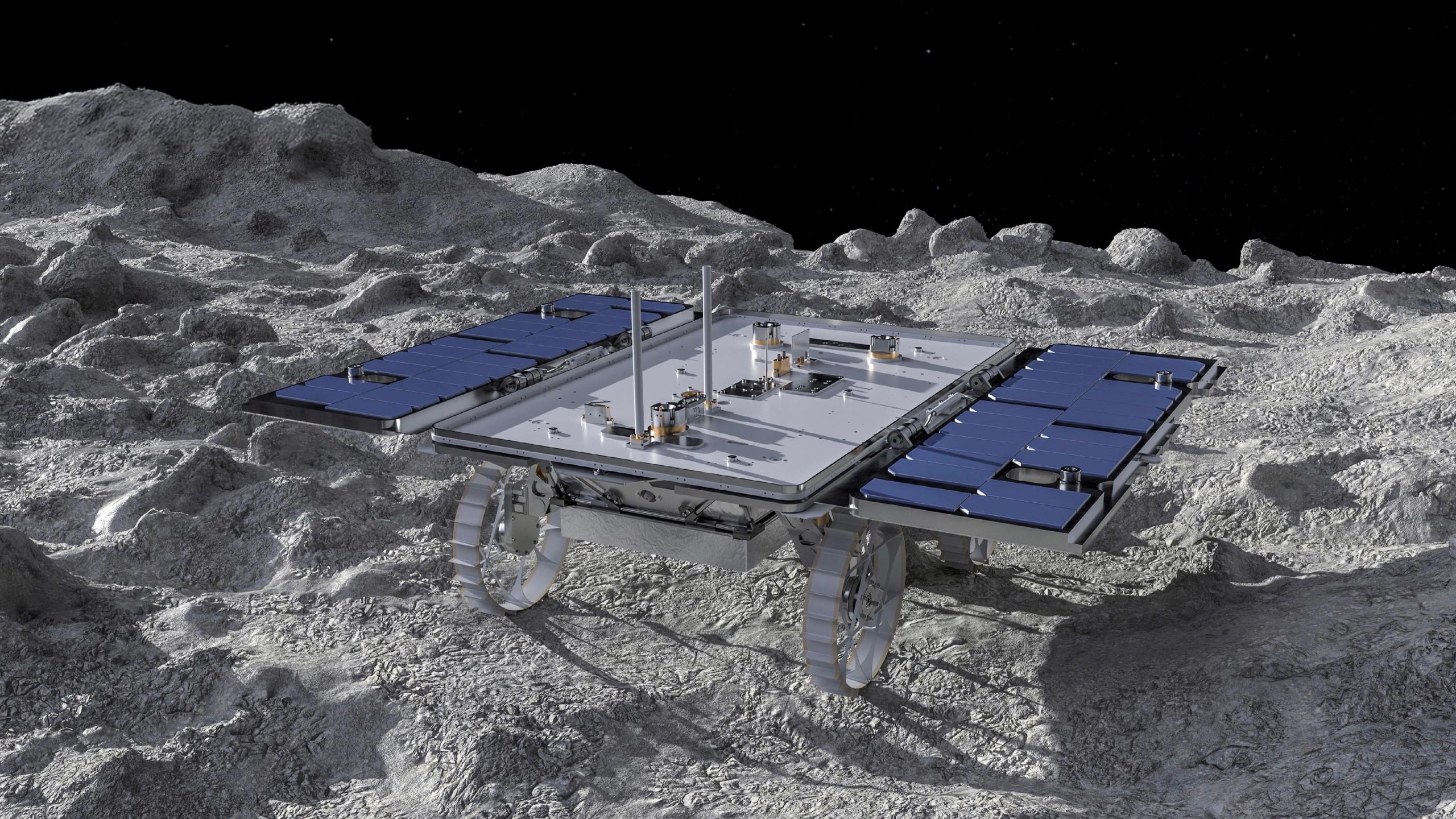
NASA’s trio of autonomous rovers is heading to the Moon as part of the CADRE mission, a groundbreaking experiment in robotic teamwork.
These suitcase-sized explorers will operate independently, using cameras and radar to scan the lunar surface and subsurface. Their success could shape the future of space exploration by demonstrating how robotic fleets can gather data and support astronauts without direct human commands.
NASA’s Lunar Rover Trio Embarks on Its Journey
Three small NASA rovers, designed to explore the Moon as a team, have been packed and shipped from the agency’s Jet Propulsion Laboratory (JPL) in Southern California. This marks the completion of the first phase of their journey to the lunar surface.
These rovers are part of CADRE (Cooperative Autonomous Distributed Robotic Exploration), a technology demonstration aimed at proving that multiple robots can work together to collect data without direct instructions from Earth. Equipped with cameras and ground-penetrating radars, they will capture images of both the Moon’s surface and subsurface while testing advanced autonomous software that allows them to collaborate autonomously.
A team at JPL packed up three small Moon rovers, delivering them in February to the facility where they’ll be attached to a commercial lunar lander in preparation for launch. The rovers are part of a project called CADRE that could pave the way for potential future multi-robot missions. Credit: NASA/JPL-Caltech
A Ride to the Moon: Launch and Destination
The CADRE rovers are set to launch aboard IM-3, Intuitive Machines’ third lunar mission, with a launch window extending into early 2026. As part of NASA’s Commercial Lunar Payload Services (CLPS) initiative, they will be deployed from the Nova-C lander in the Reiner Gamma region on the Moon’s western near side. These compact, solar-powered rovers — each about the size of a suitcase — will operate during the lunar daytime, which lasts approximately 14 Earth days. Their mission could lay the groundwork for future explorations where autonomous robot teams assist astronauts and conduct widespread scientific measurements simultaneously.
Engineers tested the system that will lower three small rovers onto the lunar surface when NASA’s CADRE (Cooperative Autonomous Distributed Robotic Exploration) technology demonstration arrives at the Moon aboard a lunar lander. The test took place in a clean room at NASA’s Jet Propulsion Laboratory in Southern California in December 2023. Three deployer systems will be installed on the lander – one for each rover. Credit: NASA/JPL-Caltech
Rigorous Testing and Preparation for Space
Construction of the CADRE hardware, along with extensive testing to ensure it can withstand the journey to space, was successfully completed in February 2024.
To get prepared for shipment to Intuitive Machines’ Houston facility, each rover was attached to its deployer system, which will lower it via tether from the lander onto the dusty lunar surface. Engineers flipped each rover-deployer pair over and attached it to an aluminum plate for safe transit. The rovers were then sealed in protective metal-frame enclosures that were fitted snuggly into metal shipping containers and loaded onto a truck. The hardware arrived safely on Sunday, February 9.

Excitement Builds as Rovers Begin Their Voyage
“Our small team worked incredibly hard constructing these robots and putting them to the test, and we have been eagerly waiting for the moment where we finally see them on their way,” said Coleman Richdale, the team’s assembly, test, and launch operations lead at JPL. “We are all genuinely thrilled to be taking this next step in our journey to the Moon, and we can’t wait to see the lunar surface through CADRE’s eyes.”
The rovers, the base station, and a camera system that will monitor CADRE experiments on the Moon will be integrated with the lander — as will several other NASA payloads — in preparation for the launch of the IM-3 mission.

More About CADRE
CADRE (Cooperative Autonomous Distributed Robotic Exploration) is a NASA technology demonstration designed to test how multiple autonomous robots can work together to explore the Moon. Managed by NASA’s Jet Propulsion Laboratory (JPL), a division of Caltech in Pasadena, California, the project was developed under the Game Changing Development program within NASA’s Space Technology Mission Directorate. It was selected as part of the Lunar Surface Innovation Initiative, which aims to accelerate the development of technologies for a sustained human presence on the Moon.
The CADRE mission will deploy a team of small, solar-powered rovers to the lunar surface to demonstrate collaborative, autonomous operations without direct human control. Using cameras and ground-penetrating radar, the rovers will map the Moon’s surface and subsurface while testing advanced robotic coordination software.
NASA’s Glenn Research Center in Cleveland and Ames Research Center in Silicon Valley contributed to the project, while Motiv Space Systems in Pasadena designed and built critical hardware components. Additionally, Clemson University in South Carolina provided research support. The mission will launch aboard an Intuitive Machines lander as part of NASA’s Commercial Lunar Payload Services (CLPS) initiative, which is overseen by the agency’s Science Mission Directorate. If successful, CADRE could pave the way for future lunar exploration missions using teams of autonomous robotic explorers.
Never miss a breakthrough: Join the SciTechDaily newsletter.
Follow us on Google and Google News.