
Close Menu
    Facebook X (Twitter) Instagram
    SciTechDaily
    • Biology
    • Chemistry
    • Earth
    • Health
    • Physics
    • Science
    • Space
    • Technology
    Facebook X (Twitter) Pinterest YouTube RSS
    SciTechDaily
    Home»Space»NASA’s Cassini Spacecraft Zooms-In On Epimetheus
    Space

    NASA’s Cassini Spacecraft Zooms-In On Epimetheus

    By NASAJuly 6, 2017No Comments2 Mins Read
    Facebook Twitter Pinterest Telegram LinkedIn WhatsApp Email Reddit
    Share
    Facebook Twitter LinkedIn Pinterest Telegram Email Reddit
    NASA's Cassini Zooms-In On Epimetheus
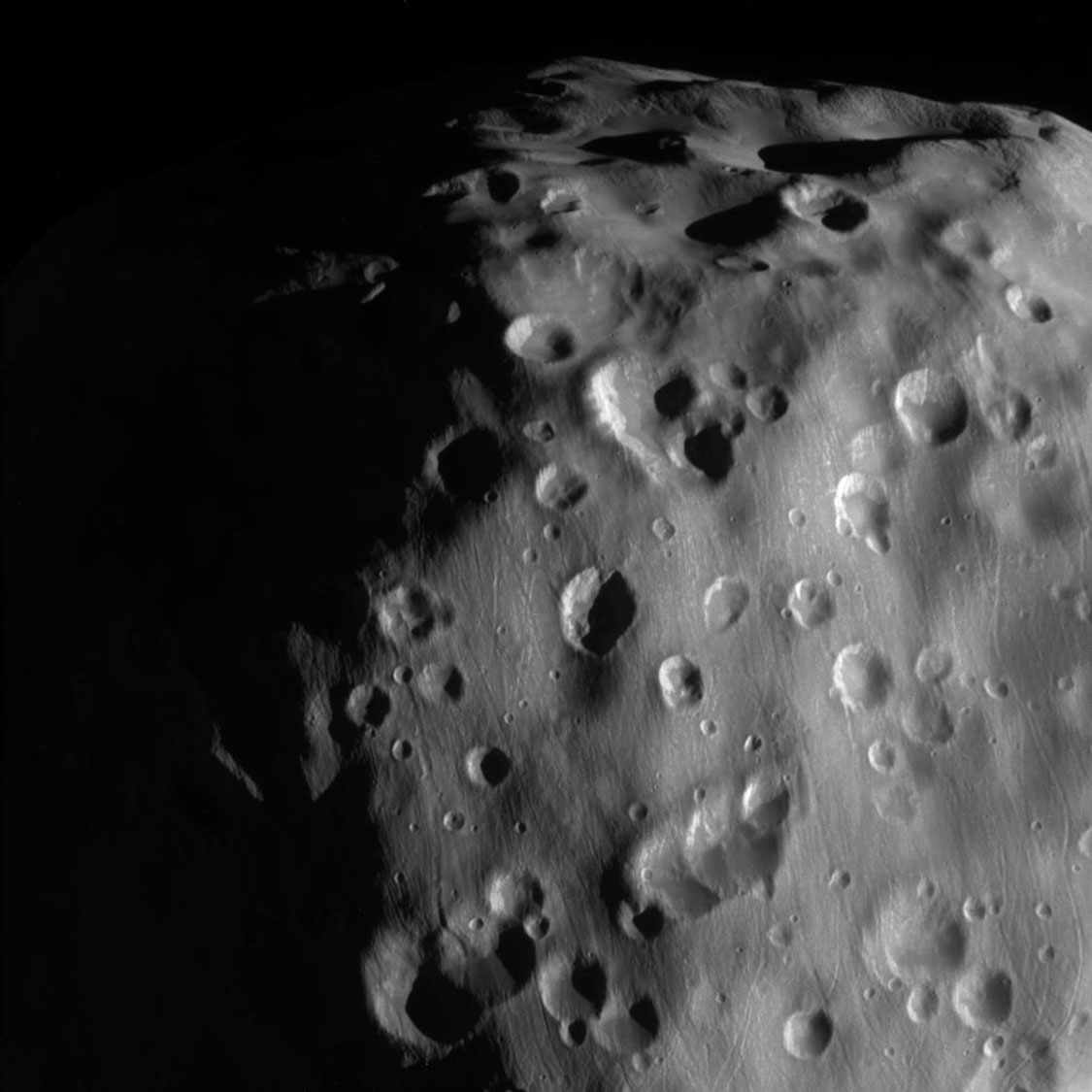
    Epimetheus (70 miles or 113 kilometers across) is too small for its gravity to hold onto an atmosphere. It is also too small to be geologically active. There is therefore no way to erase the scars from meteor impacts, except for the generation of new impact craters on top of old ones. Credit: NASA/JPL-Caltech/SSI.

    This newly released zoomed-in view of Epimetheus is one of the highest resolution images ever taken of the inner satellite of Saturn. It shows a surface covered in craters and provides vivid reminders of the hazards of space.

    Epimetheus (70 miles or 113 kilometers across) is too small for its gravity to hold onto an atmosphere. It is also too small to be geologically active. There is therefore no way to erase the scars from meteor impacts, except for the generation of new impact craters on top of old ones.

    This view looks toward anti-Saturn side of Epimetheus. North on Epimetheus is up and rotated 32 degrees to the right. The image was taken with the Cassini spacecraft narrow-angle camera on February 21, 2017 using a spectral filter which preferentially admits wavelengths of near-infrared light centered at 939 nanometers.

    The view was acquired at a distance of approximately 9,300 miles (15,000 kilometers) from Epimetheus and at a Sun-Epimetheus-spacecraft, or phase, angle of 71 degrees. Image scale is 290 feet (89 meters) per pixel.

    The Cassini mission is a cooperative project of NASA, ESA (the European Space Agency) and the Italian Space Agency. The Jet Propulsion Laboratory, a division of the California Institute of Technology in Pasadena, manages the mission for NASA’s Science Mission Directorate, Washington. The Cassini orbiter and its two onboard cameras were designed, developed and assembled at JPL. The imaging operations center is based at the Space Science Institute in Boulder, Colorado.

    Never miss a breakthrough: Join the SciTechDaily newsletter.
    Follow us on Google and Google News.

    Astronomy Cassini-Huygens Mission Epimetheus
    Share. Facebook Twitter Pinterest LinkedIn Email Reddit

    Related Articles

    Cassini Image Shows Saturn’s Rings with Dione and Epimetheus

    Natural Color View of Saturn and Titan

    Limited River Erosion on Saturn’s Moon Titan Has Scientists Looking for Possible Explanations

    NASA’s Cassini Spots Lightning in Saturn’s Northern Hemisphere

    Cassini Images Show Signs That the Seasons Are Turning On Saturn’s Moon Titan

    Cassini Changes Orbit, Saturn’s Rings Visible Again

    Cassini Data Reveals Likely Subsurface Ocean on Titan

    Heat from Within the Planet Powers Saturn’s Jet Streams

    Cassini Detects Methane Lakes on Titan

    Leave A Reply Cancel Reply

    • Facebook
    • Twitter
    • Pinterest
    • YouTube

    Don't Miss a Discovery

    Subscribe for the Latest in Science & Tech!

    Trending News

    NASA Satellites Spot Rare Underwater Volcano Eruption That Could Create Earth’s Newest Island

    520-Million-Year-Old Fossils Solve One of Evolution’s Biggest Mysteries

    This Popular Workout Supplement May Give Cancer Immunotherapy a Big Boost

    Scientists Discover Quantum Entanglement in a Crystal You Can Hold

    New Nonsurgical Knee Treatment Delivers Lasting Pain Relief

    New Water-Harvesting Jacket Pulls up to 30 Ounces of Drinking Water From the Air Daily

    17-Million-Year-Old Ape Fossil in Egypt Could Change What We Know About Human Origins

    Mysterious Signals Keep Coming From Space. Scientists May Finally Know Why

    Follow SciTechDaily
    • Facebook
    • Twitter
    • YouTube
    • Pinterest
    • Newsletter
    • RSS
    SciTech News
    • Biology News
    • Chemistry News
    • Earth News
    • Health News
    • Physics News
    • Science News
    • Space News
    • Technology News
    Recent Posts
    • Scientists Discover a Spider That Catapults Ants Into Its Web
    • This Strange Sea Creature Can Survive Five Years Without Food – Scientists Finally Know Why
    • New Quantum Sensor Opens a Window Into the Invisible Universe
    • Scientists Found a Surprisingly Simple Way To Improve Online Matchmaking
    • Scientists Reveal the Best Exercises for Aging Joints
    Copyright © 1998 - 2026 SciTechDaily. All Rights Reserved.
    • Science News
    • About
    • Contact
    • Editorial Board
    • Privacy Policy
    • Terms of Use

    Type above and press Enter to search. Press Esc to cancel.