
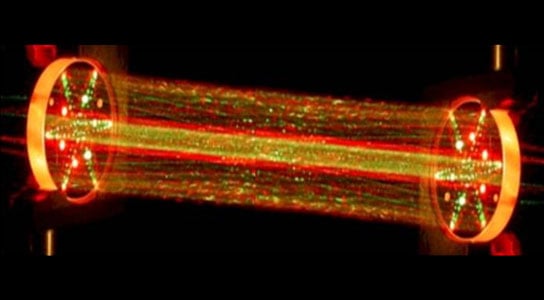
Instruments aboard Curiosity have analyzed samples of the atmosphere collected near the “Rocknest” site in Gale Crater, finding that the top of the Martian atmosphere may have been lost to interplanetary space.
NASA’s car-sized rover, Curiosity, has taken significant steps toward understanding how Mars may have lost much of its original atmosphere.
Learning what happened to the Martian atmosphere will help scientists assess whether the planet ever was habitable. The present atmosphere of Mars is 100 times thinner than Earth’s.
A set of instruments aboard the rover has ingested and analyzed samples of the atmosphere collected near the “Rocknest” site in Gale Crater where the rover is stopped for research. Findings from the Sample Analysis at Mars (SAM) instruments suggest that loss of a fraction of the atmosphere, resulting from a physical process favoring retention of heavier isotopes of certain elements, has been a significant factor in the evolution of the planet. Isotopes are variants of the same element with different atomic weights.
Initial SAM results show an increase of five percent in heavier isotopes of carbon in the atmospheric carbon dioxide compared to estimates of the isotopic ratios present when Mars formed. These enriched ratios of heavier isotopes to lighter ones suggest the top of the atmosphere may have been lost to interplanetary space. Losses at the top of the atmosphere would deplete lighter isotopes. Isotopes of argon also show enrichment of the heavy isotope, matching previous estimates of atmosphere composition derived from studies of Martian meteorites on Earth.
Scientists theorize that in Mars’ distant past its environment may have been quite different, with persistent water and a thicker atmosphere. NASA’s Mars Atmosphere and Volatile Evolution, or MAVEN, mission will investigate possible losses from the upper atmosphere when it arrives at Mars in 2014.
With these initial sniffs of Martian atmosphere, SAM also made the most sensitive measurements ever to search for methane gas on Mars. Preliminary results reveal little to no methane. Methane is of interest as a simple precursor chemical for life. On Earth, it can be produced by either biological or non-biological processes.
Methane has been difficult to detect from Earth or the current generation of Mars orbiters because the gas exists on Mars only in traces, if at all. The Tunable Laser Spectrometer (TLS) in SAM provides the first search conducted within the Martian atmosphere for this molecule. The initial SAM measurements place an upper limit of just a few parts methane per billion parts of Martian atmosphere, by volume, with enough uncertainty that the amount could be zero.
“Methane is clearly not an abundant gas at the Gale Crater site, if it is there at all. At this point in the mission we’re just excited to be searching for it,” said SAM TLS lead Chris Webster of NASA’s Jet Propulsion Laboratory in Pasadena, California. “While we determine upper limits on low values, atmospheric variability in the Martian atmosphere could yet hold surprises for us.”
In Curiosity’s first three months on Mars, SAM has analyzed atmosphere samples with two laboratory methods. One is a mass spectrometer investigating the full range of atmospheric gases. The other, TLS, has focused on carbon dioxide and methane. During its two-year prime mission, the rover also will use an instrument called a gas chromatograph that separates and identifies gases. The instrument also will analyze samples of soil and rock, as well as more atmosphere samples.
“With these first atmospheric measurements we already can see the power of having a complex chemical laboratory like SAM on the surface of Mars,” said SAM Principal Investigator Paul Mahaffy of NASA’s Goddard Space Flight Center in Greenbelt, Md. “Both atmospheric and solid sample analyses are crucial for understanding Mars’ habitability.”
SAM is set to analyze its first solid sample in the coming weeks, beginning the search for organic compounds in the rocks and soils of Gale Crater. Analyzing water-bearing minerals and searching for and analyzing carbonates are high priorities for upcoming SAM solid sample analyses.
Researchers are using Curiosity’s 10 instruments to investigate whether areas in Gale Crater ever offered environmental conditions favorable for microbial life. JPL, a division of the California Institute of Technology in Pasadena, manages the project for NASA’s Science Mission Directorate, Washington, and built Curiosity. The SAM instrument was developed at Goddard with instrument contributions from Goddard, JPL, and the University of Paris in France.
Never miss a breakthrough: Join the SciTechDaily newsletter.
Follow us on Google and Google News.
1 Comment
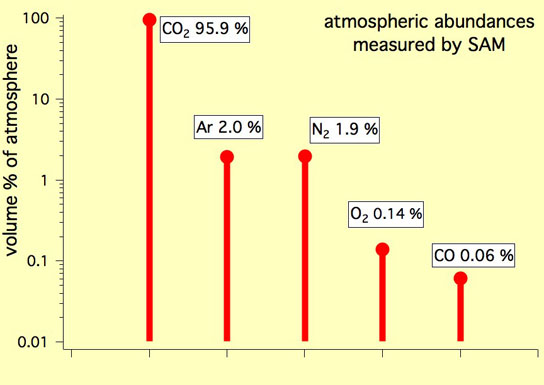
SAM instruments in Mars’s Curiosity brings out three distinct truths. One is that the atmosphere is eroded at the upper strata by losing its lighter isotopes of carbon in carbon-di-oxide leaving an increase in heavier isotope percentage of carbon in the present day. Secondly, the atmosphere is predominantly made up of CO2 (95.9%) and all its oxygen had been used up in oxidizing the planet to redness. Only a trace of oxygen (0.14%) is found. Thirdly methane the gas emanating from any biospheres if it existed is not to be traced and it will be only to a miniscule percentage of atmosphere. This means that life if existed should have been at a very distant past, when the Mars was at the proper temperature like earth while earth was still a glowing hot sphere. So finding residues or fossilized biology is very remote. The dead planet however could still be holding water buried under the land as frozen combined with salts. Thank You.