
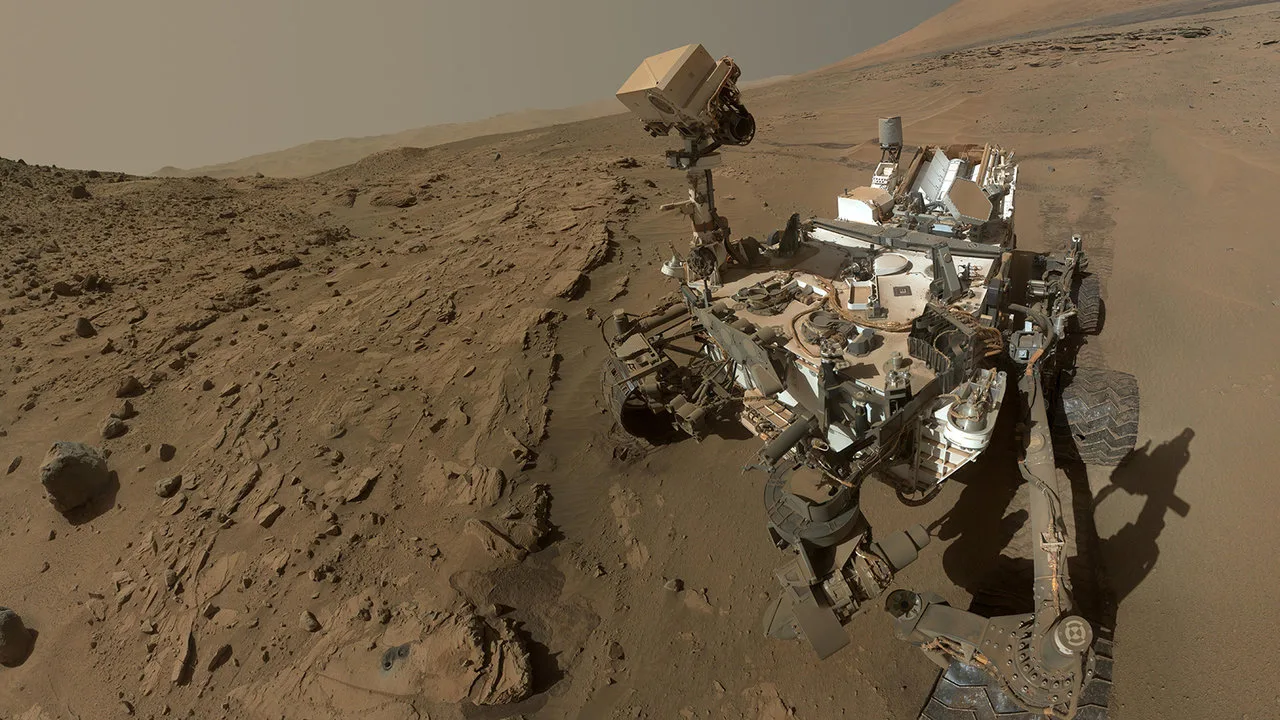
A treasure trove of clues from Curiosity reveals that ancient Mars once trapped massive amounts of CO2 in its crust, thanks to surprising concentrations of iron carbonate deep in Gale Crater.
By drilling into layers laid down in a vanished lake, scientists found up to 10% siderite in sulfate-rich rocks – carbonates that orbital surveys missed. This points to a once-active carbon cycle on Mars, where CO2 reacted with water and rock to form minerals, only to be partly released back into the air later, hinting at dynamic climatic shifts and pockets of past habitability.
Hidden CO2 Archive in Martian Crust
NASA’s Curiosity rover has uncovered a hidden chemical archive of ancient Mars’ atmosphere, which suggests that large amounts of carbon dioxide have been locked into the planet’s crust, according to a new study. The findings provide in situ evidence that a carbon cycle once operated on ancient Mars and offer new insights into the planet’s past climate. The Martian landscape shows clear signs that liquid water once flowed across its surface, which would have required a much warmer climate than the planet has today. It is therefore thought that Mars’ CO2 atmosphere must have been thicker in the past, to maintain warmer conditions. A climate containing abundant liquid water and atmospheric CO2 is expected to have reacted with Martian rocks, triggering geochemical processes that produce carbonate minerals. However, while previous analyses of Martian rock have detected the presence of carbonates, the quantities found were lower than expected from geochemical models.
Siderite Sequestration in Gale Crater
Using data from the Curiosity rover, Benjamin Tutolo and colleagues investigated carbonate minerals in part of Gale crater – which once contained an ancient lake. In 2022 and 2023, Curiosity drilled four rock samples from different stratigraphic units representing transitions from lakebed to wind-blown environments and analyzed their mineralogy using the rover’s onboard X-ray diffractometer.
The researchers identified siderite (iron carbonate) in high concentrations – ranging from approximately 5% to over 10% by weight – within magnesium sulfate-rich layers. This was unexpected, because orbital measurements had not detected carbonates in these strata. Given its provenance and chemistry, the authors infer that the siderite formed by water-rock reactions and evaporation, indicating that CO2 was chemically sequestered from the Martian atmosphere into the sedimentary rocks. If the mineral composition of these sulfate layers is representative of sulfate-rich regions globally, those deposits contain a large, previously unrecognized carbon reservoir.
The carbonates have been partially destroyed by later processes, indicating that some of the carbon dioxide was later returned to the atmosphere, forming a carbon cycle. “As details of Mars’ geochemistry are discovered through orbital and rover investigations around the planet, additional clues are revealed about the diversity of potentially habitable environments,” write Janice Bishop and Melissa Lane in a related Perspective.
Reference: “Carbonates identified by the Curiosity rover indicate a carbon cycle operated on ancient Mars” by Benjamin M. Tutolo, Elisabeth M. Hausrath, Edwin S. Kite, Elizabeth B. Rampe, Thomas F. Bristow, Robert T. Downs, Allan Treiman, Tanya S. Peretyazhko, Michael T. Thorpe, John P. Grotzinger, Amelie L. Roberts, P. Douglas Archer, David J. Des Marais, David F. Blake, David T. Vaniman, Shaunna M. Morrison, Steve Chipera, Robert M. Hazen, Richard V. Morris, Valerie M. Tu, Sarah L. Simpson, Aditi Pandey, Albert Yen, Stephen R. Larter, Patricia Craig, Nicholas Castle, Douglas W. Ming, Johannes M. Meusburger, Abigail A. Fraeman, David G. Burtt, Heather B. Franz, Brad Sutter, Joanna V. Clark, William Rapin, John C. Bridges, Matteo Loche, Patrick Gasda, Jens Frydenvang and Ashwin R. Vasavada, 17 April 2025, Science.
DOI: 10.1126/science.ado9966
Curiosity is NASA’s car-sized rover that has been exploring Mars since it landed in Gale Crater in 2012. Designed to study the planet’s geology and climate, Curiosity is equipped with a suite of scientific instruments, including cameras, spectrometers, and a drill, allowing it to analyze rocks, soil, and the atmosphere. Its primary mission is to investigate whether Mars ever had the conditions to support microbial life. Over the years, Curiosity has made groundbreaking discoveries, including evidence of ancient lakes, organic molecules, and changing environmental conditions, helping scientists piece together the planet’s complex history.
Never miss a breakthrough: Join the SciTechDaily newsletter.
Follow us on Google and Google News.