
NASA’s EUNIS sounding rocket mission has discovered evidence to explain why the sun’s atmosphere is so much hotter than its surface, detecting the strongest evidence yet for the presence of nanoflares.
Scientists have recently gathered some of the strongest evidence to date to explain what makes the sun’s outer atmosphere so much hotter than its surface. The new observations of the small-scale extremely hot temperatures are consistent with only one current theory: something called nanoflares – a constant peppering of impulsive bursts of heating, none of which can be individually detected — provide the mysterious extra heat.
NASA’s EUNIS sounding rocket mission spotted evidence to explain why the sun’s atmosphere is so much hotter than its surface. Credit: NASA/Goddard/Duberstein
What’s even more surprising is these new observations come from just six minutes worth of data from one of NASA’s least expensive type of missions, a sounding rocket. The EUNIS mission, short for Extreme Ultraviolet Normal Incidence Spectrograph, launched on April 23, 2013, gathering a new snapshot of data every 1.3 seconds to track the properties of material over a wide range of temperatures in the complex solar atmosphere.
The sun’s visible surface, called the photosphere, is some 6,000 Kelvins (5,700 Celsius), while the corona regularly reaches temperatures which are 300 times as hot.
“That’s a bit of a puzzle,” said Jeff Brosius, a space scientist at Catholic University in Washington, D.C., and NASA’s Goddard Space Flight Center in Greenbelt, Maryland. “Things usually get cooler farther away from a hot source. When you’re roasting a marshmallow you move it closer to the fire to cook it, not farther away.”
Brosius is the first author of a paper on these results appearing in The Astrophysical Journal.
Several theories have been offered for how the magnetic energy coursing through the corona is converted into the heat that raises the temperature. Different theories make different predictions about what kind of – and what temperature – material might be observable, but few observations have high enough resolution over a large enough area to distinguish between these predictions.
The EUNIS rocket, however, was equipped with a very sensitive version of an instrument called a spectrograph. Spectrographs gather information about how much material is present at a given temperature, by recording different wavelengths of light. To observe the extreme ultraviolet wavelengths necessary to distinguish between various coronal heating theories, such an instrument can only work properly in space, above the atmosphere surrounding Earth that blocks that ultraviolet light. So EUNIS flew up nearly 200 miles above the ground aboard a sounding rocket, a type of NASA mission that flies for only 15 minutes or so, and gathered about six minutes worth of observations from above the planet’s air.
During its flight, EUNIS scanned a pre-determined region on the sun known to be magnetically complex, a so-called active region, which can often be the source of larger flares and coronal mass ejections. As light from the region streamed into its spectrograph, the instrument separated the light into its various wavelengths. Instead of producing a typical image of the sun, the wavelengths with larger amounts of light are each represented by a vertical line called an emission line. Each emission line, in turn, represents material at a unique temperature on the sun. Further analysis can identify the density and movement of the material as well.
The EUNIS spectrograph was tuned into a range of wavelengths useful for spotting material at temperatures of 10 million Kelvin – temperatures that are a signature of nanoflares. Scientists have hypothesized that a myriad of nanoflares could heat up solar material in the atmosphere to temperatures of up to 10 million Kelvins. This material would cool very rapidly, producing ample solar material at the 1 to 3 million degrees regularly seen in the corona.
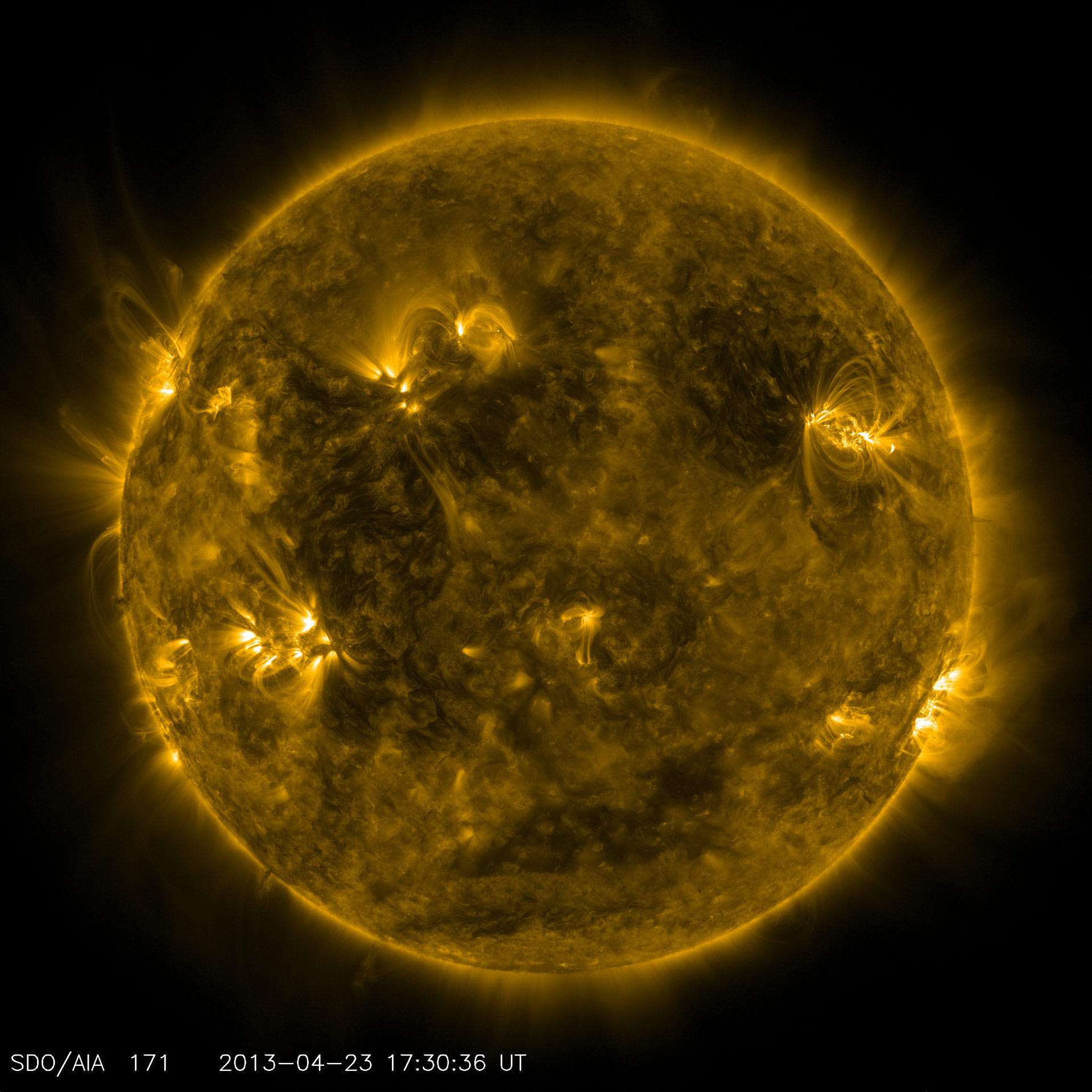
However, the faint presence of that extremely hot material should remain. Looking over their six minutes of data, the EUNIS team spotted a wavelength of light corresponding to that 10 million-degree material. To spot this faint emission line was a triumph of the EUNIS instrument’s resolution. The spectrograph was able to clearly and unambiguously distinguish the observations representing the extremely hot material.
“The fact that we were able to resolve this emission line so clearly from its neighbors is what makes spectroscopists like me stay awake at night with excitement,” said Brosius. “This weak line observed over such a large fraction of an active region really gives us the strongest evidence yet for the presence of nanoflares.”
There are a variety of theories for what mechanisms power these impulsive bursts of heat, the nanoflares. Moreover, other explanations have been offered for what is heating the corona. Scientists will continue to explore these ideas further, gathering additional observations as their tools and instruments improve. However, no other theory predicts material of this temperature in the corona, so this is a strong piece of evidence in favor of the nanoflare theory.
“This is a real smoking gun for nanoflares,” said Adrian Daw, the current principal investigator for EUNIS at Goddard. “And it shows that these smaller, less expensive sounding rockets can produce truly robust science.”
In addition to having a lower cost, sounding rockets offer a valuable test bed for new technology that may subsequently be flown on longer-term space missions. Another advantage of sounding rockets is that the instruments parachute back to the ground so they can be recovered and re-used. The EUNIS mission will be re-tuned to focus on a different set of solar wavelengths – ones that can also spot the extremely high temperature material representative of nanoflares — and fly again sometime in 2016.
Reference: “Pervasive Faint Fe XIX Emission from a Solar Active Region Observed with EUNIS-13: Evidence for Nanoflare Heating” by Jeffrey W. Brosius, Adrian N. Daw and D. M. Rabin, 10 July 2014, The Astrophysical Journal.
DOI: 10.1088/0004-637X/790/2/112
EUNIS was supported through NASA’s Sounding Rocket Program at the Goddard Space Flight Center’s Wallops Flight Facility in Virginia. NASA’s Heliophysics Division manages the sounding rocket program. EUNIS launched from the White Sands Missile Range in New Mexico. At the time of flight, the principal investigator for EUNIS was Doug Rabin at Goddard.
Never miss a breakthrough: Join the SciTechDaily newsletter.
Follow us on Google and Google News.