
Close Menu
    Facebook X (Twitter) Instagram
    SciTechDaily
    • Biology
    • Chemistry
    • Earth
    • Health
    • Physics
    • Science
    • Space
    • Technology
    Facebook X (Twitter) Pinterest YouTube RSS
    SciTechDaily
    Home»Science»Nanoparticles Deliver PNA Molecules to Correct Mutation in Cystic Fibrosis
    Science

    Nanoparticles Deliver PNA Molecules to Correct Mutation in Cystic Fibrosis

    By Ziba Kashef, Yale UniversityApril 28, 2015No Comments3 Mins Read
    Facebook Twitter Pinterest Telegram LinkedIn WhatsApp Email Reddit
    Share
    Facebook Twitter LinkedIn Pinterest Telegram Email Reddit
    Scientists Correct Mutation in Cystic Fibrosis
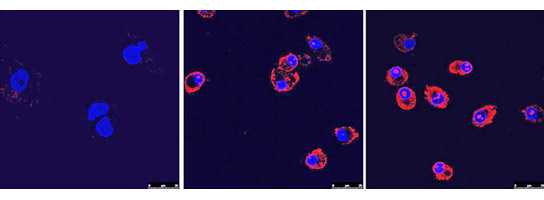
    Left to right, cystic fibrosis cells treated with gene-correcting PNA/DNA show increasing levels of uptake, or use to correct the mutation. Credit: Rachel Fields

    New research details how a team of scientists delivered peptide nucleic acids and donor DNA via microscopic nanoparticles to successfully corrected the most common mutation in the gene that causes cystic fibrosis.

    Cystic fibrosis is an inherited, life-threatening disorder that damages the lungs and digestive system. It is most commonly caused by a mutation in the cystic fibrosis gene known as F508del. The disorder has no cure, and treatment typically consists of symptom management. Previous attempts to treat the disease through gene therapy have been unsuccessful.

    To correct the mutation, a multidisciplinary team of Yale researchers developed a novel approach. Led by Dr. Peter Glazer, chair of therapeutic radiology, Mark Saltzman, chair of biomedical engineering, and Dr. Marie Egan, professor of pediatrics and of cellular and molecular physiology, the collaborative team used synthetic molecules similar to DNA — called peptide nucleic acids, or PNAs — as well as donor DNA, to edit the genetic defect.

    The study was published April 27 in Nature Communications.

    “What the PNA does is clamp to the DNA close to the mutation, triggering DNA repair and recombination pathways in cells,” Egan explained.

    The researchers also developed a method of delivering the PNA/DNA via microscopic nanoparticles. These tiny particles, which are billionths of a meter in diameter, are specifically designed to penetrate targeted cells.

    In both human airway cells and mouse nasal cells, the researchers observed corrections in the targeted genes. “The percentage of cells in humans and in mice that we were able to edit was higher than has been previously reported in gene editing technology,” said Egan. They also observed that the therapy had minimal off target, or unintended, effects on treated cells.

    While the study findings are significant, much more research is needed to refine the genetic engineering strategy, said Egan. “This is step one in a long process. The technology could be used as a way to fix the basic genetic defect in cystic fibrosis.”

    Other Yale authors include Nicole Ali McNeer, Kavitha Anandalingam, Rachel J. Fields, Christina Caputo, Sascha Kopic, Anisha Gupta, Elias Quijano, Lee Polikoff, Yong Kong, Raman Bahal, and John P. Geibel.

    This research was supported in part by the NIGMS Medical Scientist Training Program T32GM07205 (to N.A.M.), the Hartwell Foundation (to M.E.E.) and the National Institute of Health grants R01HL082655 and R01AI112443 (to P.M.G) and R01EB000487 (to W.M.S.).

    Reference: “Nanoparticles that deliver triplex-forming peptide nucleic acid molecules correct F508del CFTR in airway epithelium” by Nicole Ali McNeer, Kavitha Anandalingam, Rachel J. Fields, Christina Caputo, Sascha Kopic, Anisha Gupta, Elias Quijano, Lee Polikoff, Yong Kong, Raman Bahal, John P. Geibel, Peter M. Glazer, W. Mark Saltzman and Marie E. Egan, 27 April 2015, Nature Communications.
    DOI:10.1038/ncomms7952

    Never miss a breakthrough: Join the SciTechDaily newsletter.
    Follow us on Google and Google News.

    Genetics Molecular Physiology Nanoscience Yale University
    Share. Facebook Twitter Pinterest LinkedIn Email Reddit

    Related Articles

    Yale Engineers Develop New Colors for Solar Energy

    New Genome-Wide Analysis Links Marijuana Dependence and Major Depression

    Researchers Improve Bulk Metallic Glass Nanostructures

    Genetically Reducing AMPK Activity May Prevent Hereditary Hearing Loss

    Engineers Develop New Temperature Switchable Membrane to Regulate Flow

    Yale Researchers Find Hope for Safe and Novel Painkillers from Tarantula Venom

    New Technique Allows Researchers to Measure Electrical Activity in a Living Neuron

    Naturally Occurring Nanoparticles Harnessed to Target Disease

    Researchers Identify Mutations Responsible for USC Tumors

    Leave A Reply Cancel Reply

    • Facebook
    • Twitter
    • Pinterest
    • YouTube

    Don't Miss a Discovery

    Subscribe for the Latest in Science & Tech!

    Trending News

    Your Blood Pressure Reading Could Be Wrong Because of One Simple Mistake

    Astronomers Stunned by Ancient Galaxy With No Spin

    Physicists May Be on the Verge of Discovering “New Physics” at CERN

    Scientists Solve 320-Million-Year Mystery of Reptile Skin Armor

    Scientists Say This Daily Walking Habit May Be the Secret to Keeping Weight Off After Dieting

    New Therapy Rewires the Brain To Restore Joy in Depression Patients

    Giant Squid Detected off Western Australia in Stunning Deep-Sea Discovery

    Popular Sugar-Free Sweetener Linked to Liver Disease, Study Warns

    Follow SciTechDaily
    • Facebook
    • Twitter
    • YouTube
    • Pinterest
    • Newsletter
    • RSS
    SciTech News
    • Biology News
    • Chemistry News
    • Earth News
    • Health News
    • Physics News
    • Science News
    • Space News
    • Technology News
    Recent Posts
    • Key Magic Mushroom Ingredient Increases Laziness and Reduces Aggression
    • Researchers Solve 15-Year Mystery Behind Cancer-Causing Gut Toxin
    • One of the World’s Most Popular Weedkillers May Be Fueling Deadly Superbugs
    • Scientists Create Laser “Whirlpools” That Spin Tiny Cells Without Touching Them
    • Scientists Discover “Hidden” Materials That Could Transform Clean Energy and Batteries
    Copyright © 1998 - 2026 SciTechDaily. All Rights Reserved.
    • Science News
    • About
    • Contact
    • Editorial Board
    • Privacy Policy
    • Terms of Use

    Type above and press Enter to search. Press Esc to cancel.