
Close Menu
    Facebook X (Twitter) Instagram
    SciTechDaily
    • Biology
    • Chemistry
    • Earth
    • Health
    • Physics
    • Science
    • Space
    • Technology
    Facebook X (Twitter) Pinterest YouTube RSS
    SciTechDaily
    Home»Space»NASA’s Galaxy Evolution Explorer Set to be Decommissioned
    Space

    NASA’s Galaxy Evolution Explorer Set to be Decommissioned

    By Whitney Clavin, Jet Propulsion LaboratoryFebruary 8, 2012No Comments2 Mins Read
    Facebook Twitter Pinterest Telegram LinkedIn WhatsApp Email Reddit
    Share
    Facebook Twitter LinkedIn Pinterest Telegram Email Reddit
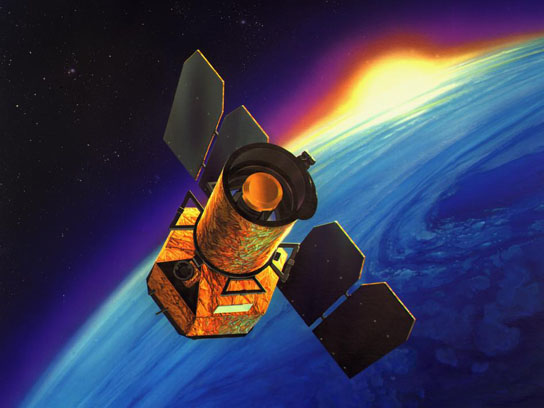
    Artist's concept of Galaxy Evolution Explorer
    Artist’s concept of Galaxy Evolution Explorer. Credit: NASA/JPL-Caltech

    Launched on April 28, 2003, the Galaxy Evolution Explorer, or Galex, was on a mission to study aspects of galaxies across 10 billion years of cosmic history. The spacecraft is now set to be decommissioned, nine years after the telescope’s launch.

    NASA’s Galaxy Evolution Explorer, or Galex, was placed in standby mode today as engineers prepare to end mission operations, nearly nine years after the telescope’s launch. The spacecraft is scheduled to be decommissioned — taken out of service — later this year. The mission extensively mapped large portions of the sky with sharp ultraviolet vision, cataloging millions of galaxies spanning 10 billion years of cosmic time.

    The Galaxy Evolution Explorer launched into space from a Pegasus XL rocket in April 2003. Since completing its prime mission in the fall of 2007, the mission was extended to continue its census of stars and galaxies.

    The mission’s science highlights include the discovery of a gigantic comet-like tail behind a speeding star, rings of new stars around old galaxies, and “teenager” galaxies, which help to explain how galaxies evolve. The observatory also helped confirm the existence of the mysterious substance or force known as dark energy, and even caught a black hole devouring a star.

    The California Institute of Technology, Pasadena, California, leads the Galaxy Evolution Explorer mission and is responsible for science operations and data analysis. NASA’s Jet Propulsion Laboratory, also in Pasadena, manages the mission and built the science instrument. The mission was developed under NASA’s Explorers Program, managed by the Goddard Space Flight Center, Greenbelt, Md. Researchers sponsored by Yonsei University in South Korea and the Center National d’Etudes Spatiales (CNES) in France collaborated on this mission. Caltech manages JPL for NASA.

    Never miss a breakthrough: Join the SciTechDaily newsletter.
    Follow us on Google and Google News.

    Galex JPL NASA Spacecraft Telescope
    Share. Facebook Twitter Pinterest LinkedIn Email Reddit

    Related Articles

    Fermi Detects the Highest-Energy Light Ever Associated With an Eruption on the Sun

    GRAIL Completes Prime Mission, Now Preparing for Extended Operations

    NASA Confirms Extra Time for Dawn to Explore Vesta

    Dawn Images Shine New Light on Vesta

    GRAIL Spacecraft Officially Begins Collecting Lunar Data

    HiRISE Images Show Old NASA Mars Lander

    Engineers Resolve Mars Science Laboratory Computer Issue

    Juno Spacecraft Completes First Trajectory Correction Maneuver

    NASA Plans Trajectory Maneuver for Mars Science Laboratory Spacecraft

    Leave A Reply Cancel Reply

    • Facebook
    • Twitter
    • Pinterest
    • YouTube

    Don't Miss a Discovery

    Subscribe for the Latest in Science & Tech!

    Trending News

    Scientists Say This Natural Hormone Reverses Obesity by Targeting the Brain

    35-Million-Year-Old Mystery: Strange Arachnid Discovered Preserved in Amber

    Is AI Really Just a Tool? It Could Be Altering How You See Reality

    JWST Reveals a “Forbidden” Planet With a Baffling Composition

    The Protein “Sabotaging” Aging Muscle Recovery Could Be Key to Surviving Aging

    This Diet–Gut Interaction Could Transform Fat Into a Calorie-Burning Machine

    Scientists Discover Hidden Virus Linked to Colorectal Cancer

    Scientists Discover 132-Million-Year-Old Dinosaur Tracks on South Africa’s Coast

    Follow SciTechDaily
    • Facebook
    • Twitter
    • YouTube
    • Pinterest
    • Newsletter
    • RSS
    SciTech News
    • Biology News
    • Chemistry News
    • Earth News
    • Health News
    • Physics News
    • Science News
    • Space News
    • Technology News
    Recent Posts
    • 500 Million Years Ago, Life Changed Forever: Scientists Reveal the DNA Changes That Helped Animals Move Onto Land
    • Surprise RNA Discovery Challenges Long-Held Beliefs About How Genes Work
    • Your IQ at 23 Could Predict Your Wealth at 27, Study Finds
    • 320 Light-Years Away, a Planet Confirms a Fundamental Cosmic Assumption
    • Astronomers Solve Decades-Long Mystery About Saturn’s Spin – “Something Strange Was Happening”
    Copyright © 1998 - 2026 SciTechDaily. All Rights Reserved.
    • Science News
    • About
    • Contact
    • Editorial Board
    • Privacy Policy
    • Terms of Use

    Type above and press Enter to search. Press Esc to cancel.