

Close Menu
    Facebook X (Twitter) Instagram
    SciTechDaily
    • Biology
    • Chemistry
    • Earth
    • Health
    • Physics
    • Science
    • Space
    • Technology
    Facebook X (Twitter) Pinterest YouTube RSS
    SciTechDaily
    Home»Space»NASA’s Line From Spain to Deep Space
    Space

    NASA’s Line From Spain to Deep Space

    By Adam Voiland, NASA Earth ObservatoryApril 4, 2021No Comments2 Mins Read
    Facebook Twitter Pinterest Telegram LinkedIn WhatsApp Email Reddit
    Share
    Facebook Twitter LinkedIn Pinterest Telegram Email Reddit
    Madrid Deep Space Communications Complex Annotated
    March 17, 2021

    Radio antennas at the Madrid Deep Space Communications Complex help scientists on Earth keep in touch with distant satellites.

    NASA’s Deep Space Network (DSN) is the giant planetary switchboard that helps dozens of distant spacecraft communicate with teams of engineers and scientists on Earth.

    The network of antennas and dishes relays messages from missions such as Voyager 1 and the Deep Space Climate Observatory (DSCOVR). Voyager 1 launched in 1977 and is still sending signals back from interstellar space, some 22 billion kilometers (14 billion miles) away. DSCOVR takes full-disc images of Earth from 1.6 million kilometers (1 million miles) away. (See image below)

    EPIC New View of Earth

    On March 17, 2021, the Operational Land Imager (OLI) on Landsat 8 acquired this natural-color image of one of the communications hubs in Robledo de Chavela, about 50 kilometers (30 miles) west of Madrid, Spain. The complex has several large radio antennas with parabolic dishes that appear as white circles in the Landsat image. The location was chosen because it was equidistant to DSN stations in Goldstone, California and Canberra, Australia. The strategic placement allows for continuous communication with spacecraft as Earth rotates.

    NASA first established a DSN facility in Spain in 1964 as it was starting the Gemini and Mercury programs. The Madrid facility, like the other two DSN facilities, has at least six antennas.

    The most powerful antenna at the Madrid facility is Deep Space Station 63. With a diameter of 70 meters (230 feet), it receives signals from missions as far away as interstellar space. In January 2021, engineers completed the installation of Deep Space Station 56, a versatile 34-meter (112-foot) antenna that is capable of communicating at multiple frequencies and with multiple spacecraft. Existing antennas are limited in the frequency bands they can receive and transmit, often restricting them to communicating only with specific spacecraft.
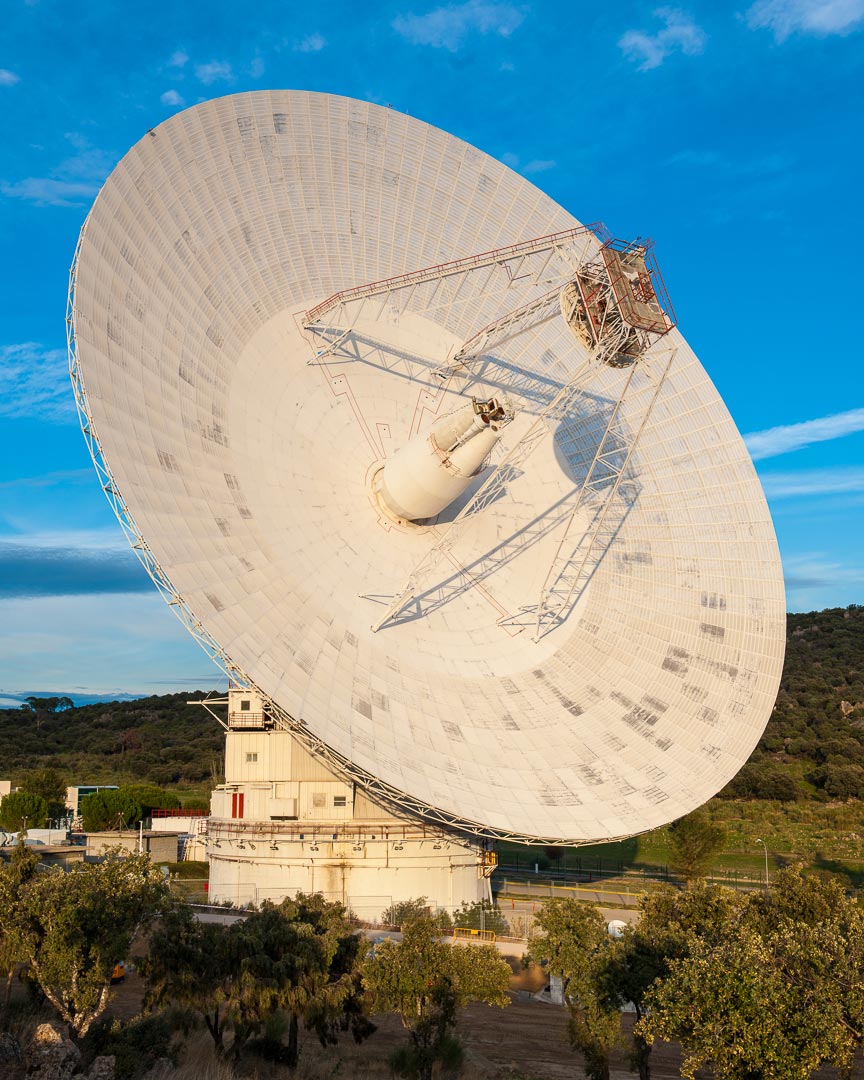
    Deep Space Station 63
    Deep Space Station 63 (DSS-63) antenna. Credit: NASA

    In addition to tracking and communicating with distant spacecraft, scientists make use of data from the DSN to study Earth’s shape and gravity field, a discipline known as very-long-baseline interferometry (VLBI) to track small changes in Earth’s crust such as the movement of tectonic plates.

    NASA Earth Observatory image by Lauren Dauphin, using Landsat data from the U.S. Geological Survey.

    Never miss a breakthrough: Join the SciTechDaily newsletter.
    Follow us on Google and Google News.

    NASA NASA Earth Observatory
    Share. Facebook Twitter Pinterest LinkedIn Email Reddit

    Related Articles

    Astronaut’s Moon Photo Reveals a View We’ll Never See on Earth

    Unforgettable Spectacle: See Comet Tsuchinshan-ATLAS Now or Wait Another 80,000 Years

    What in the World Are NASA Moon Trees?

    Two Spacecraft Designed to Study the Sun Also Got Some Recent Peeks at Earth and Other Planets

    Sea Level Watcher Takes Flight – SpaceX Launch Caught by Earth Monitoring Satellite

    Earth vs. Pluto: Snowy and Icy Peaks with Very Different Origins

    Comet NEOWISE Brightens the Night in Stunning Space Station Video

    Spectacular New Images Capture the Space Station Cruise Across the Sun

    A Dazzling Trail of Night Lights Viewed From International Space Station [Video]

    Leave A Reply Cancel Reply

    • Facebook
    • Twitter
    • Pinterest
    • YouTube

    Don't Miss a Discovery

    Subscribe for the Latest in Science & Tech!

    Trending News

    The Universe Is Expanding Too Fast and Scientists Can’t Explain Why

    “Like Liquid Metal”: Scientists Create Strange Shape-Shifting Material

    Early Warning Signals of Esophageal Cancer May Be Hiding in Plain Sight

    Common Blood Pressure Drug Shows Surprising Power Against Deadly Antibiotic-Resistant Superbug

    Scientists Uncover Dangerous Connection Between Serotonin and Heart Valve Disease

    Scientists Discover a “Protector” Protein That Could Help Reverse Hair Loss

    Bone-Strengthening Discovery Could Reverse Osteoporosis

    Scientists Uncover Hidden Trigger Behind Stem Cell Aging

    Follow SciTechDaily
    • Facebook
    • Twitter
    • YouTube
    • Pinterest
    • Newsletter
    • RSS
    SciTech News
    • Biology News
    • Chemistry News
    • Earth News
    • Health News
    • Physics News
    • Science News
    • Space News
    • Technology News
    Recent Posts
    • A Common Diabetes Drug May Hold the Key to Stopping HIV From Coming Back
    • Ancient “Syphilis-Like” Disease in Vietnam Challenges Key Scientific Assumptions
    • Drinking Alcohol To Cope in Your 20s Could Damage Your Brain for Life
    • Scientists Crack Alfalfa’s Chromosome Mystery After Decades of Debate
    • Ancient Ant-Plant Alliance Collapses As Predatory Wasps Move In
    Copyright © 1998 - 2026 SciTechDaily. All Rights Reserved.
    • Science News
    • About
    • Contact
    • Editorial Board
    • Privacy Policy
    • Terms of Use

    Type above and press Enter to search. Press Esc to cancel.