
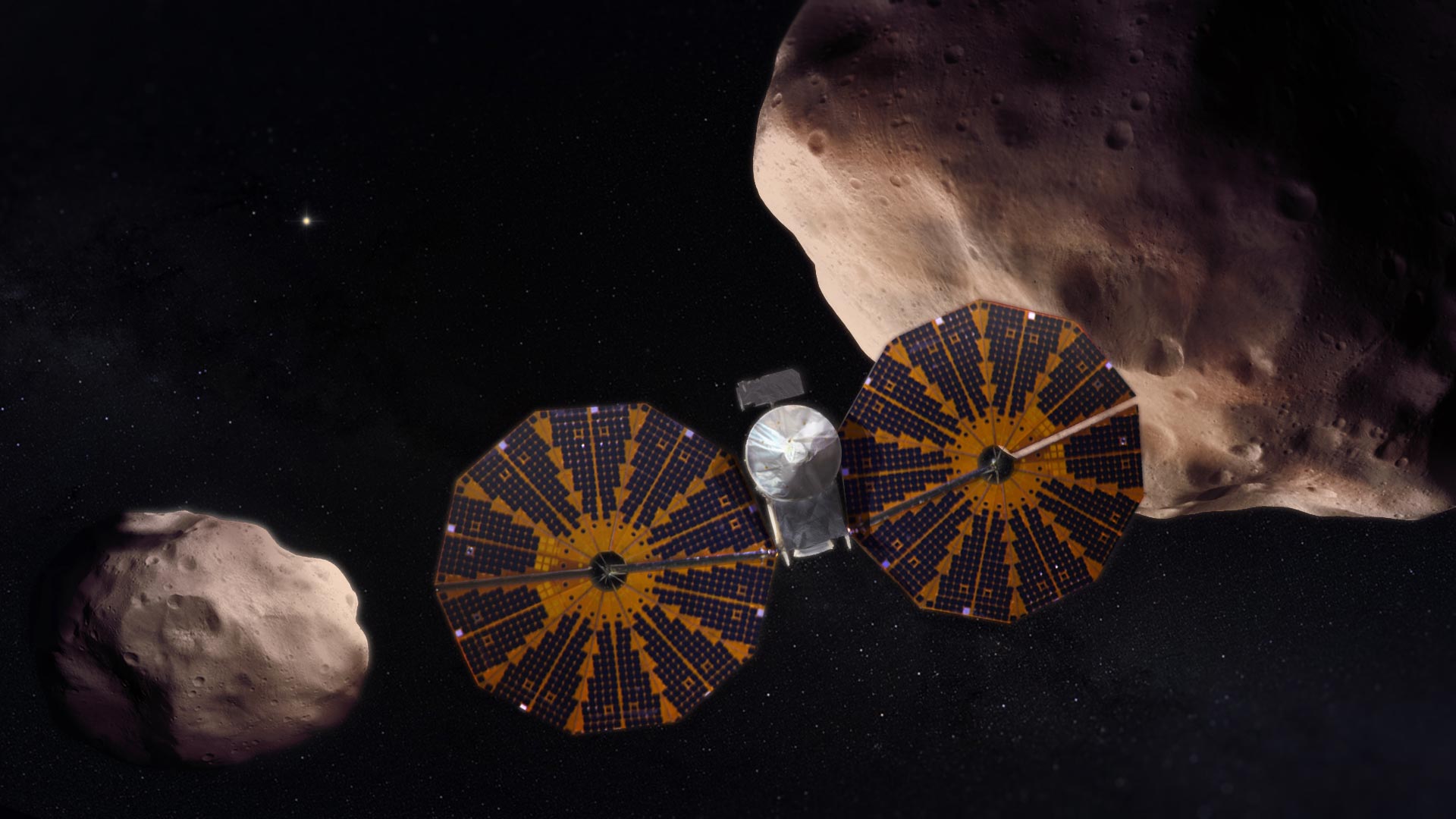
Lucy is preparing for a close encounter with the asteroid Donaldjohanson, a key milestone before its groundbreaking journey to the Jupiter Trojans.
This flyby serves as a crucial test of its optical navigation system, refining its ability to track distant celestial bodies. As Lucy approaches, the asteroid remains a mere speck against the stars, but soon it will reveal its secrets.
Lucy’s Next Close Encounter
NASA’s Lucy spacecraft is set to pass within 596 miles (960 km) of the 2-mile-wide asteroid Donaldjohanson on April 20. This will be Lucy’s second asteroid encounter, serving as a practice run before it reaches its primary targets: the Jupiter Trojan asteroids, which have never been explored before.
In November 2023, Lucy successfully observed Dinkinesh, a small main-belt asteroid, along with its contact-binary moon, Selam. Over the next two months, the spacecraft will continue imaging Donaldjohanson as part of its optical navigation program, which helps fine-tune its trajectory by tracking the asteroid’s position against the background stars.
For most of its approach, Donaldjohanson will appear as a single point of light, with no visible surface details. These features will only become clear on the day of the encounter.

A Starry Backdrop and Unexpected Visitors
Currently, the asteroid is 45 million miles (70 million km) away, appearing as a dim object among the faint stars of the Sextans constellation. In the latest images, celestial north is positioned to the right, and the camera’s 0.11-degree field of view corresponds to 85,500 miles (140,000 km) at the asteroid’s distance.
In one of Lucy’s two images, another dim asteroid briefly appears in the lower right quadrant, seemingly “photobombing” the shot. However, just like car headlights that appear motionless from a distance, Donaldjohanson moves very little between the two images, while the interloping asteroid shifts out of view.
Lucy’s Powerful Eye in Space
These observations were made by Lucy’s high-resolution camera, the L’LORRI instrument, short for Lucy LOng Range Reconnaissance Imager, provided by the Johns Hopkins Applied Physics Laboratory in Laurel, Maryland.
Asteroid Donaldjohanson is named for anthropologist Donald Johanson, who discovered the fossilized skeleton, called “Lucy,” of a human ancestor. NASA’s Lucy mission is named for the fossil.
About Lucy
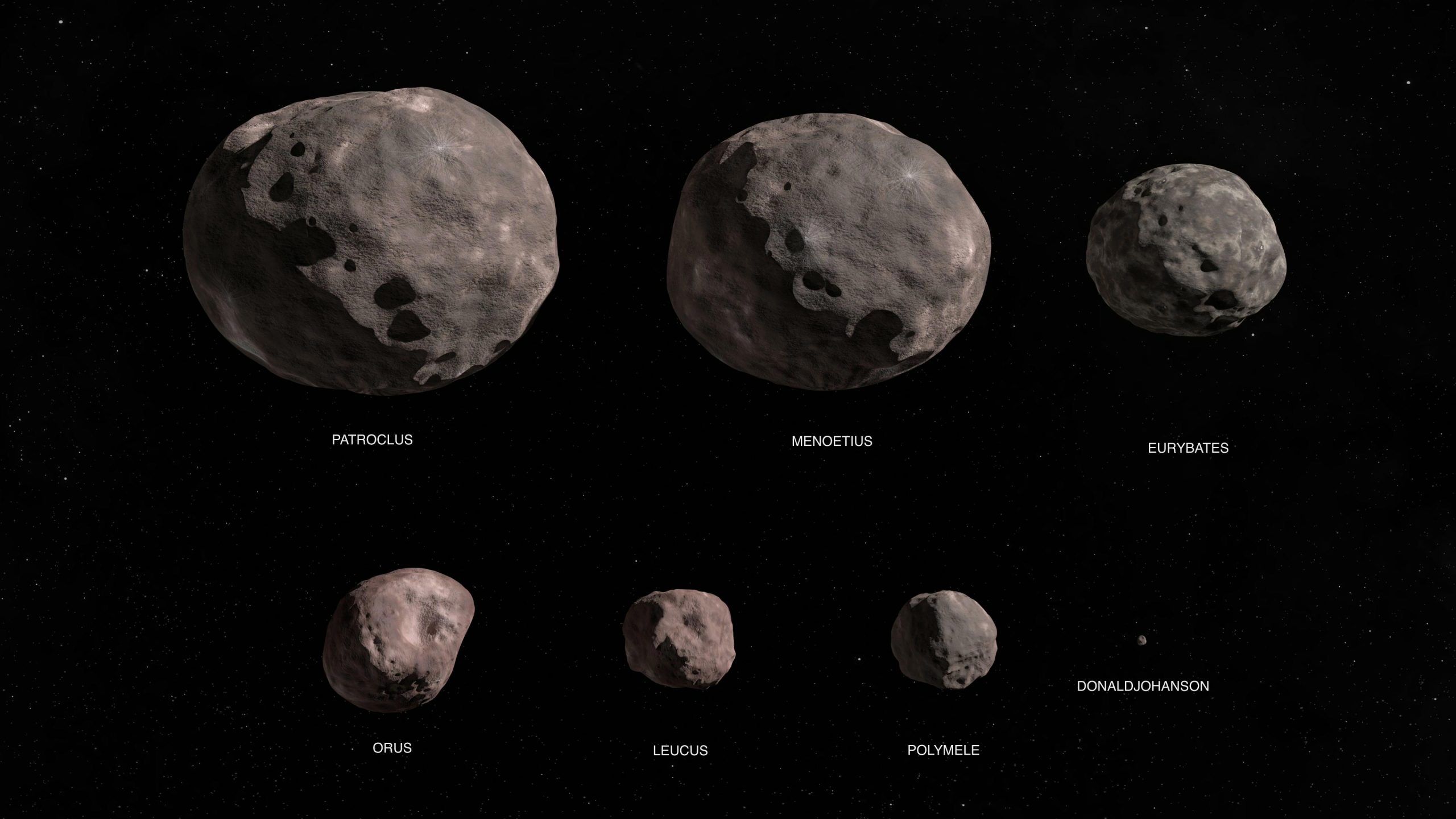
NASA’s Lucy mission is a pioneering expedition to study the Jupiter Trojan asteroids, ancient remnants from the early solar system that share Jupiter’s orbit. Launched in October 2021, Lucy is the first spacecraft to explore these celestial bodies, aiming to uncover clues about planetary formation and the origins of organic materials.
The mission is led by Principal Investigator Hal Levison at the Southwest Research Institute (SwRI) in Boulder, Colorado. NASA’s Goddard Space Flight Center in Greenbelt, Maryland, oversees mission management, systems engineering, and safety assurance, while Lockheed Martin Space in Littleton, Colorado, built the spacecraft. Lucy is the 13th mission in NASA’s Discovery Program, which is managed by NASA’s Marshall Space Flight Center in Huntsville, Alabama, under the Science Mission Directorate at NASA Headquarters in Washington, D.C.
Over its 12-year journey, Lucy will visit one main-belt asteroid and at least eight Jupiter Trojans, making it the first mission to explore so many different asteroids. By analyzing their composition, structure, and surface features, Lucy will provide new insights into the building blocks of our solar system.
Never miss a breakthrough: Join the SciTechDaily newsletter.
Follow us on Google and Google News.
1 Comment
So what is the smaller object at D’s 5 o’clock?