
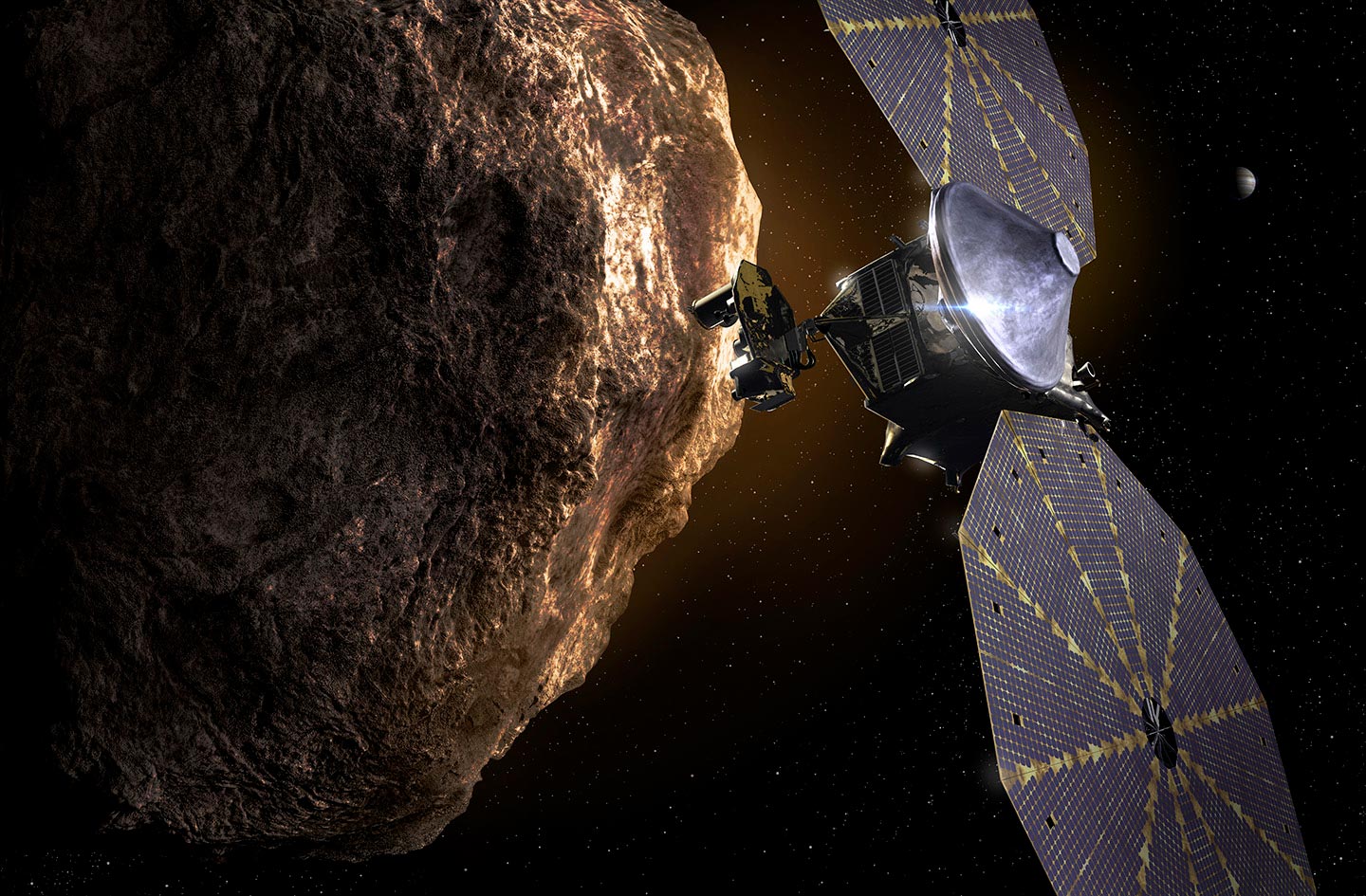
NASA’s Lucy mission is about to fly past asteroid Donaldjohanson, a strange, elongated rock in the main belt.
While this three-mile-wide object isn’t one of Lucy’s primary targets, the April 20 flyby serves as a full dress rehearsal before the spacecraft heads toward the Trojan asteroids near Jupiter – ancient objects that may hold clues to how our solar system formed. Scientists believe Donaldjohanson itself was born from a violent collision and could offer unexpected insights into asteroid evolution.
Lucy’s Main Belt Test Run
NASA’s Lucy mission, led by the Southwest Research Institute (SwRI), is getting ready to visit its next target on a 4-billion-mile journey through the solar system. On April 20, 2025, the spacecraft will fly past asteroid (52246) Donaldjohanson, a three-mile-wide object in the main asteroid belt. This flyby serves as a test ahead of Lucy’s primary mission: studying the Trojan asteroids near Jupiter.
These Trojans – two large groups of asteroids that orbit the Sun in tandem with Jupiter – have been trapped in place for billions of years. Scientists believe they contain important clues about how the solar system formed. Lucy will be the first mission to explore these ancient objects up close.
“While we can hardly wait to observe these fossils from the early solar system, the warm-up asteroids are proving to be quite interesting in their own right,” said SwRI’s Dr. Hal Levison, principal investigator of the Lucy mission. “Our 2022 flyby of Dinkinesh discovered Selam, a novel contact binary satellite of the main body. And ground-based observations suggest that Donaldjohanson is a peculiar, elongated object.”
Tracing Donaldjohanson’s Origins
New research from SwRI suggests Donaldjohanson may have formed about 150 million years ago, likely the result of a larger asteroid breaking apart. Since then, its orbit and rotation have changed significantly, offering scientists a valuable case study in asteroid evolution.
“The data collected could provide independent insights on evolutionary processes based on its shape, surface geology, and cratering history,” said SwRI’s Dr. Simone Marchi, Lucy deputy principal investigator. “Understanding the formation of Donaldjohanson could help explain its peculiarities.”
Lucy’s current target is a common asteroid type, composed of silicate rocks and perhaps some clays and organic matter. It’s likely a member of the Erigone collisional asteroid family, a group of asteroids on similar orbits created when a larger parent asteroid broke apart. The family originated in the inner main belt not far from the source regions of near-Earth asteroids (101955) Bennu and (162173) Ryugu, recently visited respectively by NASA’s OSIRIS-REx and JAXA’s Hayabusa2 missions.

Flyby Mysteries and Namesake
“The flyby will answer some questions, because, as of now, Donaldjohanson’s characteristics appear very distinct from Bennu and Ryugu. The flyby may uncover unexpected connections,” Marchi said.
Donaldjohanson is named for the paleontologist who discovered Lucy, the fossilized skeleton of an early hominin found in Ethiopia in 1974 and the inspiration for the name of the Lucy mission. Just as the Lucy fossil provided unique insights into the origin of humanity, the Lucy mission promises to expand our knowledge of the origin of humanity’s home world. Donaldjohanson is the only named asteroid yet to be visited while its namesake is still living.
“Encounters with main belt asteroids not only provide a close-up view of those bodies but also allow us to perform an end-to-end test of the spacecraft’s systems before we get to the Trojans,” Levison said. “The instruments aboard Lucy will allow unprecedented precision in mapping these relics, which are effectively fossils of the planet formation process. The vital clues to deciphering the history of our solar system, including our home planet.”
Mission Team and Management
Lucy is a NASA mission designed to explore the Trojan asteroids—ancient remnants of the early solar system that share Jupiter’s orbit around the Sun. It is the 13th mission in NASA’s Discovery Program, which supports focused, cost-effective planetary science missions. The spacecraft was built by Lockheed Martin Space in Littleton, Colorado, and is operated under the leadership of the Southwest Research Institute’s Solar System Science and Exploration Division in Boulder, Colorado. NASA’s Goddard Space Flight Center manages mission operations, systems engineering, and safety oversight. The Discovery Program itself is managed by NASA’s Marshall Space Flight Center in Huntsville, Alabama, on behalf of the agency’s Science Mission Directorate in Washington, D.C.
Never miss a breakthrough: Join the SciTechDaily newsletter.
Follow us on Google and Google News.