
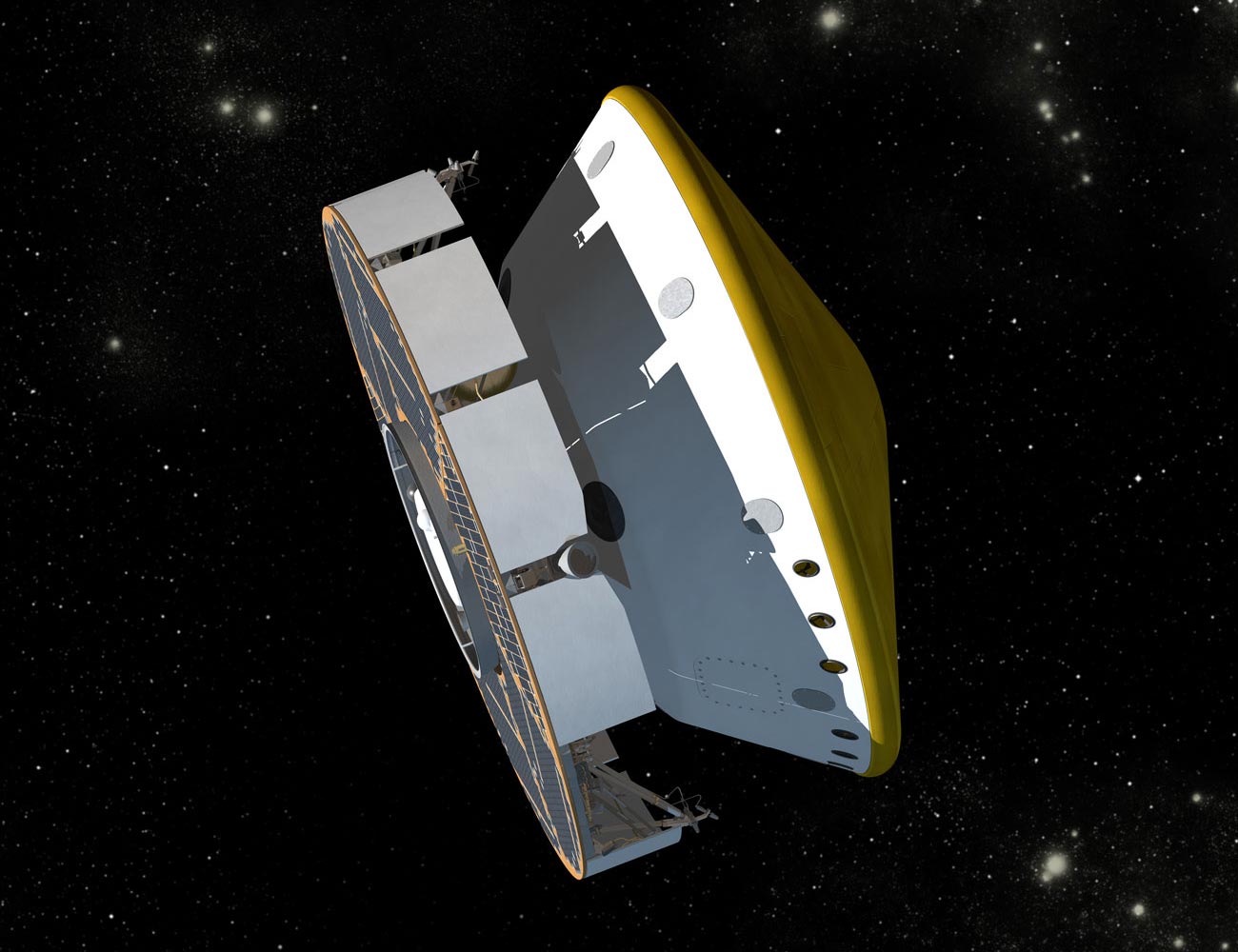
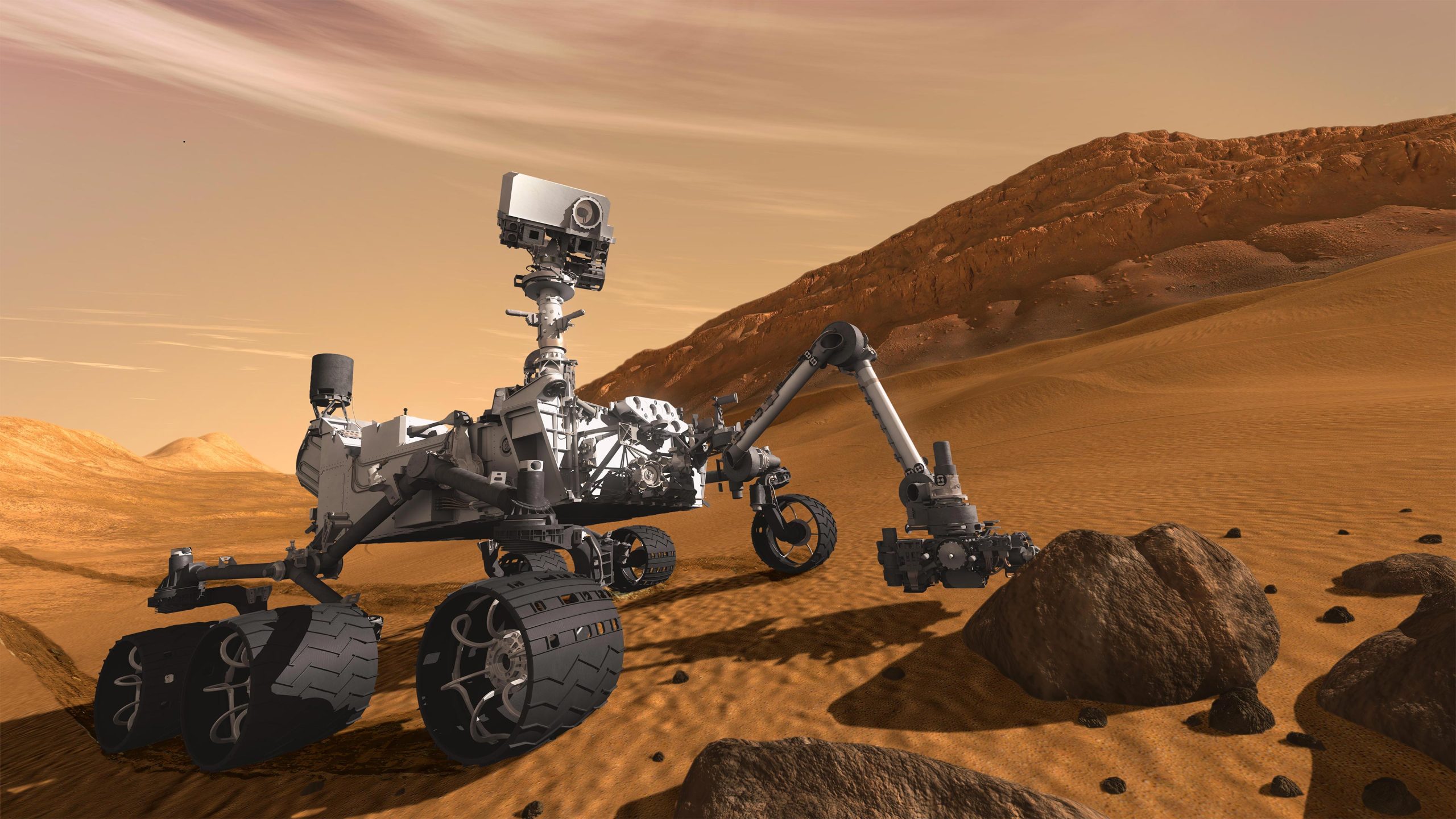
It took a three-hour series of thruster-engine firings for NASA’s Mars Science Laboratory spacecraft to pull off the maneuver to refine its flight path while on its journey to Mars. Once there, the rover Curiosity will explore a region inside Gale Crater to see if it holds clues about whether life existed on Mars.
NASA’s Mars Science Laboratory spacecraft successfully refined its flight path Wednesday with the biggest maneuver planned for the mission’s journey between Earth and Mars.
“We’ve completed a big step toward our encounter with Mars,” said Brian Portock of NASA’s Jet Propulsion Laboratory, Pasadena, California, deputy mission manager for the cruise phase of the mission. “The telemetry from the spacecraft and the Doppler data show that the maneuver was completed as planned.”
The Mars Science Laboratory mission will use its car-size rover, Curiosity, to investigate whether the selected region on Mars inside Gale Crater has offered environmental conditions favorable for supporting microbial life and favorable for preserving clues about whether life existed.
Engineers had planned today’s three-hour series of thruster-engine firings to accomplish two aims: to put the spacecraft’s trajectory about 25,000 miles (about 40,000 kilometers) closer to encountering Mars and to advance the time of the encounter by about 14 hours, compared with the trajectory following the mission’s November 26, 2011, launch.
“The timing of the encounter is important for arriving at Mars just when the planet’s rotation puts Gale Crater in the right place,” said JPL’s Tomas Martin-Mur, chief navigator for the mission.
The mission’s second trajectory correction maneuver, expected to be about one-sixth the magnitude of this first one, is scheduled for March 26. Up to four additional opportunities for fine-tuning, as needed, are scheduled before the arrival at Mars on August 5, 2012, PDT (August 6, EDT and Universal Time).
The spacecraft’s initial trajectory resulting from the launch included an intentional offset to prevent the upper stage of the launch vehicle from hitting Mars. That upper stage was not cleaned the way the spacecraft itself was to protect Mars from Earth’s microbes.
The Mars Science Laboratory spacecraft rotates in flight at about two revolutions per minute. Today’s maneuver included two different components: one that changed velocity in the direction of the axis of the spacecraft’s rotation, and one that changed velocity in a direction perpendicular to that.
The maneuver used the eight thruster engines on the cruise stage of the spacecraft, grouped into two sets of four. It began with a thrust lasting about 19 minutes, using just one thruster in each set and affecting velocity along the direction of the axis of rotation. Then, to affect velocity perpendicular to that line, each set of thrusters was fired for 5 seconds when the rotation put that set facing the proper direction. These 5-second bursts were repeated more than 200 times during a period of about two hours for a total of about 40 minutes.
The maneuver was calculated to produce a net change in velocity of about 12.3 miles per hour (5.5 meters per second), combining a slight increase in speed with a small change in direction of travel.
As of 9 a.m. PST (noon EST) on Thursday, January 12, the spacecraft will have traveled 81.2 million miles (130.6 million kilometers) of its 352-million-mile (567-million-kilometer) flight to Mars. It will be moving at about 10,300 mph (16,600 kilometers per hour) relative to Earth, and at about 68,700 mph (110,500 kilometers per hour) relative to the sun.
JPL, a division of the California Institute of Technology in Pasadena, manages the Mars Science Laboratory mission for the NASA Science Mission Directorate, Washington.
Never miss a breakthrough: Join the SciTechDaily newsletter.
Follow us on Google and Google News.