
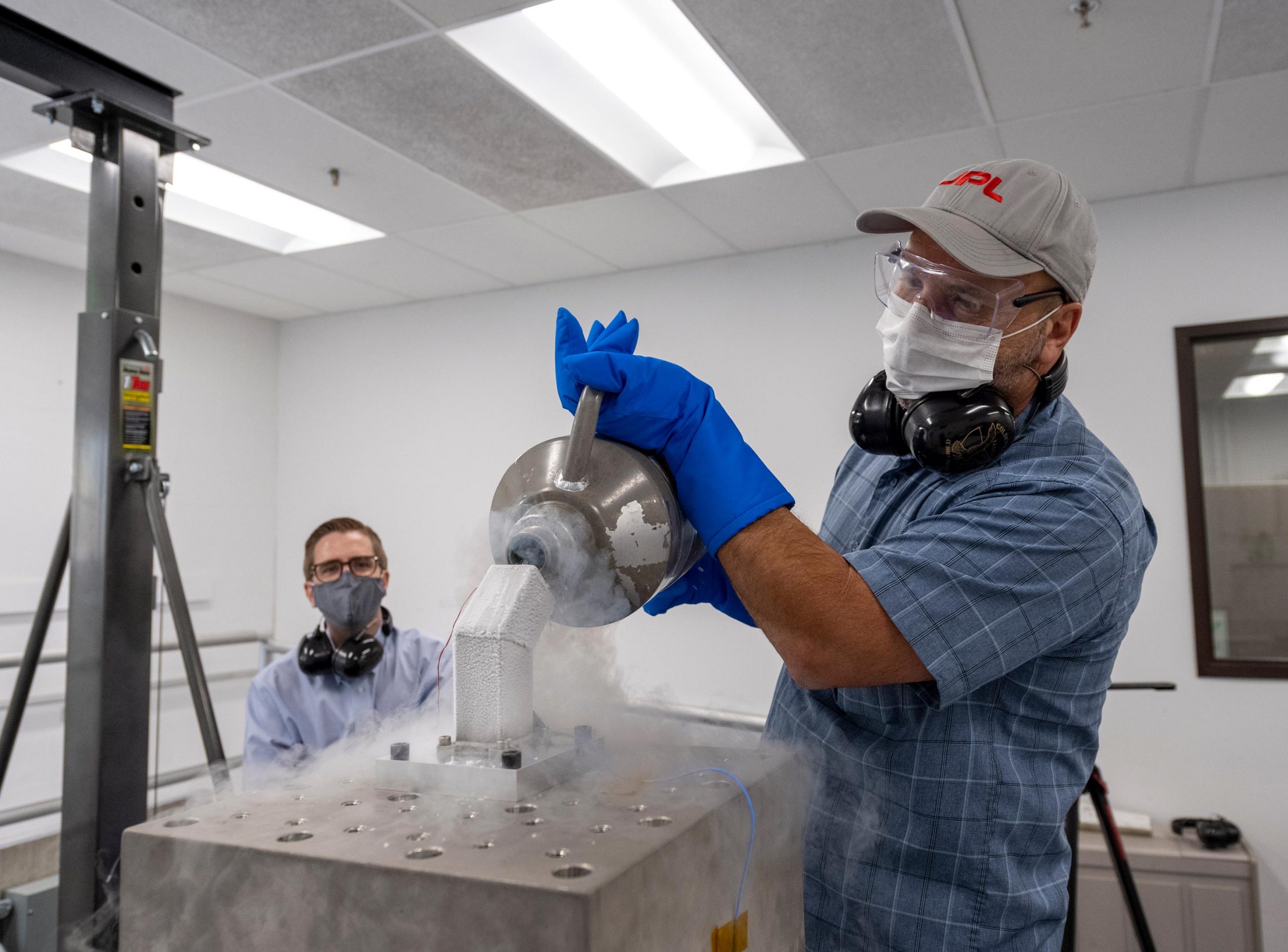
Many exploration destinations in our solar system are frigid and require hardware that can withstand the extreme cold. During NASA’s Artemis missions, temperatures at the Moon’s South Pole will drop drastically during the lunar night. Farther into the solar system, on Jupiter’s moon Europa, temperatures never rise above -260 degrees Fahrenheit (-162 degrees Celsius) at the equator.
One NASA project is developing special gears that can withstand the extreme temperatures experienced during missions to the Moon and beyond. Typically, in extremely low temperatures, gears – and the housing in which they’re encased, called a gearbox – are heated. After heating, a lubricant helps the gears function correctly and prevents the steel alloys from becoming brittle and, eventually, breaking. NASA’s Bulk Metallic Glass Gears (BMGG) project team is creating material made of “metallic glass” for gearboxes that can function in and survive extreme cold environments without heating, which requires energy. Operations in cold and dim or dark environments are currently limited due to the amount of available power on a rover or lander.
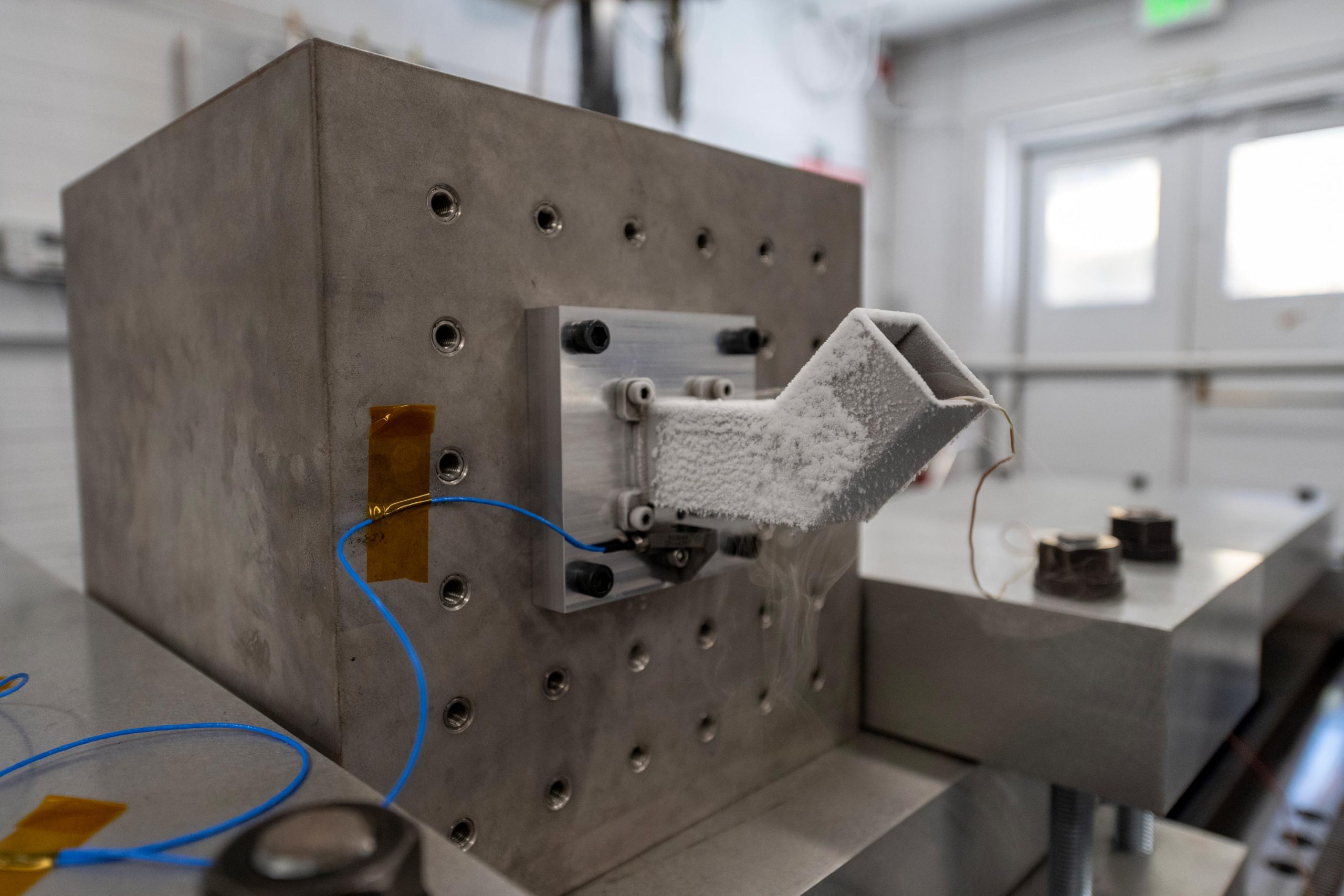
The BMGG unheated gearboxes will reduce the overall power needed for a rover or lander’s operations, such as pointing antennas and cameras, moving robotic arms, handling and analyzing samples, and mobility (for a rover). The power saved with the BMGG gearbox could extend a mission or allow for more instruments.
The team recently tested the gears at NASA’s Jet Propulsion Laboratory in Southern California. At JPL’s Environmental Test Laboratory, engineers mounted the motor and gearbox on a tunable beam designed to measure the response an item has to a shock, or forceful impact. Team members then used liquid nitrogen to cool the gears down to roughly -279 degrees Fahrenheit (-173 degrees Celsius). Next, they fired a cylindrical steel projectile at the beam to simulate a “shock event.” Shock testing is used to ensure spacecraft hardware will not break during events that cause a sudden jolt, such as the release of an antenna or what a spacecraft experiences during entry, descent, and landing. The test simulated how the bulk metallic glass gears might behave when collecting a regolith sample during the lunar night – which spans roughly 14 days on Earth – or deploying a science instrument on an ocean world in our solar system.
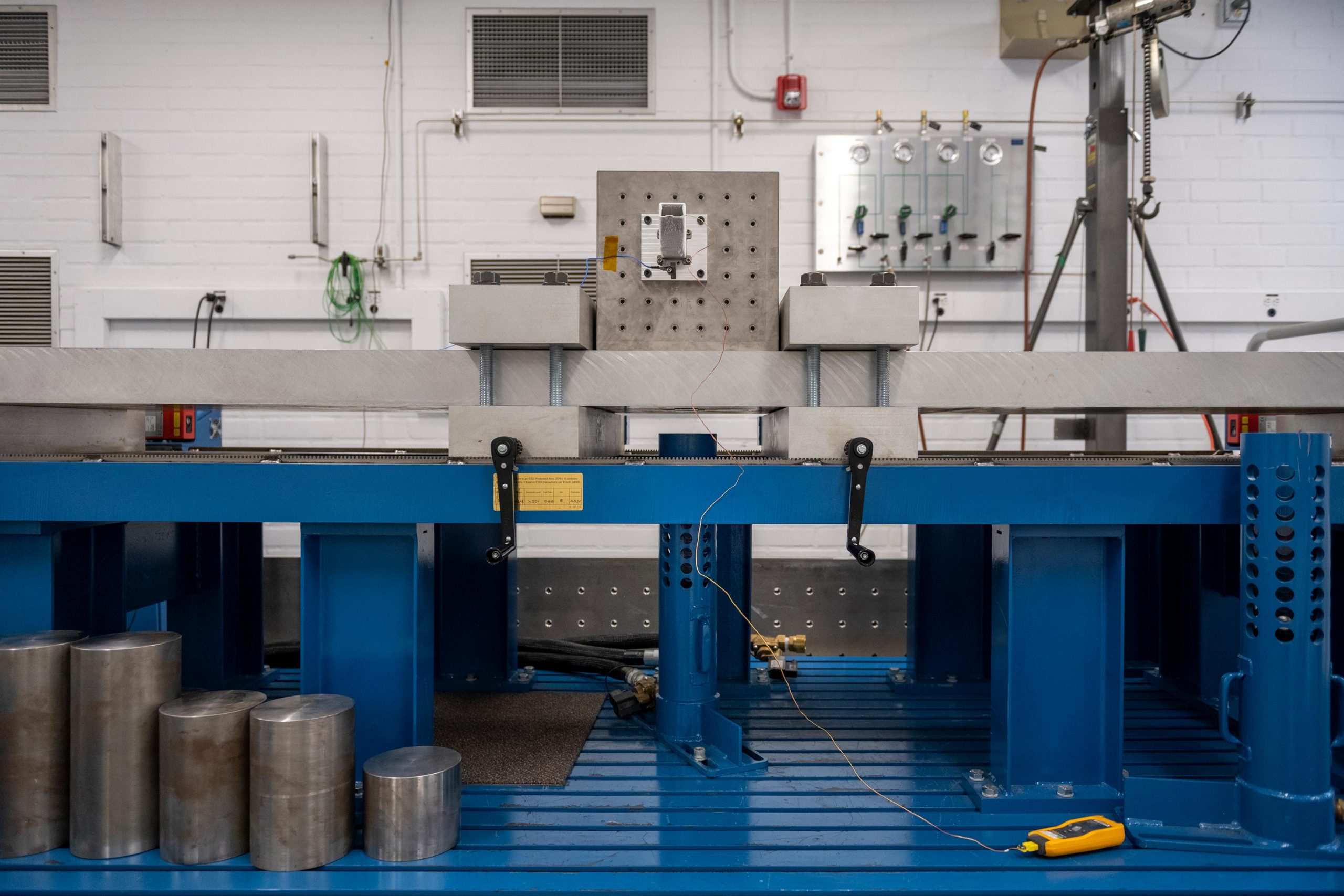
“Before NASA sends hardware like gearboxes, particularly those made with new materials, to extremely cold environments, we want to make sure they will not be damaged by the stressful events that occur during the life of a mission,” said Peter Dillon, BMGG project manager at JPL. “This shock testing simulates the stresses of entry, descent, and landing, and potential surface operations.”
Before each shock test, a team member poured liquid nitrogen over the motor and gearbox contained in a “bucket.” Liquid nitrogen, which boils at -320 degrees Fahrenheit (-196 degrees Celsius), brought the gearbox’s temperature below -279 degrees Fahrenheit (-173 degrees Celsius). The liquid nitrogen drained and, within a few seconds, a steel impactor fired at a steel beam on which the motor and gearbox were mounted. The team then ran the motor to drive the gearbox to determine whether or not the shock event had damaged the gearbox and its motor. The team monitored the electrical current required to run the motor and listened for any irregular sounds that indicated damage. The motor and gearbox were shock tested twice in three different orientations. Each test demonstrated that the gears could withstand a “shock event” at a temperature as low as -279 degrees Fahrenheit (-173 degrees Celsius).
“This is an exciting event as it demonstrates both the mechanical resilience of the bulk metallic glass alloy and the design of the gearbox,” Dillon said. “These gears could help enable potential operations during the lunar night, in permanently shadowed lunar craters, in polar regions on the Moon, and on ocean worlds.”
The BMGG team will perform additional cold temperature testing next year to qualify the gears for use in future NASA missions.
Never miss a breakthrough: Join the SciTechDaily newsletter.
Follow us on Google and Google News.
16 Comments
Someone care to explain what “metallic glass” is?
My thoughts exactly.
What is bulk metal glass, and how is it made?
Bad example of safety equipment. Long sleeves and face shield please. Liquid nitrogen can spit out easily.
Metallic glass is noncrystalline metal. It’s a big trick to end up with solid metal that lacks crystals. Eliminating crystals eliminates grain boundaries, which become the planes of fracture when a gear shatters. But most metals crystallize readily, almost unstoppably when cast in bulk. So the key was to invent alloys that are bad at crystallizing, because the crystal they want to form is too weird to grow past the nanoscale. Bulk Metallic Glasses are typically not the strongest alloy, but they can be amazingly tough. Hope that helps!
Thanks John Turner for explaining the basics of BMGG. I’m just an autobody restoration tech that restores old cars and I love to learn about things such as this. Keeps my brain functioning…
Metallic glass is metal not allowed to crystalize. When you break off a head off of a screw and you look you can see the metallic crystals. The way they’re currently doing this is by pouring the molten metal on a freezing fast spinning wheel and shooting it out in thin strips so that it’s not allowed to crystallize.
Metallic glass eh? Sounds a lot like Montgomery Scott’s been giving someone advice on how to build whale tanks.
Transparent Aluminum
Transparent aluminum heard
There’s a Company out there, Liquidmetal Technologies, that’s been trying to commercialize BMG’s for too many years, but this (for NASA), is most likely being done by Visser Precision.
How is metallic glass better than metal? Is it just because does it not require lubricant? Or is it tougher? Why does it not require lube? Isn’t there a metallic alloy choice that doesn’t need lube? Or, isn’t there a lube that doesn’t require heat? Does the glass have a better thermal expansion coefficient that is somehow more amenable to ops? Is it significantly lighter?
Protective gear? He is wearing his Covid mask. It will save him! Lol
Actually, I think the theory of his clothing is that there are no places for the liquid nitrogen to collect so it would roll right off him before doing any damage. I would not risk it though.
Your site doesn’t work right with chrome on android. I can’t see the full pictures or read all the captions for them. Pan or zoom out doesn’t help or doesn’t work.
Try switching to desktop version.
I’m using a cheap android phone and desktop version works ok. ikr!
What to know what metallic glass is?
https://youtu.be/oULkYytYPgs
So it’s kinda like rolls of fiberglass instead the strands are made up of metal particles instead of fibers?