
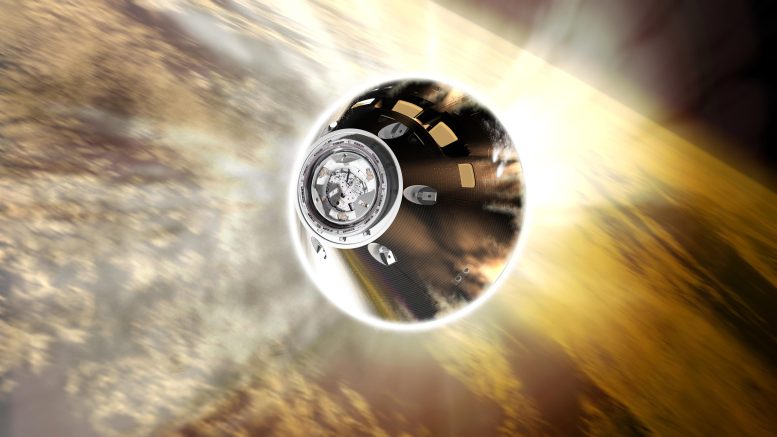
NASA’s Orion spacecraft will splash down in the Pacific Ocean on Sunday at 9:39 a.m. PST (12:39 p.m. EST), bringing an end to a several-week-long journey 40,000 miles beyond the moon and back. During its historic mission, Orion reached a record-setting distance of 268,563 miles (432,210 km) from Earth, beating the previous record set by Apollo 13 in 1970. Space buffs can tune into NASA’s live stream with coverage beginning at 8 a.m. PST (11 a.m. EST) to witness some extreme physics—what will be the last leg of the historic Artemis I mission, which launched from Kennedy Space Center in Florida on November 16.
The numbers are mind-boggling: The Orion capsule will hit Earth’s atmosphere flying at speeds of almost 25,000 mph (or about 11 kilometers per second) and experience temperatures nearing 5,000 degrees Fahrenheit in the process.
Iain Boyd is a professor in the Ann and H.J. Smead Department of Aerospace Engineering Sciences who has spent his career studying hypersonics, or vehicles that travel far faster than the speed of sound. He also leads a $15 million NASA institute called the Advanced Computational Center for Entry System Simulation (ACCESS). This effort investigates new ways to protect spacecraft as they undergo the extremes of entering atmospheres on Earth, Mars, and beyond.
He spoke about the conditions Orion can expect to face this weekend, and why the growing space tourism industry may require new kinds of spacecraft heat shields.

NASA is using a maneuver called a “skip entry” to slow down the Orion capsule. What does that mean?
The alternative to a skip entry is a direct entry—just coming straight into Earth’s atmosphere and going down. In a skip entry, you come into the atmosphere at a shallower angle, then you skip back out into space and come back in again. It’s kind of like when you skip stones on a lake. It’s a way of decelerating without getting into the heating right away. It also provides more flexibility on where the capsule will land.
Right away. Even with those maneuvers, Orion is going to face blistering conditions Sunday. What can we expect to happen?
When you fly very rapidly through air or any other gas, the gas itself gets heated up. It’s like the friction when you rub your hands together. In this case, when you’re coming back from the moon at those velocities, the temperatures of the gases are higher than the surface temperature of the sun—many, many thousands of degrees.
Orion isn’t carrying any human crewmembers on this mission. But it will in the future. How will NASA keep them safe from that kind of heat?
Unlike airplanes, hypersonic vehicles, including capsules, have what’s called a thermal protection system. Usually, it’s a collection of different materials that cover the outside of the vehicle to ensure that that heat is kept out.
Artemis uses what we call an ‘ablating’ thermal protection system. This is material that, by design, disintegrates under heat and comes apart atom by atom—but in a controlled, well-understood way. As it disintegrates, those atoms carry energy and heat away from the vehicle.
That strategy is pretty similar to what NASA did during the Apollo era. Are scientists also exploring new ways of protecting spacecraft on reentry?
One of the highlights of the ACCESS institute is that we’re going to analyze NASA’s upcoming Mars Sample Return mission, which is scheduled for later this decade.
NASA is going to fly to Mars, land a rover on the surface, scoop up some Martian dirt and rock and fly all the way back. That capsule will enter Earth’s atmosphere at about 14 kilometers per second. The Orion spacecraft will be moving at around 11 kilometers per second. Fourteen kilometers per second doesn’t sound like a big jump, but it turns out to be a different physics regime. We’re going to need different materials and a different kind of heat shield.
How would those new heat shields work?
Some of the approaches that are being studied are what are called woven materials. You begin by weaving together fibers made of carbon, and then you inject material into the gaps between the fibers. It sounds low tech, but it’s actually very high tech.
The fibers themselves will still ablate. But when the chemicals that are injected in between the fibers heat up, they will break down and become gas. That gas flows from inside the heat shield to out, creating additional cooling effects
As the space tourism industry grows, we’re going to be seeing a lot more spacecraft launch from Earth—and, hopefully, come back. What kinds of issues will that raise?
One of the key challenges for a successful space economy is going to be more efficient vehicles and more efficient heat shields. And that is going to require us to better understand all of these physical and chemical processes. Every single layer we can shave off our heat shield because we’re confident that we don’t need it is going to increase the efficiency of bringing stuff back from space.
Never miss a breakthrough: Join the SciTechDaily newsletter.
Follow us on Google and Google News.