

Perseverance, NASA’s Mars rover, has completed a daring ascent of Jezero Crater’s rim, tackling steep grades and rugged terrain to reach new scientific frontiers.
The rover’s fifth campaign, exploring the Northern Rim, promises groundbreaking insights into Mars’ geological past, including rocks potentially dating back to the early solar system. This mission is not just about Mars — it’s a step toward humanity’s exploration of the cosmos.
Perseverance Reaches New Heights
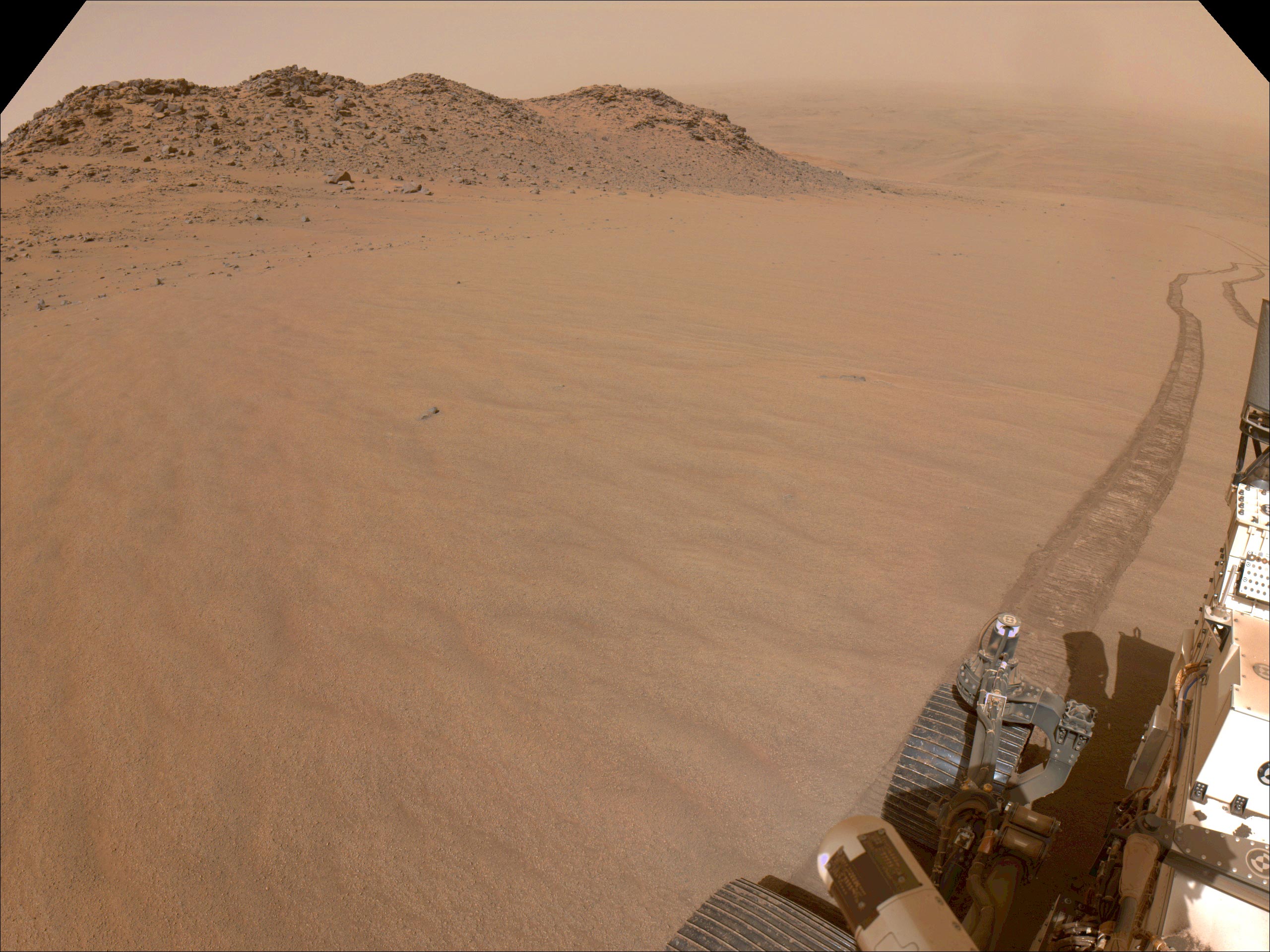
NASA’s Perseverance Mars rover has reached the top of Jezero Crater’s rim, at a site the science team calls “Lookout Hill.” After a challenging months-long climb, the rover is now heading toward its first science destination in this new region, which is unlike any it has explored before.
Over the course of 3½ months, Perseverance ascended 1,640 vertical feet (500 meters) along steep slopes with grades up to 20%. Along the way, it paused to conduct scientific observations. On December 12, during the American Geophysical Union’s annual meeting in Washington, D.C., the science team shared details about the climb, their recent findings, and the exciting plans for the rover’s next phase of exploration.
Innovative Approaches for Challenging Terrain
“During the Jezero Crater rim climb, our rover drivers have done an amazing job negotiating some of the toughest terrain we’ve encountered since landing,” said Steven Lee, deputy project manager for Perseverance at NASA’s Jet Propulsion Laboratory in Southern California. “They developed innovative approaches to overcome these challenges — even tried driving backward to see if it would help — and the rover has come through it all like a champ. Perseverance is ‘go’ for everything the science team wants to throw at it during this next science campaign.”
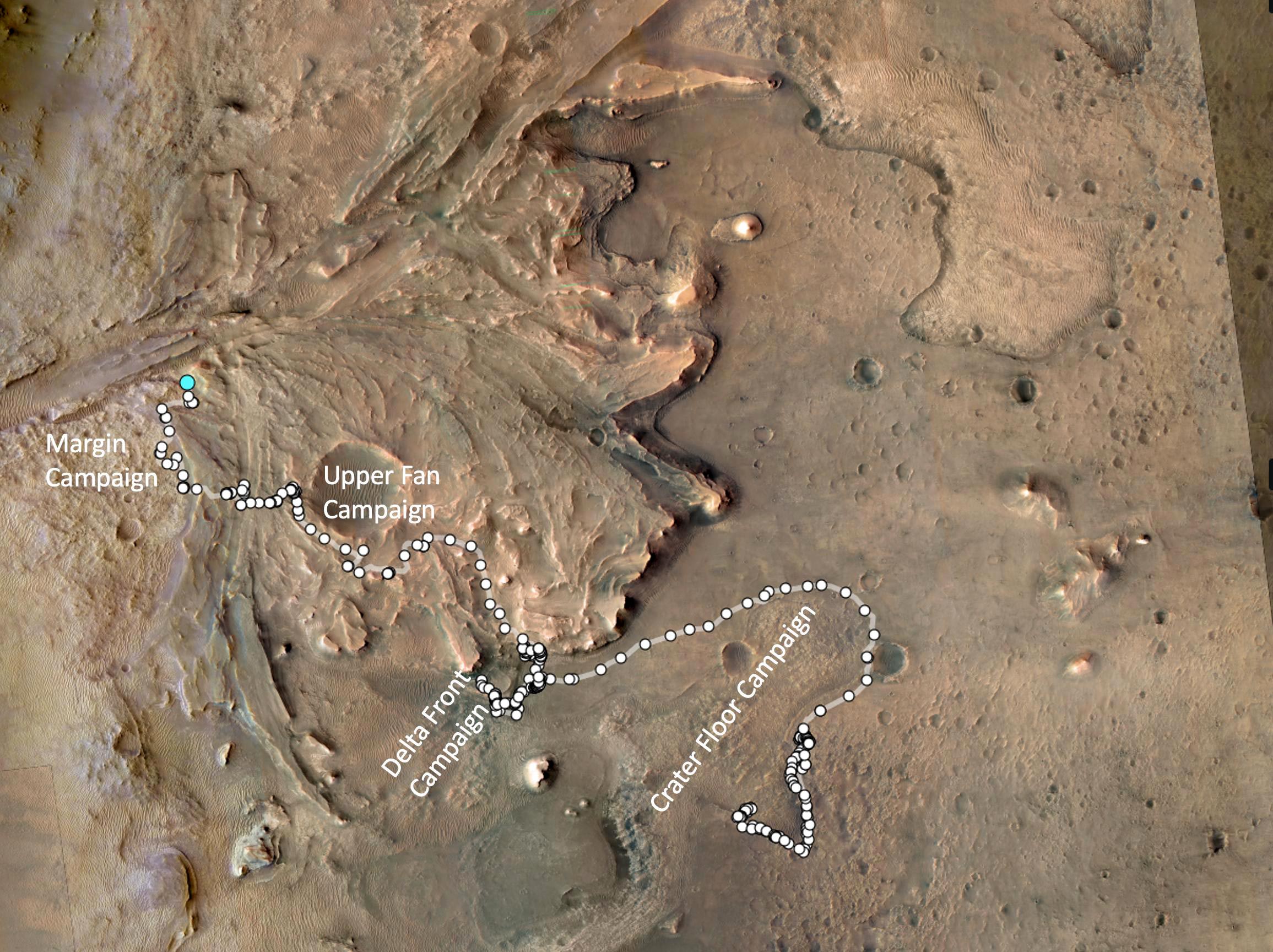
Since landing at Jezero in February 2021, Perseverance has completed four science campaigns: the “Crater Floor,” “Fan Front,” “Upper Fan,” and “Margin Unit.” The science team is calling Perseverance’s fifth campaign the “Northern Rim” because its route covers the northern part of the southwestern section of Jezero’s rim. Over the first year of the Northern Rim campaign, the rover is expected to visit as many as four sites of geologic interest, take several samples, and drive about 4 miles (6.4 kilometers).
A scan across a panorama captured by NASA’s Perseverance Mars rover shows the steepness of the terrain leading to the rim of Jezero Crater. The rover’s Mastcam-Z camera system took the images that make up this view on December 5. Credit: NASA/JPL-Caltech/ASU/MSSS
Unlocking Martian History
“The Northern Rim campaign brings us completely new scientific riches as Perseverance roves into fundamentally new geology,” said Ken Farley, project scientist for Perseverance at Caltech in Pasadena. “It marks our transition from rocks that partially filled Jezero Crater when it was formed by a massive impact about 3.9 billion years ago to rocks from deep down inside Mars that were thrown upward to form the crater rim after impact.”
“These rocks represent pieces of early Martian crust and are among the oldest rocks found anywhere in the solar system. Investigating them could help us understand what Mars — and our own planet — may have looked like in the beginning,” Farley added.
This animation shows the position of NASA’s Perseverance Mars rover as of December 4, 2024, the 1,347th Martian day, or sol, of the mission, along with the proposed route of the mission’s fifth science campaign, dubbed Northern Rim, over the next several years. Credit: NASA/JPL-Caltech/ESA/University of Arizona
First Stop: ‘Witch Hazel Hill’
With Lookout Hill in its rearview mirror, Perseverance is headed to a scientifically significant rocky outcrop about 1,500 feet (450 meters) down the other side of the rim that the science team calls “Witch Hazel Hill.”
“The campaign starts off with a bang because Witch Hazel Hill represents over 330 feet of layered outcrop, where each layer is like a page in the book of Martian history. As we drive down the hill, we will be going back in time, investigating the ancient environments of Mars recorded in the crater rim,” said Candice Bedford, a Perseverance scientist from Purdue University in West Layfette, Indiana. “Then, after a steep descent, we take our first turns of the wheel away from the crater rim toward ‘Lac de Charmes,’ about 2 miles south.”
Lac de Charmes intrigues the science team because, being located on the plains beyond the rim, it is less likely to have been significantly affected by the formation of Jezero Crater.
After leaving Lac de Charmes, the rover will traverse about a mile (1.6 kilometers) back to the rim to investigate a stunning outcrop of large blocks known as megabreccia. These blocks may represent ancient bedrock broken up during the Isidis impact, a planet-altering event that likely excavated deep into the Martian crust as it created an impact basin some 745 miles (1,200 kilometers) wide, 3.9 billion years in the past.
More About Perseverance
The Perseverance rover, part of NASA’s Mars 2020 mission, is a groundbreaking exploration vehicle designed to unlock Mars’ secrets and pave the way for future human exploration. A key focus of its mission is astrobiology—searching for signs of ancient microbial life by collecting and caching samples of Martian rock and regolith. These samples, which could provide critical insights into Mars’ history and habitability, will be returned to Earth through NASA’s Mars Sample Return Program in collaboration with the European Space Agency (ESA).
In addition to its astrobiological goals, Perseverance studies Mars’ geology and past climate, contributing valuable data to prepare for future human missions to the Red Planet. This effort aligns with NASA’s broader Moon to Mars initiative, which includes Artemis missions aimed at advancing human exploration. Built and managed by NASA’s Jet Propulsion Laboratory (JPL), Perseverance represents a vital step in humanity’s journey to explore and understand the cosmos.
Never miss a breakthrough: Join the SciTechDaily newsletter.
Follow us on Google and Google News.
2 Comments
Just amazing pictures! Keep up the good work and science collections!
Thank You NASA